Facts
The respondent invoked arbitration under a contract dated 28 February 2013 concerning civil works.
Source reference: no citationThe majority arbitral award was released on 23 February 2024, followed by the dissenting award on 28 February 2024.
Source reference: p.3, para. 5On 22 March 2024, the appellant filed an application purportedly under Section 33 of the Arbitration and Conciliation Act, 1996, seeking extensive corrections to the award, including reconsideration of findings on contractual interpretation, quantification, and computation of several claims.
Source reference: pp.3–14, para. 6The Arbitral Tribunal rejected the application on 3 June 2024.
Source reference: p.14, para. 8The appellant thereafter filed a petition under Section 34 on 29 August 2024.
Source reference: p.14, para. 9The Single Judge dismissed the petition as time-barred, holding that the Section 33 application was in substance an impermissible review application and could not extend limitation.
Source reference: pp.15–17, paras. 13–14Issues
Whether a formally filed application under Section 33 of the Arbitration and Conciliation Act, 1996, made within thirty days of receipt of the arbitral award and with notice to the opposite party, extends the limitation period under Section 34(3), even when the application is substantively misconceived, sham, or seeks a review on merits.
Source reference: pp.2–3, paras. 2–3; p.18, para. 18Whether the appellant’s Section 34 petition was barred by limitation when limitation was calculated from the date of the award rather than the date of disposal of the Section 33 application.
Source reference: pp.14–15, paras. 10–12Law Applied
Section 34(3) of the Arbitration and Conciliation Act, 1996, prescribes three months for filing an application to set aside an arbitral award, with a non-extendable further period of thirty days on sufficient cause; where a request has been made under Section 33, limitation runs from the date on which that request is disposed of.
Source reference: p.2, para. 2Section 33 permits correction of computation, clerical, typographical, or similar errors, interpretation of a specific point where agreed, and issuance of an additional award in appropriate cases.
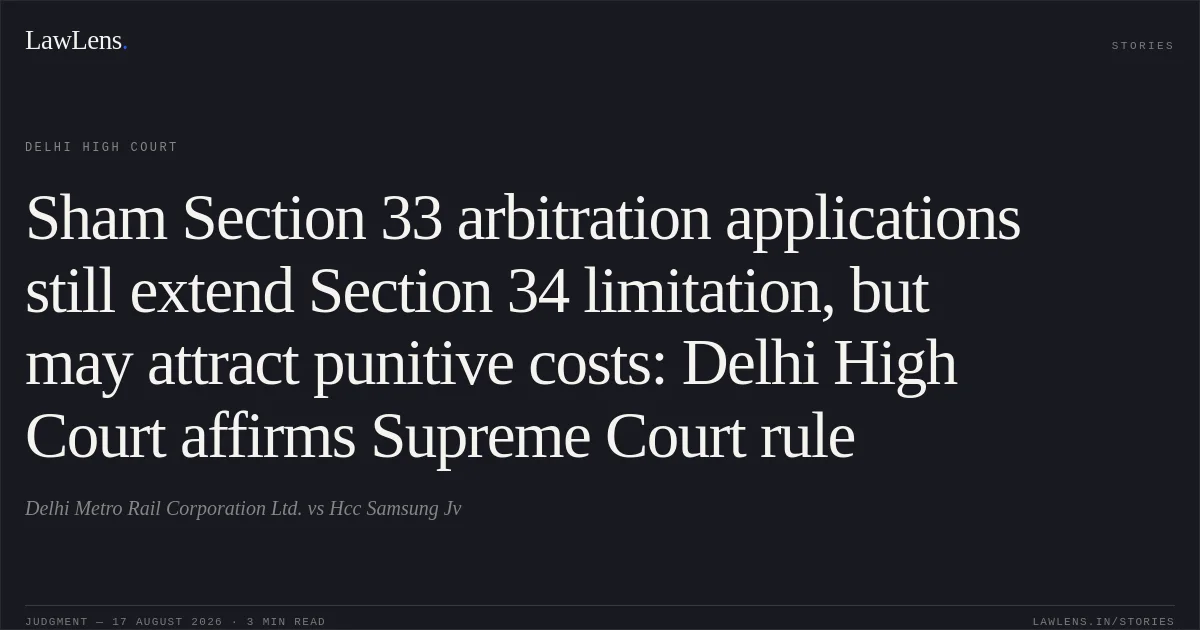
Source reference: p.2, para. 3In Geojit Financial Services Ltd. v. Sandeep Gurav, 2025 SCC OnLine SC 1811, the Supreme Court held that, for Section 34(3), the relevant consideration is whether a formal request was made within thirty days and with notice to the other party; the ultimate maintainability or merits of that request are immaterial.
Source reference: pp.18–22, paras. 23–32, 34The same principle was followed in National Highways Authority of India v. T. Younis, 2026 SCC OnLine SC 1060.
Source reference: pp.22–23, para. 17State of Arunachal Pradesh v. Damani Construction Co., (2007) 10 SCC 742, was distinguished because it concerned a mere letter and not a formal Section 33 application.
Source reference: pp.20–22, paras. 33–34A sham Section 33 application may attract punitive costs, but does not deprive the applicant of the statutory computation of limitation under Section 34(3).
Source reference: p.23, para. 19Reasoning
The Court found that the appellant’s application was not genuinely directed at clerical or typographical corrections; it sought a wholesale reconsideration of the award on merits and was effectively an attempt to obtain additional time to challenge the award.
Source reference: p.14, para. 7; pp.23–24, paras. 21–22Nevertheless, applying the binding decisions in Geojit and T. Younis, the Court held that the decisive factors were that the application was formally presented under Section 33, filed within thirty days of receipt of the award, and considered and disposed of by the Arbitral Tribunal.
Source reference: pp.18–23, paras. 18–19The reason for its rejection, or the fact that it was beyond the permissible scope of Section 33, could not determine the commencement of limitation.
Source reference: pp.18–23, paras. 18–19Since the Section 33 application was disposed of on 3 June 2024, limitation under Section 34(3) had to be computed from that date.
Source reference: p.23, para. 20The Single Judge therefore erred in treating the petition as time-barred by disregarding the period up to disposal of the Section 33 application.
Source reference: p.23, para. 20Holding
The Court held that the appellant’s Section 34 petition could not be dismissed as barred by limitation because the limitation period commenced on 3 June 2024, when the formally filed Section 33 application was rejected, notwithstanding its sham and merits-review character.
The Single Judge’s judgment was quashed and set aside.
Source reference: p.24, para. 24However, recognising the appellant’s misuse of Section 33, the Court imposed punitive costs of ₹5,00,000 payable to the respondent within twelve weeks from pronouncement of the judgment.
Source reference: p.24, para. 24The appeal was accordingly disposed of.
Source reference: no citationActs & Sections Cited
3 provisions across 1 statute referred to in this judgment. Each provision opens on LawLens.
Arbitration and Conciliation Act, 19963
Original Court PDF
Delhi Metro Rail Corporation Ltd.vsHcc Samsung Jv
Click to open original judgment
Original judgment, available to read, download and summarize on LawLens.in