Facts
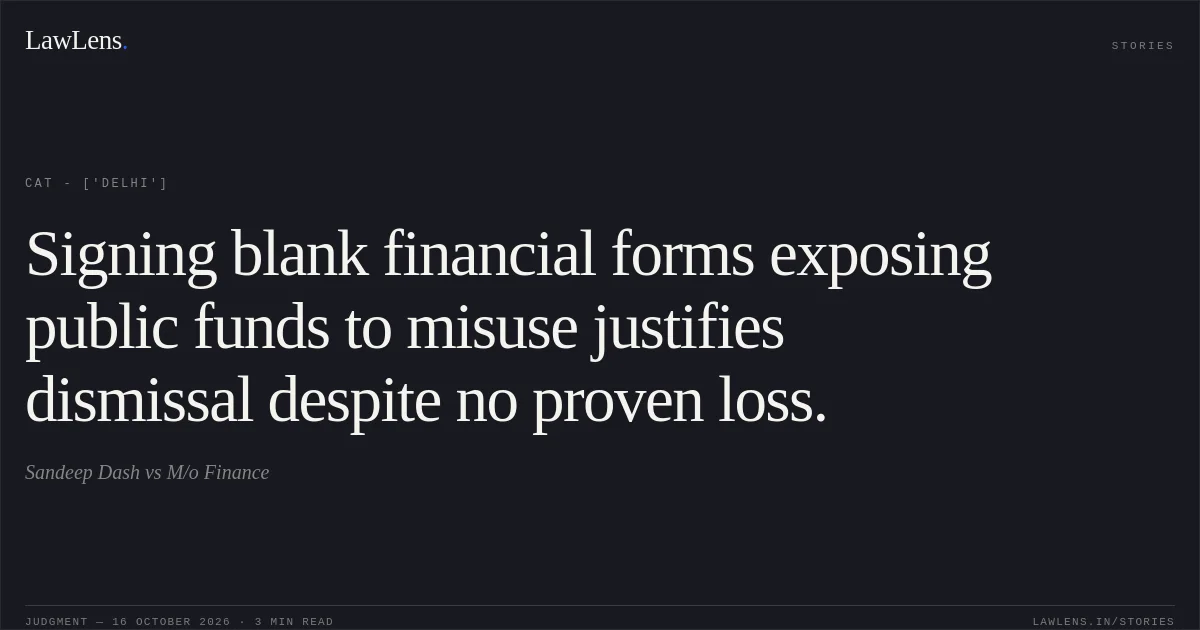
The applicant, an Indian Civil Accounts Service officer, served as Executive Director (Finance) at Bangalore Metro Rail Corporation Ltd. (BMRCL) from May 2005 to April 2007.
Source reference: p. 2–8In 2011, disciplinary proceedings were initiated over investments of BMRCL funds with PNB Asset Management Company, including alleged unauthorised investment through a broker, investment in equity-based funds contrary to applicable guidelines, and repeated switch-in/switch-out transactions.
Source reference: p. 2–8The Inquiry Officer found all three charges not proved, but the Disciplinary Authority disagreed, obtained the UPSC’s advice, and imposed dismissal from service on 14 March 2016.
Source reference: p. 2–8The applicant challenged the penalty, alleging, among other matters, delay, procedural unfairness, insufficient grounds for disagreement, and disproportionality.
Source reference: p. 25–26Issues
1. Whether the delay in initiating disciplinary proceedings prejudiced the applicant so as to invalidate the proceedings
Source reference: p. 13–162. Whether the non-appearance of a prosecution witness vitiated the inquiry, and whether the applicant’s investment transactions breached applicable guidelines or required approval
Source reference: p. 16–223. Whether the Disciplinary Authority gave adequate reasons for disagreeing with the Inquiry Officer and followed the required procedure
Source reference: p. 22–344. Whether the Tribunal could interfere with the findings on the evidence, including because only photocopies of transaction forms were produced
Source reference: p. 34–385. Whether dismissal from service was disproportionate to the proved misconduct
Source reference: p. 36–41Law Applied
The proceedings were governed by Rules 14 and 15(2) of the CCS (CCA) Rules, 1965 and Rules 3(1) and 3(2)(i) of the CCS (Conduct) Rules, 1964.
Source reference: no citationUnder Rule 15(2), a Disciplinary Authority disagreeing with an Inquiry Officer must consider the employee’s representation and record its findings; disagreement must be reasoned and the employee afforded an opportunity to respond (Deputy General Manager v. Ajai Kumar Srivastava, (2021) 2 SCC 612).
Source reference: p. 22–23Delay alone does not invalidate disciplinary proceedings unless prejudice or mala fides are established; the Tribunal considered P.V. Mahadevan v. MD, T.N. Housing Board and Prem Nath Bali v. Registrar, High Court of Delhi.
Source reference: p. 8–9, 15–16In departmental inquiries, strict rules of evidence do not apply, and judicial review ordinarily addresses legality, procedural fairness, perversity, or absence of evidence—not evidentiary sufficiency (State of Haryana v. Rattan Singh).
Source reference: p. 34–36Interference with penalty is limited; where an officer handles public money in a position of trust, integrity is paramount (Regional Manager, U.P.S.R.T.C. v. Hoti Lal, AIR 2003 SC 1462).
Source reference: p. 38–40Reasoning
The Tribunal held that the time taken to complete the multi-stage proceedings, including consideration of the Inquiry Officer’s report, the applicant’s response, and UPSC advice, did not by itself establish prejudice or procedural invalidity.
Source reference: p. 14–16The absence of one witness did not vitiate the inquiry, particularly as the Inquiry Officer did not rely on that witness’s written statement.
Source reference: p. 16The Tribunal found that the Board’s investment decisions restricted investment authority and that the applicant, as the senior finance officer, had signed blank investment and transaction forms and failed to ensure that the transactions complied with those decisions.
Source reference: p. 17–22It accepted the Disciplinary Authority’s reasons for disagreement and found that the applicant had been given an opportunity to respond.
Source reference: p. 23–34Applying the limits on judicial review, it declined to reweigh the evidence; the applicant’s admission that he signed blank forms meant that production of photocopies had not caused demonstrated prejudice.
Source reference: p. 34–38It further held that the applicant’s responsibility for safeguarding public funds, and the repeated nature of the transactions, made dismissal not so disproportionate as to warrant intervention.
Source reference: p. 38–41Holding
The Tribunal found no basis to set aside the disciplinary proceedings or the penalty.
It held that the delay had not been shown to cause prejudice, the Disciplinary Authority’s disagreement and findings were not liable to be disturbed on judicial review, and dismissal was not disproportionate in the circumstances.
Source reference: p. 41The Original Application was dismissed, with no order as to costs.
Source reference: p. 41Acts & Sections Cited
1 provisions across 1 statute referred to in this judgment. Each provision opens on LawLens.
Administrative Tribunals Act, 19851
Original Court PDF
Sandeep DashvsM/o Finance
Click to open original judgment
Original judgment, available to read, download and summarize on LawLens.in