Facts
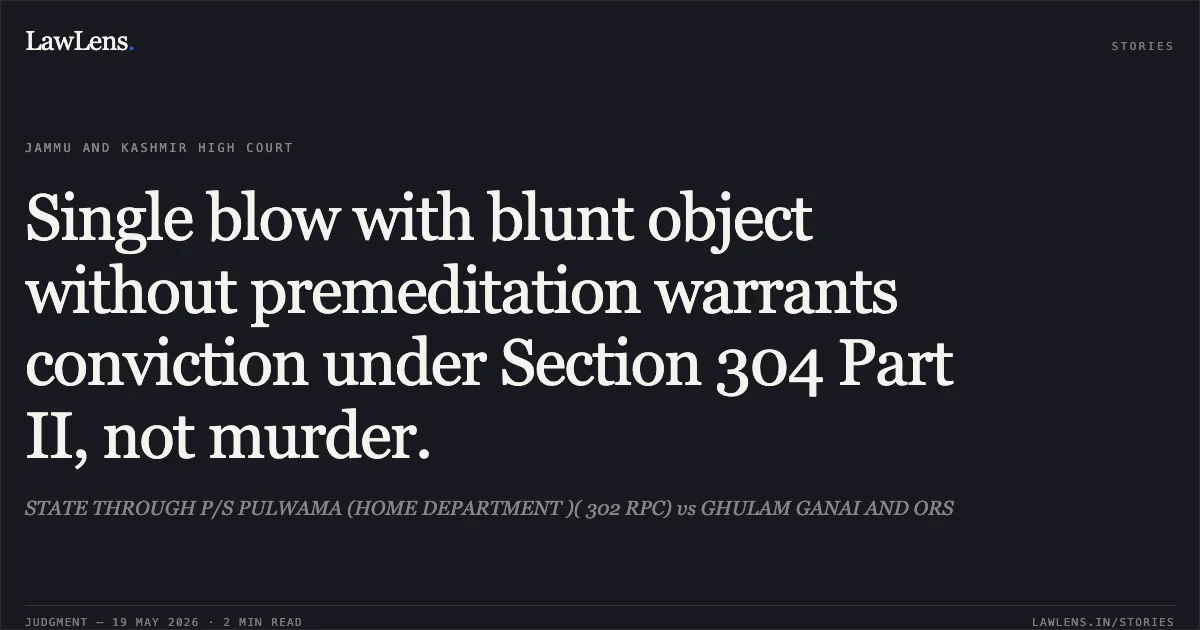
The State appealed a judgment dated 09.05.2015 by the Principal Sessions Judge, Pulwama, which acquitted the respondents of murder (Section 302 RPC) and instead convicted Respondent No. 3 under Section 304 Part II RPC and Respondents Nos. 1 and 2 under Section 323 RPC
Source reference: para 1On 16.08.2011, the deceased, Danish Farooq, was allegedly ambushed over a boundary wall dispute; Respondent No. 3 struck the deceased's head with a Danda (wooden stick) while others participated
Source reference: para 2The Trial Court found only a single injury on the head without a fracture or grievous internal damage
Source reference: para 3The appeal sought a conviction for murder, while the respondents noted that the conviction of Respondent No. 3 had already been upheld by the High Court in a separate proceeding (CRA No. 15/2016) and that the sentences had been served
Source reference: para 5Issues
1. Whether the Trial Court erred in acquitting the respondents of Section 302/34 RPC and instead convicting them under Section 304 Part II and Section 323 RPC
Source reference: para 42. Whether an appellate court should interfere with a judgment of acquittal when the findings are based on a reasonable appreciation of evidence
Source reference: para 11Law Applied
The court applied Section 302 of the Ranbir Penal Code (RPC) regarding murder and Section 304 Part II regarding culpable homicide not amounting to murder
Source reference: p. 2; p. 3It further relied on the principle of "common intention" under Section 34 RPC and "voluntarily causing hurt" under Section 323
Source reference: para 2; para 10A key evidentiary rule applied was that in cases of a single blow with a blunt object without premeditation, the act may be characterized by "knowledge" of the likelihood of death rather than "intention" to cause death
Source reference: para 9Additionally, the court applied the settled principle of appellate review: an order of acquittal should not be disturbed unless the findings are perverse or based on misappreciation of evidence
Source reference: para 11Reasoning
The court reasoned that the medical evidence, specifically the testimony of the Medical Officer, confirmed only one external injury—a hematoma on the skull—with no internal fractures or multiple injuries
Source reference: para 7This supported the conclusion that there was no premeditated "intention" to kill, but rather an act committed with "knowledge" of its danger during a sudden quarrel
Source reference: para 8-9The court found that because Respondent No. 3 inflicted only a single blow and Respondents 1 and 2 only used fists/kicks (unsupported by medical evidence of multiple injuries), the Trial Court’s downgrade from murder to culpable homicide and simple hurt was legally sound
Source reference: para 10Furthermore, the court noted that the conviction of Respondent No. 3 had already attained finality in a previous High Court ruling, and the State failed to demonstrate any perversity in the Trial Court’s findings
Source reference: para 11-12Holding
The court answered the issues in the negative, finding no merit in the State's appeal. It held that the Trial Court correctly appreciated the medical and ocular evidence in characterizing the offence under Section 304 Part II RPC for Respondent No. 3 and Section 323 RPC for Respondents 1 and 2
The High Court dismissed the appeal and upheld the judgment of the Principal Sessions Judge, Pulwama
Source reference: para 14-15Acts & Sections Cited
4 provisions across 1 statute referred to in this judgment. Linked provisions open on LawLens.
Ranbir Penal Code, 19244
Original Court PDF
STATE THROUGH P/S PULWAMA (HOME DEPARTMENT )( 302 RPC)vsGHULAM GANAI AND ORS
Click to open original judgment
Original judgment, available to read, download and summarize on LawLens.in