Facts
The appellant purchased stamp papers valued at ₹6 lakh on 28.12.2023 for a proposed property transaction.
Source reference: para. 2The transaction did not materialise, and the stamp papers were not used for execution of any sale agreement or other instrument.
Source reference: para. 2She applied for refund of the stamp duty on 22.07.2025.
Source reference: para. 2The Collector rejected the application under Section 50 of the Indian Stamp Act, 1899, as time-barred.
Source reference: para. 2The learned Single Judge upheld the Collector’s order on 30.04.2026, leading to the present Letters Patent Appeal.
Source reference: para. 1Issues
Whether the appellant’s claim for refund of duty paid on unused stamp papers was governed by Section 50 of the Indian Stamp Act, 1899, rather than Section 49?
Source reference: paras. 6–8Whether the six-month period prescribed under Section 50(2) is mandatory and could be condoned in the circumstances of the case?
Source reference: paras. 4, 6, 8Whether the precedents relied upon by the appellant warranted granting refund despite the delay?
Source reference: para. 7Law Applied
Sections 49 and 50 of the Indian Stamp Act, 1899 provide for refund or relief in distinct situations.
Source reference: para. 6Section 49 primarily concerns stamp papers that have been spoiled, damaged, or rendered useless before use, whereas Section 50 applies where stamp papers have been purchased but no instrument has been executed upon them.
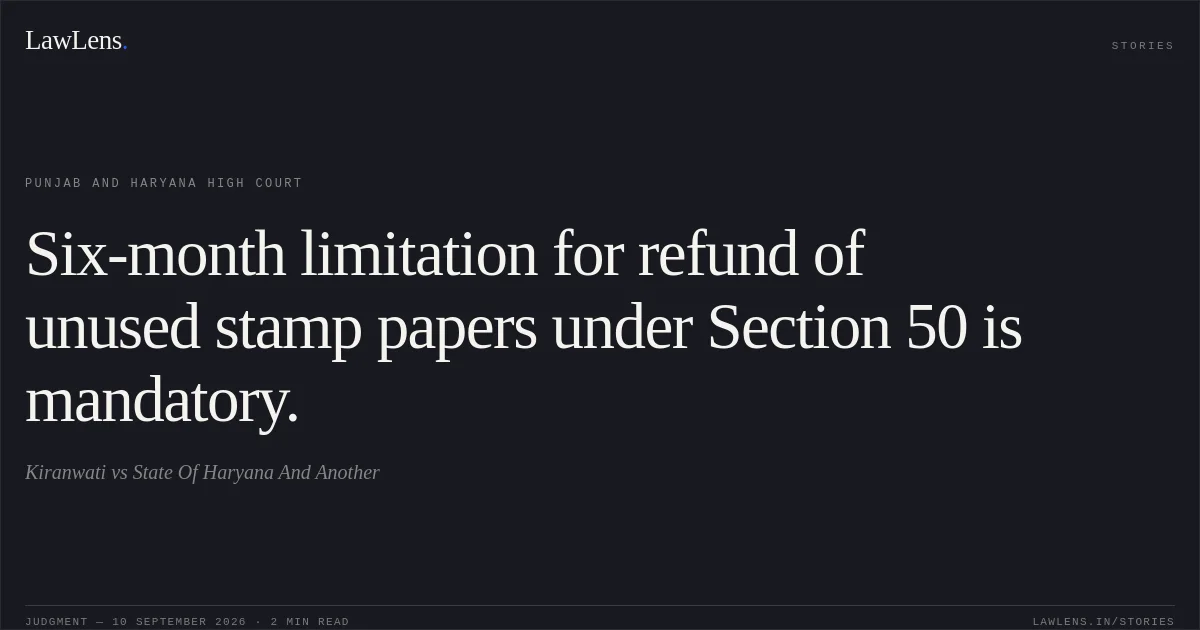
Source reference: para. 6Section 50(2) requires an application for refund of unused stamp papers to be made within six months from the date of purchase, and this limitation is mandatory.
Source reference: paras. 6, 8The Court relied on Prem Rani v. State of Haryana, which held that the limitation under Section 50 must be strictly construed so that stale claims attain finality.
Source reference: para. 8The Court distinguished Bano Saiyed Parwaz v. Chief Controlling Revenue Authority and Committee-GFIL v. Libra Buildtech Pvt. Ltd., as those decisions involved materially different circumstances, including timely applications, fraud, judicial supervision, or specific directions for refund.
Source reference: para. 7Reasoning
The Court held that the appellant’s case fell squarely within Section 50 because the stamp papers remained unused and no instrument had been executed upon them.
Source reference: para. 6Since the papers were purchased on 28.12.2023, the application filed on 22.07.2025 was made substantially beyond the prescribed six-month period.
Source reference: para. 6The appellant neither explained the delay nor specified when the proposed transaction failed to materialise.
Source reference: para. 8The Court found that the exceptional circumstances present in the authorities cited by the appellant—such as a timely application, fraud by the vendor, or a court-supervised transaction—were absent in the present case.
Source reference: para. 7Applying the mandatory nature of Section 50(2) and the principle that stale refund claims cannot be reopened at the applicant’s discretion, the Court found no infirmity or perversity in the Single Judge’s decision.
Source reference: para. 8Holding
The Court answered the issues against the appellant.
It held that the refund application was governed by Section 50, was filed beyond the mandatory six-month limitation period, and could not be entertained in the absence of any explanation for the delay.
Source reference: paras. 6, 8The Letters Patent Appeal was dismissed, with no order as to costs.
Source reference: para. 9Any pending miscellaneous applications were also disposed of.
Source reference: para. 10Acts & Sections Cited
2 provisions across 1 statute referred to in this judgment. Each provision opens on LawLens.
Indian Stamp Act, 18992
Original Court PDF
KiranwativsState Of Haryana And Another
Click to open original judgment
Original judgment, available to read, download and summarize on LawLens.in