Facts
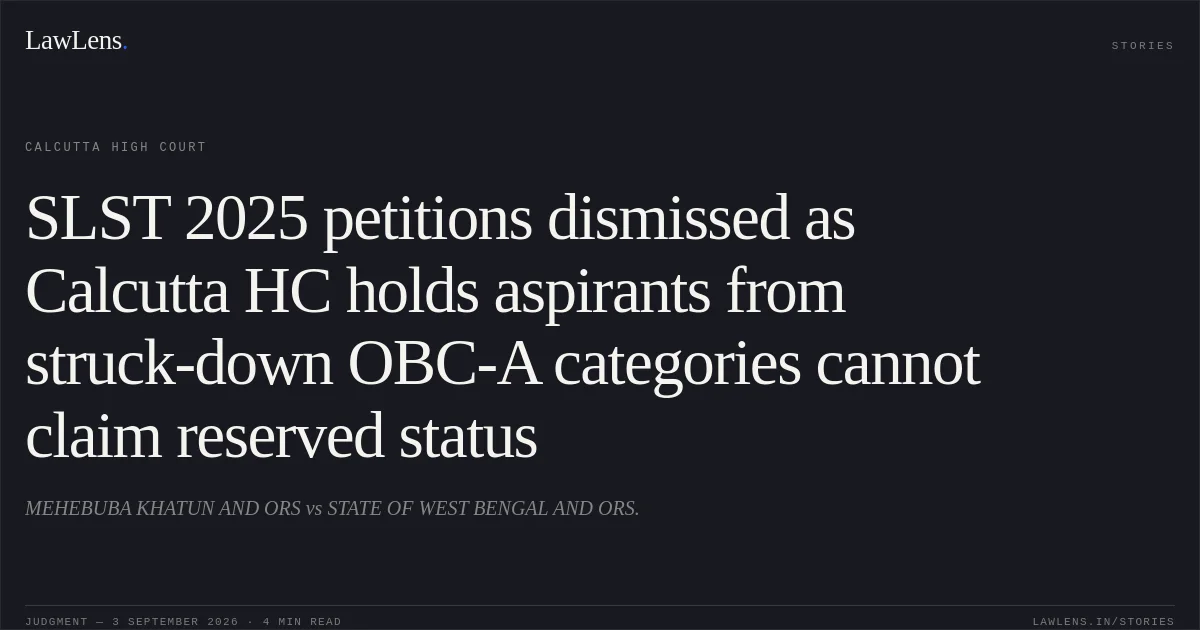
The petitioners were candidates for the Second State Level Selection Test, 2025 (“SLST 2025”), conducted for appointment of assistant teachers.
Source reference: para. 6They had applied as OBC-A candidates, qualified in the written examination, and were included in the Final Merit List/Warning List published on 21 January 2026.
Source reference: para. 6Following the Division Bench judgment in Amal Chandra Das v. State of West Bengal, 2024 SCC OnLine Cal 5389, which invalidated the OBC status of several classes, including the class claimed by the petitioners, the State issued communications and notifications concerning the applicable reservation regime.
Source reference: paras. 9–12, 35The Commission thereafter issued notifications dated 19 and 21 August 2026 requiring candidates to declare their OBC sub-category or category details, providing that failure to do so would result in automatic treatment as Unreserved/General candidates.
Source reference: para. 7The counselling process had also been deferred.
Source reference: para. 7The petitioners challenged these measures and sought continuation of the SLST 2025 process under the reservation policy allegedly applicable on the last date for submission of applications.
Source reference: para. 8The respondents contended that the petitioners had no subsisting right to claim OBC-A status or to challenge the recruitment process, particularly because the entire SLST 2016 selection had been annulled and no appointment letters had been issued in the SLST 2025 process.
Source reference: paras. 21–32Issues
1. Whether the petitioners, whose claimed OBC-A categories had been invalidated before the commencement of the SLST 2025 recruitment process, retained any legal right to participate or be considered as reserved-category candidates.
Source reference: paras. 33–392. Whether the State and the Central School Service Commission could require the petitioners to re-declare their OBC sub-category and treat non-compliant candidates as Unreserved/General candidates pursuant to the State’s reservation policy.
Source reference: paras. 7, 30, 42–453. Whether the petitioners had the requisite enforceable constitutional or legal right under Article 226 to challenge the recruitment notifications before issuance of appointment letters.
Source reference: paras. 33–34, 40–41Law Applied
The Court applied the principle that a writ petition under Article 226 is maintainable only where the petitioner establishes an existing, lawful and enforceable legal or constitutional right.
Source reference: paras. 33–34Relying on Amal Chandra Das v. State of West Bengal, 2024 SCC OnLine Cal 5389, the Court held that the relevant OBC categories and certificates had been invalidated, with the judgment attaining finality after withdrawal of the State’s Special Leave Petition.
Source reference: paras. 9–12, 35–36It relied on State of West Bengal v. Baishakhi Bhattacharyya (Chatterjee), which upheld cancellation of the entire SLST 2016 selection, including the appointments of candidates not individually found tainted, while permitting eligible candidates to participate in a fresh selection with appropriate concessions and without creating any right or equity from their earlier appointments.
Source reference: paras. 37–39The Court also considered the Supreme Court’s directions in Bibek Paria v. State of West Bengal and the order dated 29 August 2025, but construed them as protecting untainted candidates from adverse application of the newly prescribed eligibility criteria, not as preserving an invalidated reserved-category status.
Source reference: paras. 14–19, 31It further applied the principle that mere participation in a selection process does not create a vested right to appointment before issuance of an appointment letter.
Source reference: para. 40The Court held that Tej Prakash Pathak v. Rajasthan High Court, (2025) 2 SCC 1, was inapplicable because the State had not changed the rules of the game but had implemented its reservation policy.
Source reference: para. 44Reasoning
The Court held that the petitioners’ claimed OBC-A status had already become legally unavailable when SLST 2025 commenced on 30 May 2025, since the Amal Chandra Das judgment had invalidated the relevant reserved categories and the State’s challenge had subsequently been withdrawn.
Source reference: paras. 35–36Although the petitioners were treated as untainted candidates in the annulled SLST 2016 process, Baishakhi Bhattacharyya had cancelled the entire selection and made clear that any continuation in service was only an interim or ad hoc arrangement that created no right or equity.
Source reference: paras. 37–39The protective directions permitting untainted candidates to participate in a fresh selection did not revive their invalidated caste status or confer a right to compete as OBC-A candidates.
Source reference: paras. 38–39Consequently, the Commission’s notifications merely implemented the State’s reservation policy and did not retrospectively alter the rules governing the selection.
Source reference: paras. 42–45Since the petitioners had neither a valid reserved-category right nor appointment letters, they lacked an enforceable right to challenge the notifications under Article 226.
Source reference: paras. 40–46Holding
The Court answered the issues against the petitioners.
It held that they could not claim OBC-A/reserved-category benefits in SLST 2025 after invalidation of the relevant categories, that the Commission was entitled to require re-declaration of category details and treat non-compliant candidates as Unreserved/General candidates, and that the petitioners had no enforceable right to maintain the writ petitions before appointment.
Source reference: paras. 39–46WPA 23207 of 2026 and WPA 23209 of 2026 were dismissed without any order as to costs.
Source reference: para. 47Original Court PDF
MEHEBUBA KHATUN AND ORSvsSTATE OF WEST BENGAL AND ORS.
Click to open original judgment
Original judgment, available to read, download and summarize on LawLens.in