Facts
The Petitioners were hutment dwellers whose structures were situated on or around C.S. No. 782, Mazgaon Division.
Source reference: paras. 3, 6–7; pp. 2–3Respondent Nos. 4 and 5 owned adjoining parcels of land on which a redevelopment scheme under Regulation 33(7) of the Development Control and Promotion Regulations for Greater Bombay, 2034 (“DCPR 2034”) was proposed.
Source reference: paras. 3, 6–7; pp. 2–3The Corporation issued an IOD on 29 March 2007, followed by an undertaking dated 4 April 2007 concerning the setback area and an undertaking dated 12 March 2008 by Respondent No. 5 stating that eligible hutment dwellers within the Developers’ land would be accommodated in the redevelopment scheme.
Source reference: paras. 3, 6–7; pp. 2–3The Petitioners had earlier instituted Long Cause Suit No. 2605 of 2008 seeking permanent alternate accommodation in the Developers’ redevelopment scheme.
Source reference: paras. 8–14; pp. 3–5The Suit was dismissed for non-prosecution in 2013, and applications for restoration were rejected; the Suit remained unrestored.
Source reference: paras. 8–14; pp. 3–5In 2014, the Corporation recorded that, out of 44 hutments, 30 were to be rehabilitated by the Corporation, 11 by the Developers, and 3 society-office structures were to be demolished by the Developers.
Source reference: paras. 10, 32–33; pp. 4, 11–13An Annexure-II dated 4 September 2015 declared the Petitioners eligible for rehabilitation under the Corporation’s bottleneck policy.
Source reference: paras. 11, 15; pp. 4–5On 3 February 2026, the Corporation allotted them permanent alternate accommodation in PAP tenements at Bhandup.
Source reference: paras. 11, 15; pp. 4–5The Petitioners challenged the allotment and sought in-situ rehabilitation on the Developers’ land.
Source reference: para. 16; p. 5Pursuant to directions in an earlier writ petition, they filed an appeal before the Assistant Commissioner, which was rejected by the impugned order dated 13 May 2026.
Source reference: para. 16; p. 5They thereafter filed the present writ petition under Article 226.
Source reference: para. 2; p. 2Issues
Whether the Petitioners could maintain the present writ petition seeking in-situ rehabilitation on the Developers’ land despite the earlier civil suit seeking substantially similar relief having been dismissed and not restored.
Source reference: paras. 28–30; pp. 9–10Whether the undertakings dated 4 April 2007 and 12 March 2008 created an enforceable right in favour of the Petitioners to obtain in-situ rehabilitation on the Developers’ land.
Source reference: paras. 18–20, 31–34; pp. 6, 10–13Whether the impugned order dated 13 May 2026 was arbitrary, non-speaking, or violative of natural justice.
Source reference: paras. 20, 34–35; pp. 6, 13–14Whether the Petitioners possessed a constitutional or legal right to insist upon in-situ rehabilitation, notwithstanding the Corporation’s offer of permanent alternate accommodation at Bhandup.
Source reference: paras. 40–43; pp. 15–17Law Applied
The Court exercised its discretionary jurisdiction under Article 226 of the Constitution, holding that writ jurisdiction is ordinarily inappropriate for resolving seriously disputed and fact-intensive questions of entitlement, land demarcation, and rehabilitation responsibility.
Source reference: para. 39; p. 15Regulation 33(7) of the DCPR 2034 governed the redevelopment scheme on the Developers’ land, while the Corporation’s Annexure-II dated 4 September 2015 and the bottleneck policy determined the Petitioners’ eligibility for rehabilitation by the Corporation.
Source reference: paras. 11, 23, 31–32; pp. 4, 7, 10–11The Court relied on Abdul Majid Vakil Ahmad Patvekari v. Slum Rehabilitation Authority, 2021 SCC OnLine Bom 13719, for the principle that protection as slum dwellers does not confer a right to rehabilitation on the same land or a right equivalent to ownership; the right is to rehabilitation, not to a particular site.
Source reference: para. 41; p. 16The Court further held that promissory estoppel and legitimate expectation could not assist the Petitioners in the absence of a demonstrated enforceable representation or promise conferring the claimed right.
Source reference: para. 43; p. 17Reasoning
The Court found that the Petitioners’ earlier Suit involved substantially similar claims and had not been restored, making the present proceedings an impermissible “second bite at the cherry”.
Source reference: paras. 29–30; pp. 9–10On merits, the unchallenged Annexure-II established that the Petitioners were eligible for rehabilitation by the Corporation, rather than establishing an entitlement to rehabilitation under the Developers’ scheme.
Source reference: para. 31; p. 10The Corporation’s 2014 communication and the land-wise breakup showed that the majority of hutment dwellers, including the Petitioners, were to be rehabilitated by the Corporation, while only specified hutments on the Developers’ land were the Developers’ responsibility.
Source reference: paras. 32–33; pp. 11–13The Assistant Commissioner had considered the undertakings, the factual material, and the parties’ contentions and had passed a reasoned order; consequently, there was no violation of natural justice warranting interference under Article 226.
Source reference: para. 34–35; pp. 13–14The Court also declined to adjudicate the disputed question of whether individual structures stood on the Corporation’s or the Developers’ land.
Source reference: para. 39; p. 15Finally, because the Corporation was offering ready permanent alternate accommodation at Bhandup, the Petitioners could not insist on rehabilitation at Chinchpokli; rehabilitation did not imply ownership or a right to a particular location.
Source reference: paras. 40–42; pp. 15–17Holding
The Court held that the Petitioners had no enforceable constitutional or legal right to insist upon in-situ rehabilitation on the Developers’ land.
The impugned order dated 13 May 2026 was found to be a reasoned order based on the relevant rehabilitation records and did not violate natural justice.
Source reference: paras. 34–35, 42; pp. 13–14, 16–17The Petition was therefore not entertained and was disposed of, with liberty to the Petitioners to pursue such claims or counter-claims before the appropriate authority or court in accordance with law.
Source reference: paras. 44–45; p. 17No order as to costs was made.
Source reference: paras. 44–45; p. 17Original Court PDF
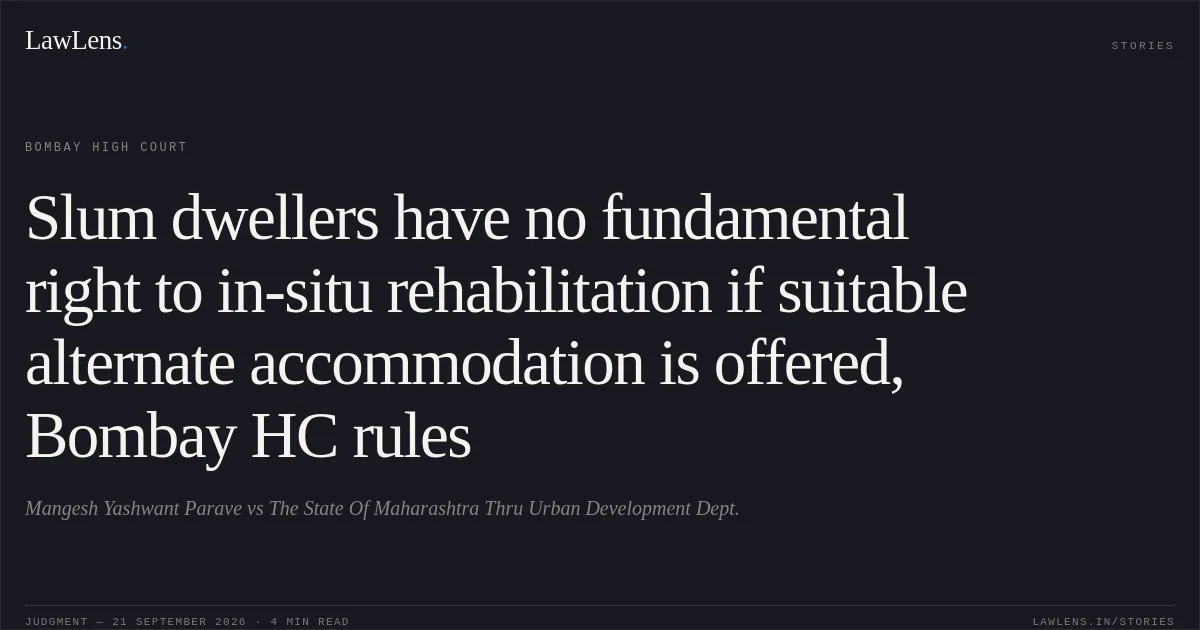
Mangesh Yashwant ParavevsThe State Of Maharashtra Thru Urban Development Dept.
Click to open original judgment
Original judgment, available to read, download and summarize on LawLens.in
![Railway authority directed to decide pension representations by a reasoned order within three months.. SWAPAN KUMAR SHOME vs EASTERN RAILWAY. CAT - ['Kolkata']. LawLens](/stories/thumbnails/railway-authority-directed-to-decide-pension-representations-by-a-reasoned-order-within-th-c678aa51f4bf4d4dba1806458b45f390.webp)
![Postal Service Group B officers must complete four years’ regular service for Grade Pay ₹5,400.. HARIHAR VIBHUTI PANDEY vs Union Of India. CAT - ['Lucknow']. LawLens](/stories/thumbnails/postal-service-group-b-officers-must-complete-four-years-regular-service-for-grade-pay-5-4-fd07a9f098d44594aebe92e1923da537.webp)