Facts
The petitioner filed a petition under Sections 276 and 278 of the Indian Succession Act, 1925, seeking probate or letters of administration in respect of the registered Will dated 19 September 2002 executed by Late Sh. Bishamber Lal Aggarwal.
Source reference: p.1, paras. 1–2The deceased died on 21 November 2012 and was survived by his wife, Smt. Satya Kumari, and daughter, Ms. Vibha Mahajan; the petitioner was the executor and beneficiary named in the Will.
Source reference: p.2, paras. 3–5Under the Will, the deceased bequeathed Flat No. 27, Type B, Block No. 3, First Floor, with Parking Space No. 0, Sector-56, Gurugram, to the petitioner.
Source reference: p.2, para. 4The Will was registered with the Sub-Registrar-IX, New Delhi, and one attesting witness, Sh. Anurag Jain, verified the petition under Section 281 of the Act and affirmed the due execution and attestation of the Will.
Source reference: p.2, para. 6The Central Government Employees Welfare Housing Organisation required the petitioner to obtain probate or letters of administration for transfer or mutation of the flat in her favour.
Source reference: p.2, para. 7Citations were published in The Statesman and Veer Arjun, but no objections were received.
Source reference: p.3, paras. 8–9The property was valued at Rs. 73,38,100, and the proceedings were transferred from the Patiala House Courts to the Delhi High Court on account of pecuniary jurisdiction under Section 273(b) of the Act.
Source reference: p.3, paras. 10–11The deceased’s wife and daughter did not appear or contest the proceedings.
Source reference: p.3, para. 12Issues
Whether the registered Will dated 19 September 2002 was duly executed and proved in accordance with the Indian Succession Act and the applicable law, so as to entitle the petitioner to probate?
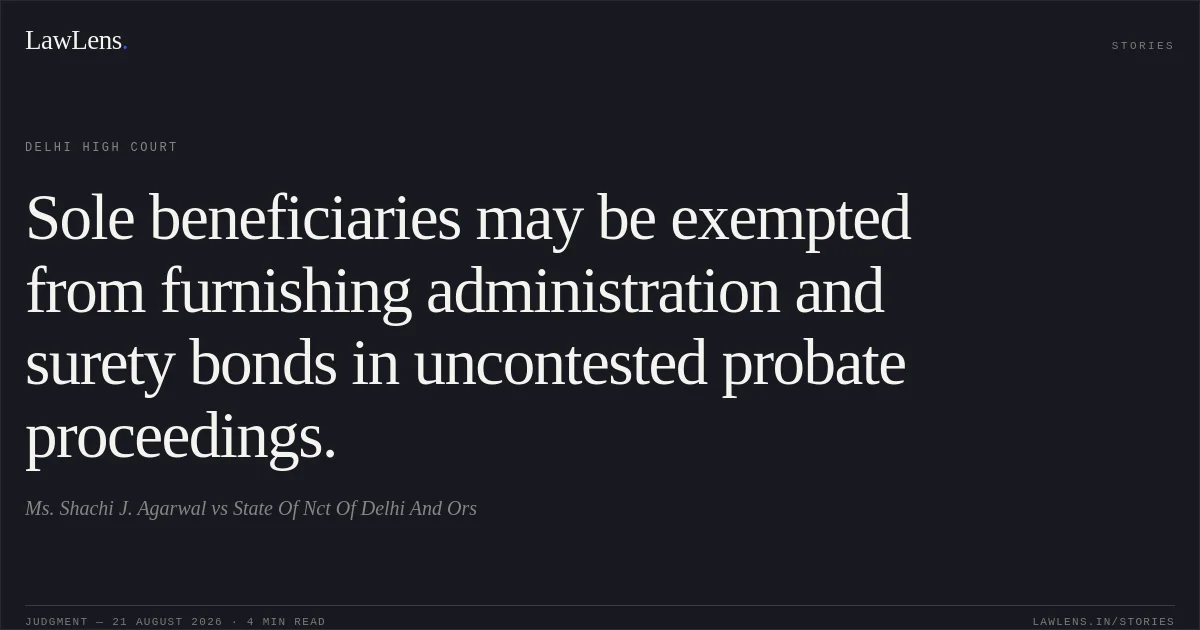
Source reference: p.4, paras. 13–15Whether the petitioner, being the sole beneficiary and executor under the Will and facing no contest from the deceased’s other legal heirs, was required to furnish an administration bond or surety bond?
Source reference: pp.4–6, paras. 16–18Whether the Delhi High Court had jurisdiction to grant probate after transfer of the proceedings on account of the valuation of the estate?
Source reference: p.3, para. 11Law Applied
The Court applied Sections 276 and 278 of the Indian Succession Act, 1925, governing petitions for probate or letters of administration; Section 68 of the Indian Evidence Act, 1872, requiring proof of a Will through at least one attesting witness; Section 281 of the Succession Act concerning verification by an attesting witness; Section 272 of the Succession Act and Rule 6 of Chapter XXIX of the Delhi High Court (Original Side) Rules, 2018, concerning the grant of probate; and Section 273(b) concerning pecuniary jurisdiction.
Source reference: pp.1, 3–4, paras. 1, 6, 11, 13–15In relation to administration and surety bonds, the Court relied on Section 291 of the Succession Act and Sanjay Suri v. State & Ors., 2003 SCC OnLine Del 966, which held that requiring a sole beneficiary and legal heir to furnish an administration bond would serve no meaningful purpose because the beneficiary would effectively be administering his or her own estate.
Source reference: pp.4–5, para. 16The Court also followed its earlier order dated 5 August 2024 in TEST.CAS. 48/2017, where the bond requirement was waived for a sole beneficiary who was not a natural legal heir.
Source reference: pp.4–6, para. 16Reasoning
The Court found that the Will was a registered testamentary instrument, expressly identified the petitioner as beneficiary and executor, and was supported by the evidence of one attesting witness, who confirmed that the testator signed the Will in his presence and that he attested it in the presence of the testator and the other witness.
Source reference: pp.2, 4, paras. 6, 13–14This satisfied the statutory requirement under Section 68 of the Evidence Act and established due execution of the Will.
Source reference: pp.2, 4, paras. 6, 13–14The publication of citations without objection, together with the non-appearance of the deceased’s wife and daughter, indicated that the grant of probate was uncontested.
Source reference: p.3, para. 12; p.6, para. 17Since the estate valuation exceeded the relevant pecuniary threshold, the transfer to and exercise of jurisdiction by the High Court was held proper under Section 273(b).
Source reference: p.3, para. 11Finally, treating the petitioner as the sole beneficiary and noting the absence of any contest, the Court held that insisting on an administration or surety bond would be unnecessary and purposeless, consistent with Sanjay Suri and TEST.CAS. 48/2017.
Source reference: pp.4–6, paras. 16–17Holding
The Court held that the Will dated 19 September 2002 was duly executed and proved by Late Sh. Bishamber Lal Aggarwal, and that no legal impediment existed to the grant of probate.
The petition was allowed, and probate was granted in favour of the petitioner, subject to her filing the requisite court fees.
Source reference: p.6, para. 18The petitioner was exempted from furnishing an administration bond or surety bond because she was the sole beneficiary and the grant was uncontested by the other legal heirs.
Source reference: p.6, paras. 17–18Acts & Sections Cited
6 provisions across 1 statute referred to in this judgment. Each provision opens on LawLens.
Indian Succession Act, 19256
Original Court PDF
Ms. Shachi J. AgarwalvsState Of Nct Of Delhi And Ors
Click to open original judgment
Original judgment, available to read, download and summarize on LawLens.in