Facts
The appellant was convicted by the Trial Court under Section 302 of the IPC for the murder of Junaid on 24.03.2017
Source reference: p. 1-2The prosecution alleged that the appellant stabbed the deceased with a meat-cutting knife in broad daylight after a chase
Source reference: p. 2The case rested primarily on the testimony of PW-21 (the deceased’s uncle), who claimed to be an eyewitness
Source reference: p. 3The Trial Court sentenced the appellant to life imprisonment
Source reference: p. 2The appellant challenged the conviction on grounds of material contradictions in eyewitness testimony, hostile public witnesses, and procedural lapses in the recovery of the weapon
Source reference: p. 6-8Issues
1. Whether the solitary testimony of PW-21 is sufficiently reliable to sustain a conviction for murder under Section 302 IPC
Source reference: p. 10 / para. 272. Whether the prosecution successfully established the recovery of the weapon of offence at the instance of the appellant
Source reference: p. 13 / para. 373. Whether the circumstantial evidence and "last seen" theory, as presented through PW-6 and PW-7, corroborate the charge of murder
Source reference: p. 12 / para. 33Law Applied
The Court applied Section 302 (Punishment for murder) and Section 300 (Definition of murder) of the IPC
Source reference: p. 5It relied on the evidentiary principle that while a conviction can be based on the testimony of a sole eye-witness, such testimony must be "wholly reliable" and of "stellar quality," as established in *State of Rajasthan v. Bhola Singh*
Source reference: p. 10 / para. 27Furthermore, it applied Section 27 of the Indian Evidence Act regarding the admissibility of recoveries made pursuant to a disclosure statement
Source reference: p. 13-14and Section 65-B concerning the admissibility of electronic evidence (CCTV footage)
Source reference: p. 13 / para. 36Reasoning
The High Court found the testimony of PW-21 unreliable due to "unnatural conduct"; instead of aiding his bleeding nephew, he allegedly ran to a relative's house, a claim contradicted by other family members (PW-9, PW-10, PW-12) who stated PW-10 provided the first information
Source reference: p. 11 / para. 30The Court noted that public witnesses (PW-5, PW-1) turned hostile, and "last seen" witnesses (PW-6, PW-7) testified that the appellant and deceased were friendly just prior to the incident, negating a motive for sudden violence
Source reference: p. 12 / para. 33The recovery of the knife was deemed doubtful because it was found in an open public shop hours after the incident, yet the Investigating Officer failed to find it during the initial spot visit
Source reference: p. 14 / para. 39Additionally, the lack of a Section 65-B certificate rendered the CCTV evidence inadmissible, and the absence of fingerprints on the weapon further weakened the nexus between the appellant and the crime
Source reference: p. 13-14Holding
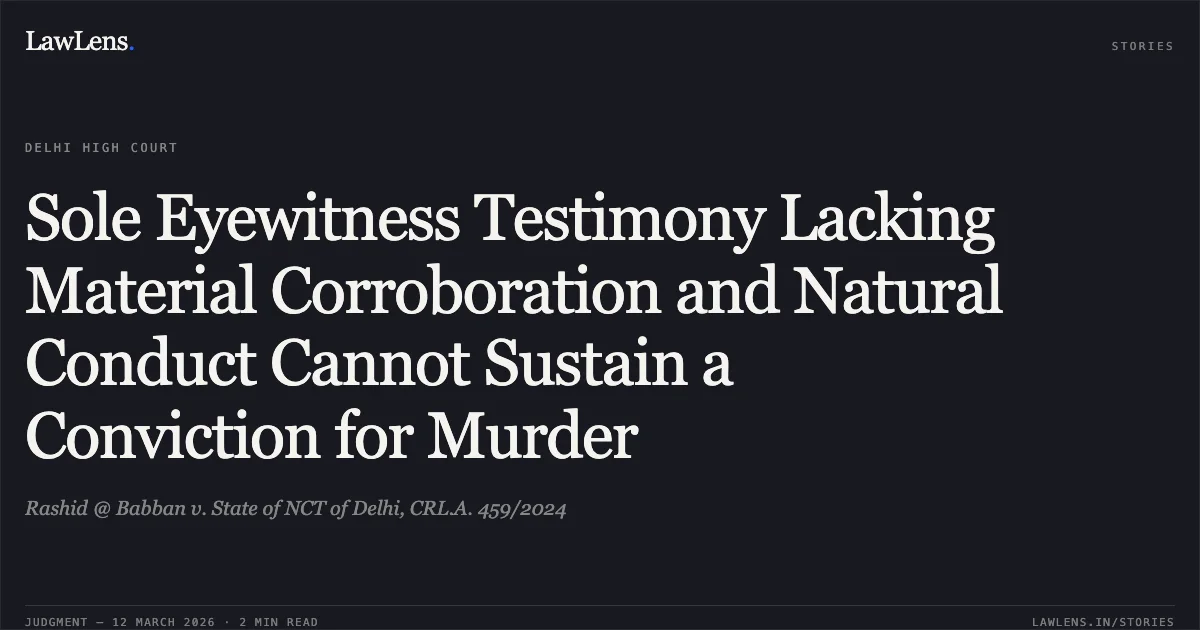
The Court held that the prosecution failed to prove the charges beyond a reasonable doubt as the chain of circumstances was broken and the sole eyewitness was unreliable
The High Court set aside the Trial Court's orders dated 30.10.2023 and 21.03.2024, acquitted the appellant of all charges, and ordered his immediate release
Source reference: p. 15 / para. 43The appeal was allowed
Source reference: p. 15 / para. 44Acts & Sections Cited
3 provisions across 2 statutes referred to in this judgment. Each provision opens on LawLens.
Code of Criminal Procedure, 19731
Indian Penal Code, 18602
Original Court PDF
Rashid @ Babban v. State of NCT of Delhi, CRL.A. 459/2024
Click to open original judgment
Original judgment, available to read, download and summarize on LawLens.in