Facts
The Respondent No. 1 (DTU) issued a Notice Inviting Tender (NIT) on November 7, 2025, for sanitation and housekeeping services
Source reference: p. 2, para 4.1The Petitioner participated but was disqualified at the technical stage on January 9, 2026
Source reference: p. 3, para 4.6Out of 343 bidders, 342 were disqualified, leaving Respondent No. 2 (a Public Sector Undertaking) as the sole technically qualified bidder
Source reference: p. 3, para 4.4-4.5DTU justified the disqualification based on Clause 2.1 of the NIT, which restricted eligibility to Government agencies or PSUs
Source reference: p. 3, para 4.7The Petitioner challenged the validity of Clause 2.1, alleging it was arbitrary, discriminatory, and inconsistent with Clause 3.1 (which allowed registration as a Company/Firm/Society) and the General Financial Rules (GFR)
Source reference: p. 4, para 4.10-4.11Notably, the Petitioner’s wife is the current contractor whose term expires on March 31, 2026
Source reference: p. 5, para 5.1; p. 8, para 9Issues
1. Whether Clause 2.1 of the NIT, restricting participation to Government agencies/PSUs, is arbitrary, illegal, or inconsistent with the broader qualification criteria in Clause 3.1
Source reference: p. 4, para 4.102. Whether the award of a contract to a sole technically qualified bidder violates the General Financial Rules (GFR), 2017, specifically regarding competition and single tender enquiries
Source reference: p. 4, para 4.113. Whether the writ petition is barred by delay and laches given the imminent commencement of the new contract
Source reference: p. 6, para 5.3; p. 8, para 10Law Applied
The court primarily applied the principles of judicial review in tender matters as established in Jagdish Mandal v. State of Orissa (2007), which dictates that courts should not interfere in commercial transactions unless the decision-making process is mala fide, intended to favor someone, or so arbitrary that no responsible authority could have reached it
Source reference: p. 6-7, para 8The court also considered the General Financial Rules (GFR), 2017, including Rules 166, 173, 184, and 201, regarding procurement transparency and competitive bidding
Source reference: p. 4-5, para 4.11-4.12Furthermore, the court applied the doctrine of "delay and laches" under Article 226 of the Constitution of India
Source reference: p. 8, para 10Reasoning
The Court observed that the Petitioner approached the bench on March 26, 2026, despite being aware of the disqualification since January 2026 and the contract award since March 2, 2026
Source reference: p. 8, para 9-10It held that entertaining the petition at such a late stage would disrupt essential sanitation services scheduled to commence on April 1, 2026
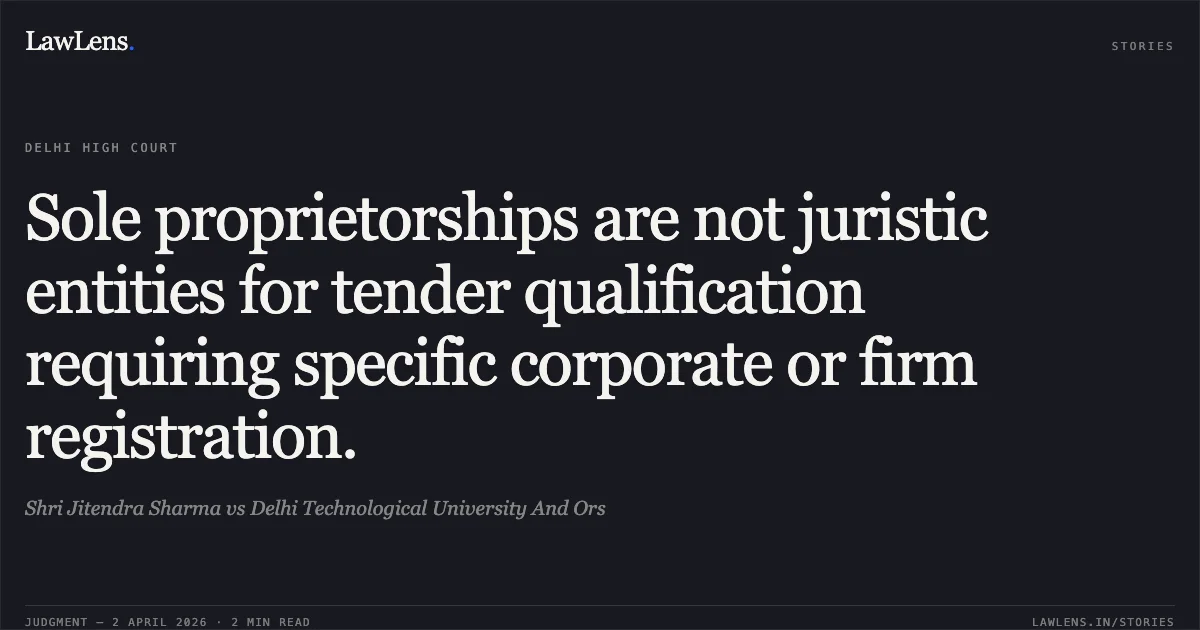
Source reference: p. 8, para 10The Court further scrutinized the Petitioner’s eligibility under Clause 3.1, which requires bidders to be registered as a "Company, Firm, Society, Trust or Nigam"
Source reference: p. 8-9, para 11Since the Petitioner is a sole proprietorship and not a distinct juristic entity, the Court found he failed to satisfy even the basic qualification criteria he claimed to rely upon
Source reference: p. 9, para 12The Court also noted that the litigation appeared to be a "proxy" attempt to extend the existing contract held by the Petitioner’s wife
Source reference: p. 5, para 5.1; p. 8, para 10Holding
The Court dismissed the petition, holding that it was barred by delay and laches and lacked merit
The Court found that the Petitioner did not qualify as a juristic entity under Clause 3.1 of the NIT
Source reference: p. 9, para 12Consequently, the Court declined to rule on the validity of the restrictive Clause 2.1 or the alleged GFR violations, leaving those questions open for future appropriate proceedings
Source reference: p. 9, para 13All pending applications were disposed of accordingly
Source reference: p. 9, para 14Original Court PDF
Shri Jitendra SharmavsDelhi Technological University And Ors
Click to open original judgment
Original judgment, available to read, download and summarize on LawLens.in


![Authorities must decide pensionary and retiral-benefit claims through a reasoned order within eight weeks.. Habibullah khan vs HOME DEPARTMENT. CAT - ['Srinagar']. LawLens](/stories/thumbnails/authorities-must-decide-pensionary-and-retiral-benefit-claims-through-a-reasoned-order-wit-d0cbe8a8119c48fbabe7df9f2d353488.webp)