Facts
The marriage of the complainant’s daughter was fixed with Naveen Kumar, and an engagement ceremony was held on April 22, 2024
Source reference: para 2.aPost-engagement, the complainant alleged that Naveen, his brother Praveen, father Kaushal Singh, and the petitioner, Urmila Devi, demanded ₹25–30 lakhs, 25 Tola gold, and a car as dowry
Source reference: para 2.aConsequently, an FIR was registered at the Women Police Station, Ujjain, for offences under Sections 3 and 4 of the Dowry Prohibition Act, 1961
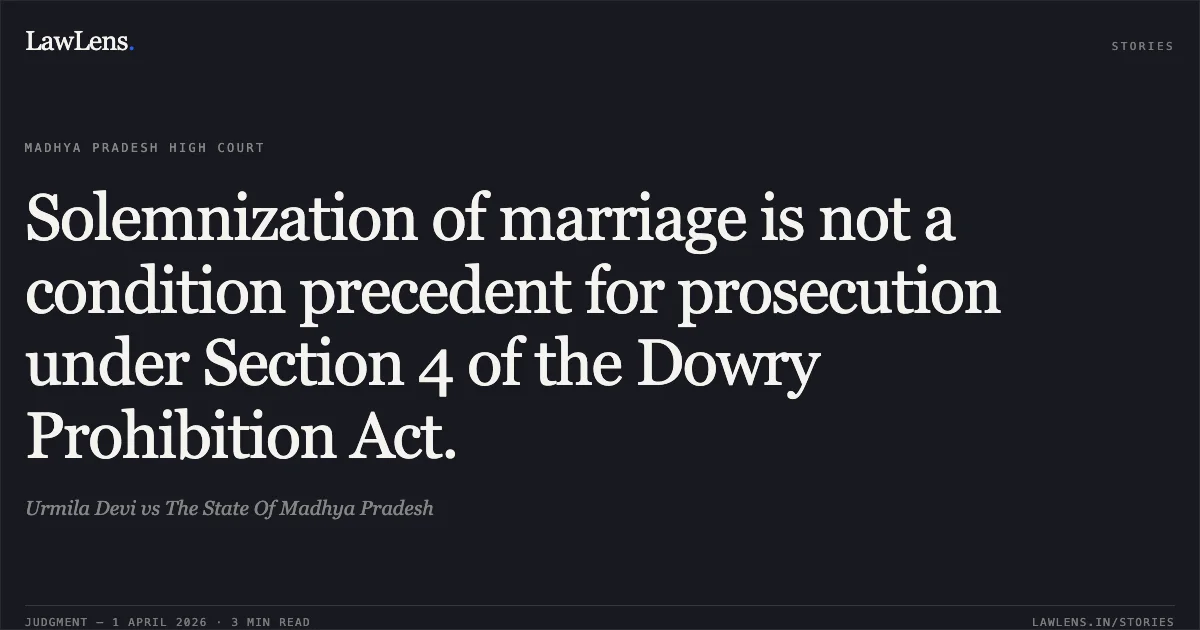
Source reference: para 2.aThe petitioners moved the High Court under Section 482 of the CrPC (Section 528 of the BNSS, 2023) to quash the FIR, contending that they were falsely implicated, no specific demand was attributable to them, and that the solemnization of marriage is a condition precedent for an offence under Section 4 of the Dowry Prohibition Act
Source reference: para 3Issues
1. Whether the solemnization of marriage is a mandatory prerequisite for the constitution of an offence under Section 4 of the Dowry Prohibition Act, 1961?
Source reference: para 3 / para 92. Whether the allegations in the FIR and the material collected during the investigation prima facie disclose the commission of a cognizable offence justifying the continuation of criminal proceedings?
Source reference: para 11Law Applied
Section 4 of the Dowry Prohibition Act, 1961, which penalizes the direct or indirect demand of dowry from the parents or guardians of a bride or bridegroom
Source reference: para 9The court relied on the Supreme Court’s decision in L.V. Jadhav v. Shankarrao Abasaheb Pawar (1983), which established that a liberal construction must be given to the word "dowry" under Section 4 to include any property demanded as consideration for marriage, even if the marriage is not yet solemnized
Source reference: para 9the court applied the principles for quashing FIRs laid down in State of Haryana v. Ch. Bhajan Lal, which restrict the use of inherent powers to cases where allegations, even if accepted in their entirety, fail to constitute an offence
Source reference: para 7Reasoning
The court rejected the petitioners' contention that marriage must be solemnized to trigger Section 4 of the Dowry Prohibition Act.
Source reference: para 9Citing L.V. Jadhav, the court reasoned that the dominant object of the Act is to stamp out the practice of demanding dowry in any form, whether before, at, or after the marriage.
Source reference: para 9It held that a "demand" itself is punishable under Section 4, regardless of whether the other party consented or whether the marriage ceremony was completed.
Source reference: para 9Upon perusing the FIR and the material on record, the court observed specific allegations regarding the demand for cash, gold, and a vehicle for the marriage.
Source reference: para 11The court emphasized that under Section 482 CrPC, it cannot engage in a "threadbare analysis" or evaluation of evidence, as the veracity of the prosecution's claims is a matter for trial.
Source reference: para 11Since the allegations prima facie established the petitioners' complicity, the court found no grounds for quashing the proceedings.
Source reference: para 11-12Holding
The High Court dismissed the petition, holding that the FIR and the final report prima facie showed the petitioners' involvement in the alleged offence.
The court affirmed that a demand for dowry prior to marriage constitutes an offence under Section 4 of the Dowry Prohibition Act.
Source reference: para 9Consequently, quashing the FIR would constitute an abuse of the process of the court. The petition was dismissed as meritless.
Source reference: para 12Acts & Sections Cited
9 provisions across 3 statutes referred to in this judgment. Each provision opens on LawLens.
Code of Criminal Procedure, 19733
Bharatiya Nagarik Suraksha Sanhita, 20231
Original Court PDF
Urmila DevivsThe State Of Madhya Pradesh
Click to open original judgment
Original judgment, available to read, download and summarize on LawLens.in


