Facts
Following the 13 May 2026 confidence vote, 25 AIADMK MLAs allegedly voted contrary to the party whip, prompting disqualification proceedings under the Tenth Schedule.
Source reference: p. 19–30Six later resigned and joined TVK. Four of them—against whom disqualification proceedings remained pending—were the subject of petitions challenging the Speaker’s acceptance of their resignations and seeking time-bound decisions on the pending proceedings.
Source reference: p. 19–30As to the other two MLAs, the party had withdrawn its disqualification proceedings and no fresh petitions were shown to be pending.
Source reference: p. 19–30A separate political party also challenged the resignation notifications concerning three of the four MLAs whose disqualification proceedings remained pending.
Source reference: p. 19–30The petitioners alleged that the resignations were accepted hastily and in circumstances suggesting political inducement; the respondents maintained that the resignations were personal, voluntary and genuine.
Source reference: p. 31–40Issues
Whether the Speaker was required to conduct a detailed inquiry before accepting the resignations, and whether their prompt acceptance was arbitrary or constitutionally improper.
Source reference: p. 41, 43–58Whether the Speaker was barred from accepting resignations while disqualification proceedings were pending.
Source reference: p. 41, 59–77Whether acceptance of the resignations rendered the pending disqualification proceedings academic or infructuous.
Source reference: p. 41, 77–86Whether the High Court could direct the Speaker to decide the pending disqualification proceedings within a fixed time.
Source reference: p. 41, 87–105Law Applied
Article 190(3)(b) of the Constitution requires a member’s written resignation to be accepted by the Speaker; the Speaker must not accept it if, after such inquiry as the Speaker thinks fit, the resignation is found not to be voluntary or genuine.
Source reference: p. 46–54Rules 21–24 of the Tamil Nadu Legislative Assembly Rules govern the form, acceptance and inquiry into resignations; where a member personally hands over the resignation and confirms its voluntary and genuine character, Rule 22 permits acceptance if the Speaker has no contrary information.
Source reference: p. 46–54Under the Tenth Schedule, the Speaker decides disqualification petitions as a tribunal, and a disqualification decision relates to the date of the alleged defection; resignation does not extinguish the consequences of earlier conduct.
Source reference: p. 64–69, 80–86The Court relied, among other authorities, on Shrimanth Balasaheb Patil v. Karnataka Legislative Assembly, (2020) 2 SCC 595; Subhash Desai v. State of Maharashtra, (2024) 2 SCC 719; and Rajendra Singh Rana v. Swami Prasad Maurya, (2007) 4 SCC 270, concerning the scope of resignation inquiries and the continuing effect of alleged defection.
Source reference: p. 55–57, 64–69, 80–86Under Kihoto Hollohan v. Zachillhu, judicial review of the Speaker’s Tenth Schedule functions is limited, but the High Court may intervene in exceptional circumstances; Keisham Meghachandra Singh v. Speaker, Manipur Legislative Assembly, (2021) 16 SCC 503, and Padi Kaushik Reddy v. State of Telangana, 2025 SCC OnLine SC 1576, support directions to ensure timely adjudication.
Source reference: p. 91–101Reasoning
The Court held that the resignation inquiry is confined to whether the resignation is genuine and whether the member intends to relinquish membership of their free will; it does not ordinarily extend to investigating political motives or alleged inducements.
Source reference: p. 50–58The MLAs personally appeared, tendered signed resignations and affirmed their voluntary intention, while the pleadings did not allege forgery or impersonation.
Source reference: p. 50–58The Speaker was therefore not required to conduct a roving inquiry, and the surrounding political allegations did not invalidate acceptance.
Source reference: p. 50–58The Court treated resignation and disqualification as distinct constitutional processes: pending disqualification proceedings did not prevent the Speaker from accepting a resignation, nor did acceptance extinguish proceedings concerning alleged prior defection.
Source reference: p. 61–77, 85–86However, the four pending proceedings had remained at the notice stage for more than four months. Applying the authorities permitting judicial intervention to secure a prompt decision, the Court found a time-bound direction warranted.
Source reference: p. 87–105It did not address disqualification proceedings against the two other MLAs because none were shown to be pending.
Source reference: p. 25–26, 59–60Holding
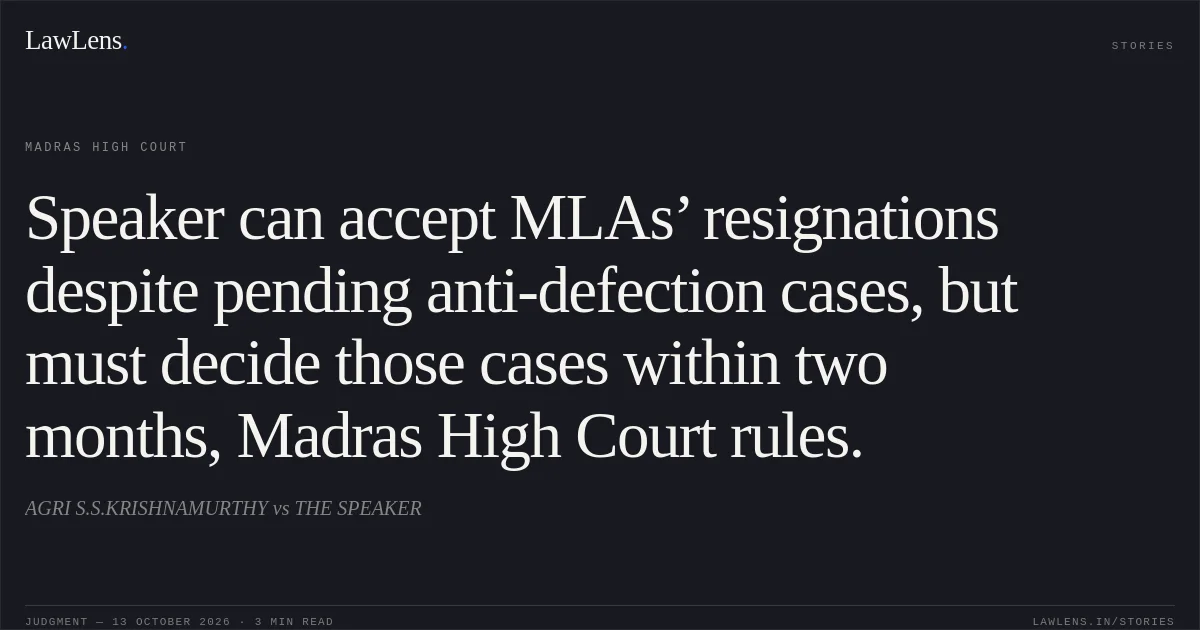
The Court upheld the acceptance of the resignations and the consequential vacancy notifications, holding that the Speaker was not constitutionally barred from accepting them during pending disqualification proceedings and that the proceedings were not thereby rendered infructuous.
It directed the Speaker to prepare and publish, within seven days, a timetable for the pending proceedings and to conclude them within two months of the judgment; no more than two adjournments were to be granted to the defecting MLAs, subject to observance of natural justice and a reasoned final decision.
Source reference: p. 102–105W.P. Nos. 26155 and 26422 of 2026 were dismissed; W.P. Nos. 23081, 23085 and 22397 of 2026 were partly allowed.
Source reference: p. 107–108No order as to costs.
Source reference: p. 107–108Acts & Sections Cited
3 provisions across 1 statute referred to in this judgment. Each provision opens on LawLens.
Representation of the People Act, 19513
Original Court PDF
AGRI S.S.KRISHNAMURTHYvsTHE SPEAKER
Click to open original judgment
Original judgment, available to read, download and summarize on LawLens.in
![Courts will not interfere with transfers absent mala fides or violation of statutory rules.. M Ramya vs EMPLOYEES STATE INSURANCE CORPORATION (ESIC). CAT - ['Chennai']. LawLens](/stories/thumbnails/courts-will-not-interfere-with-transfers-absent-mala-fides-or-violation-of-statutory-rules-a6845e9ca6f548fca284c51c8351957f.webp)
![Courts cannot direct one-time recruitment age relaxation absent authority in the governing rules or advertisement.. UT OF PUDUCHERRY vs M ANDAL. CAT - ['Chennai']. LawLens](/stories/thumbnails/courts-cannot-direct-one-time-recruitment-age-relaxation-absent-authority-in-the-governing-895d78fde47143e2a8ed0207c4b6a44f.webp)
![A review cannot correct an allegedly erroneous decision absent an error apparent on the record.. Ajit Kumar Jha vs RAILWAY BOARD. CAT - ['Delhi']. LawLens](/stories/thumbnails/a-review-cannot-correct-an-allegedly-erroneous-decision-absent-an-error-apparent-on-the-re-8ac952fd4eba470c92f7da20af72a220.webp)