01Facts
The applicants—respondent no. 2’s mother-in-law, father-in-law, brother-in-law and husband—sought quashing under Section 482 Cr.P.C. of the summoning order dated 23 September 2013, order dated 19 January 2015 and the proceedings in Criminal Case No. 1404 of 2013.
pp. 2–3Respondent no. 2 alleged that, after her marriage with applicant no. 4 on 29 April 2005, the applicants subjected her to dowry-related harassment and, on 23 June 2012 at about 6:30 p.m., assaulted her and demanded dowry.
pp. 2–3She was medically examined, and the injuries were recorded as fresh and caused by a hard and blunt object.
pp. 2–3, 15The police filed a charge-sheet against the applicants under Sections 323, 504, 506 and 498A IPC and Sections 3/4 of the Dowry Prohibition Act.
p. 3The applicants relied on a prior Mahila Helpline report, subsequent findings in proceedings under Sections 125 Cr.P.C. and 13(1) of the Hindu Marriage Act, and alleged that the criminal case arose from a monetary dispute and contained false allegations.
pp. 3–4, 12–13The respondent and the State opposed quashing, relying upon the prompt FIR, the medical evidence and the statements recorded under Section 161 Cr.P.C.
pp. 13–1402Issues
i.1. Whether the criminal proceedings under Sections 323, 504, 506 and 498A IPC and Sections 3/4 of the Dowry Prohibition Act, arising from allegations of dowry demand and assault, should be quashed under Section 482 Cr.P.C.
¶ 23ii.2. Whether the prior Mahila Helpline report, findings in matrimonial and maintenance proceedings, and the applicants’ contention that the allegations were vague or motivated justified interference at the pre-trial stage.
¶ 18–24iii.3. Whether the existence of specific allegations supported by a contemporaneous medical examination raised triable issues that could not appropriately be adjudicated in proceedings under Section 482 Cr.P.C.
¶ 25–2903Law Applied
The Court applied Section 482 Cr.P.C., which permits the High Court to prevent abuse of the process of law and secure the ends of justice, but does not ordinarily permit a detailed evaluation of disputed facts where the complaint discloses a prima facie case.
Section 498A IPC requires examination of allegations of cruelty or harassment by the husband or his relatives, including harassment connected with an unlawful demand for property or valuable security; Sections 323, 504 and 506 IPC and Sections 3/4 of the Dowry Prohibition Act were also relevant to the charge-sheet.
p. 3Relying on Taramani Parakh v. State of Madhya Pradesh, (2015) 11 SCC 260, the Court held that where allegations, if proved, disclose an offence, the question whether cruelty or harassment was actually committed is ordinarily a matter for trial and proceedings should not be quashed prematurely.
¶ 27–28The Court distinguished authorities concerning vague, omnibus or unsupported allegations, including Arti Mehta, Digambar, Mst. Rehana Begum and Lokesh Kumar Jain, on the basis of their different factual settings.
¶ 24, 29Provisions in the judgment · 13 · Linked ones open on LawLens
Code of Criminal Procedure, 1973 Section 482Section 125Section 161
Indian Penal Code, 1860 Section 323Section 504Section 506Section 494Section 495Section 307
Dowry Prohibition Act, 1961 Section 3Section 4
Hindu Marriage Act, 1955 Section 13
Family Courts Act, 1984 Section 7
04Reasoning
The Court found that the FIR contained specific allegations of dowry demand and assault, including the date, time and nature of the alleged incident on 23 June 2012.
¶ 25The allegation of assault at approximately 6:30 p.m. was supported by the medical examination conducted immediately thereafter, which recorded fresh injuries, one of which was kept under observation and attributed to a hard and blunt object.
¶ 25This material created a prima facie case and distinguished the matter from cases involving only general or omnibus allegations against the husband’s relatives.
¶ 24–25The Court declined to conclusively assess the Mahila Helpline report, the parties’ competing versions, the medical-record discrepancies, or the findings in subsequent matrimonial proceedings, holding that these involved disputed factual matters appropriate for consideration at trial.
¶ 26–29Applying Taramani Parakh, the Court held that it could not conclude at the threshold that, even if the allegations were proved, no offence would be made out.
¶ 27–2805Holding
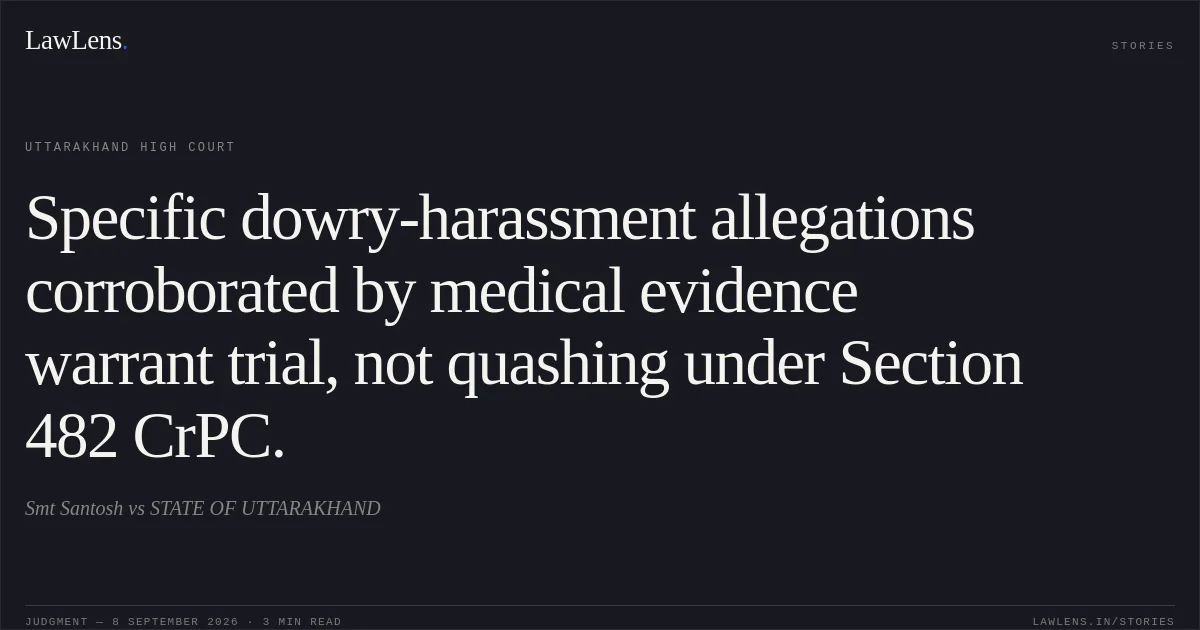
The Court held that the allegations of dowry harassment and assault, corroborated by the prompt medical examination, disclosed a triable case and did not warrant exercise of inherent jurisdiction under Section 482 Cr.P.C.
¶ 25–29The Criminal Miscellaneous Application was accordingly dismissed, and the charge-sheet, summoning order and criminal proceedings were not quashed.
¶ 31The Court clarified that its observations were confined to the question of quashing and would not prejudice the trial court, which was directed to decide the case on its own merits.
¶ 30Original Court PDF
Smt SantoshvsSTATE OF UTTARAKHAND
Click to open original judgment
Original judgment, available to read, download and summarize on LawLens.in