01Facts
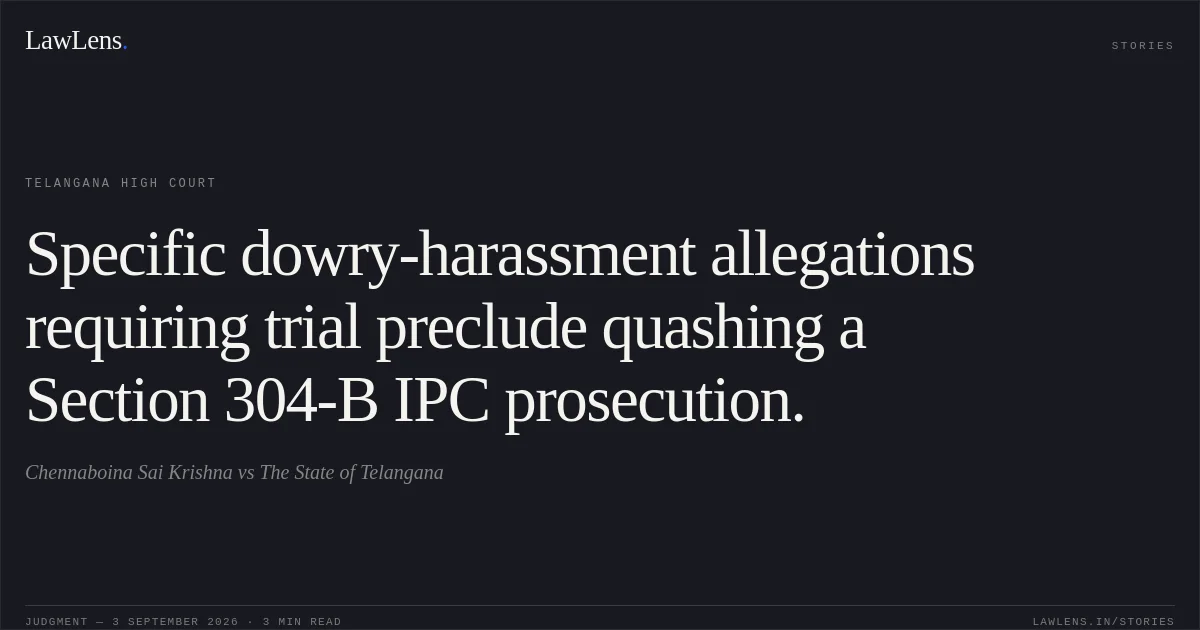
The deceased, Chennaboina Soundarya, married Accused No.1 on 10.11.2019 and died by suicide at her matrimonial home on 25.01.2023, within seven years of marriage.
pp. 3–5, 10–11Her father alleged that, after an initial period of marriage, the accused subjected her to mental and physical harassment, demanded additional dowry of ₹10,00,000, and insisted that she surrender her monthly salary of ₹30,000.
pp. 4–5, 13–15Crime No.83 of 2023 was initially registered under Sections 498-A and 306 read with Section 109 IPC. During investigation, after a further representation by the deceased’s father, the offence was altered to Section 304-B IPC.
p. 5, 12After recording statements of LWs.1 to 26, the Investigating Officer filed the final report, and the case was committed to the Sessions Court as S.C.No.626 of 2023.
p. 5, 12Accused No.1 and Accused Nos.3 to 6 invoked Section 528 of the BNSS seeking quashing of the proceedings.
p. 302Issues
i.Whether the allegations in the complaint, final report, and witness statements disclosed the essential ingredients of an offence under Section 304-B IPC against the petitioners so as to justify continuation of the Sessions proceedings.
pp. 6–8, 15–18 · ¶ 8–14ii.Whether the absence of the accused persons’ names or allegations against them in the deceased’s suicide note warranted quashing of the proceedings at the pre-trial stage.
pp. 7–8, 16–18 · ¶ 11–14iii.Whether the High Court should exercise its inherent jurisdiction under Section 528 of the BNSS to quash the prosecution where the truthfulness and evidentiary value of the allegations remained matters for trial.
pp. 18–20 · ¶ 15–1703Law Applied
The Court applied Section 304-B IPC, which requires a woman’s death otherwise than under normal circumstances within seven years of marriage and proof that, soon before her death, she was subjected to cruelty or harassment by her husband or his relatives in connection with a dowry demand.
pp. 3, 17–18Section 113-B of the Indian Evidence Act permits a presumption of dowry death only after the prosecution establishes the foundational fact of proximate cruelty or harassment for dowry, as explained in Sham Lal v. State of Haryana, (1997) 9 SCC 759.
p. 17The Court relied on Naresh Kumar v. State of Haryana, (2015) 1 SCC 797, for the principle that a suicide note is not an “encyclopaedia of the entire situation” and must be assessed with the surrounding evidence.
pp. 16–17Under State of Haryana v. Bhajan Lal, 1992 Supp (1) SCC 335, and Kamal Shivaji Pokarnekar v. State of Maharashtra, AIR 2019 SC 947, inherent powers to quash criminal proceedings are to be exercised sparingly and only where the allegations, even if taken at face value, do not disclose an offence, are legally barred, inherently improbable, frivolous, vexatious, or oppressive.
pp. 18–20Provisions in the judgment · 7 · Linked ones open on LawLens
Bharatiya Nagarik Suraksha Sanhita, 2023 Section 528
Indian Penal Code, 1860 Section 34Section 306Section 109Section 107
Code of Criminal Procedure, 1973 Section 161Section 482
04Reasoning
The Court found that the prosecution material contained specific allegations that the petitioners demanded additional dowry of ₹10,00,000 and the deceased’s salary, subjected her to physical and mental harassment, and continued such conduct after she returned to the matrimonial home in May 2022.
pp. 13–15Since the deceased died by suicide at her matrimonial home on 25.01.2023, approximately three years after marriage, the temporal requirement under Section 304-B IPC was prima facie satisfied.
pp. 10, 15–16The statements of the deceased’s family members, neighbours, the person who had intervened in the matrimonial dispute, and other witnesses were sufficient at the threshold stage to disclose a case requiring trial.
pp. 11–12, 15–16The Court held that the absence of the petitioners’ names in the suicide note did not conclusively exonerate them, particularly because the note had to be evaluated alongside the allegations and surrounding circumstances.
pp. 16–17Determining the credibility of those allegations or their evidentiary value would require a trial and could not be undertaken in proceedings under Section 528 BNSS.
pp. 18–2005Holding
The Court held that the complaint, charge sheet, and witness statements prima facie disclosed the ingredients of Section 304-B IPC and that the prosecution could not be quashed merely because the suicide note did not name the accused or attribute responsibility to them.
¶ 10–14The petitions under Section 528 BNSS were accordingly dismissed, and the proceedings in S.C.No.626 of 2023 before the I Additional District and Sessions Judge-cum-Special Sessions Court, Medchal-Malkajgiri District, were permitted to continue. Pending miscellaneous applications were closed.
¶ 18Original Court PDF
Chennaboina Sai KrishnavsThe State of Telangana
Click to open original judgment
Original judgment, available to read, download and summarize on LawLens.in