Facts
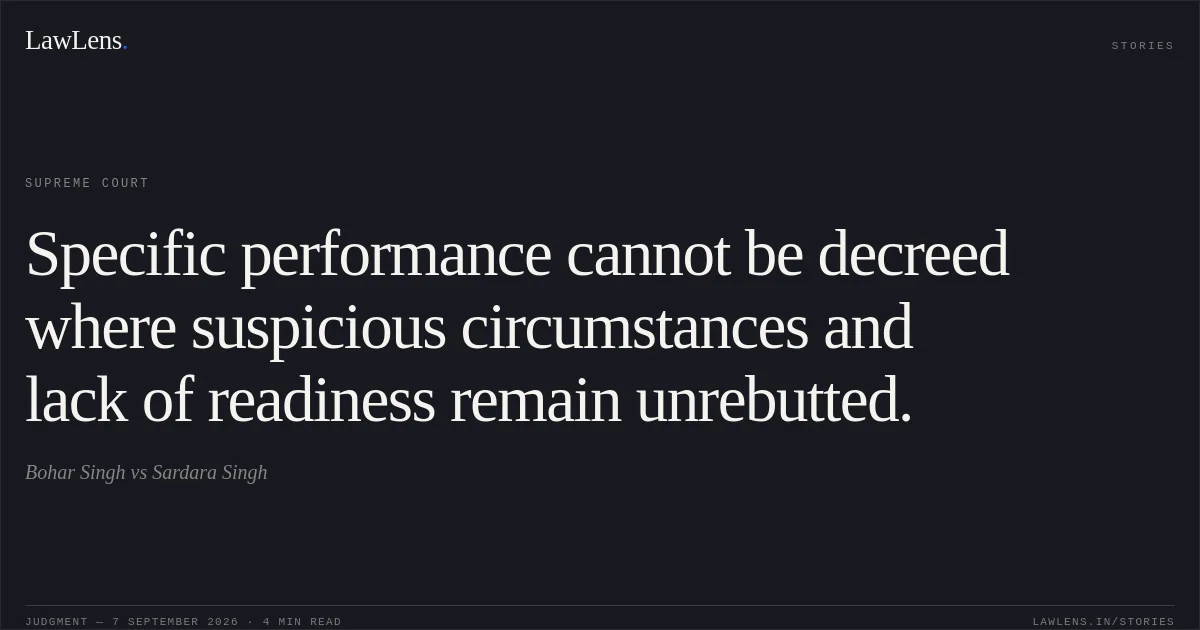
The respondents instituted a suit for specific performance in 1987 based on an agreement to sell dated 16 August 1984 concerning four acres of land at ₹12,000 per acre. An earnest amount of ₹27,300 was allegedly paid, with two years stipulated for payment of the balance consideration and execution of the sale deed. The respondents claimed that the period was extended up to 19 June 1987.
Source reference: p.1–2The defendant disputed the transaction as a sale agreement, contending that the documents had been executed in connection with a loan transaction involving the plaintiffs’ father. He also relied on a receipt dated 27 May 1987 acknowledging payment of ₹27,875 by the defendant to the plaintiffs’ father.
Source reference: p.1–2The Trial Court dismissed the suit after finding several suspicious circumstances, including discrepancies concerning the purchase of stamp paper, non-delivery of possession despite the agreement’s recital, apparent tampering in the extended date, and the plaintiffs’ failure to establish readiness and willingness.
Source reference: p.2–4The First Appellate Court reversed the dismissal and decreed specific performance, and the High Court affirmed that decree in second appeal.
Source reference: p.4The Supreme Court granted leave and examined whether the appellate courts had properly reassessed the Trial Court’s findings.
Source reference: p.1Issues
Whether the plaintiffs established the genuineness and enforceability of the agreement to sell, including the alleged extension of time up to 19 June 1987, in light of the suspicious circumstances and the defendant’s contention that documents had been executed in connection with a loan transaction.
Source reference: p.2–6Whether the plaintiffs proved continuous readiness and willingness to perform their part of the contract as required for a decree of specific performance.
Source reference: p.4Whether the First Appellate Court and the High Court were justified in reversing the Trial Court’s reasoned findings without properly addressing the material suspicious circumstances and evidentiary discrepancies.
Source reference: p.4–6Law Applied
The Court applied the principles governing specific performance under the Specific Relief Act, particularly the requirement that a plaintiff seeking specific performance must prove readiness and willingness to perform the contractual obligations.
Source reference: p.4–6It also applied the general evidentiary principles that the party asserting a contract must establish its execution and enforceability, and that material suspicious circumstances must be satisfactorily explained before the evidentiary burden can be shifted to the opposing party.
Source reference: p.4–6The Court further emphasized the limited scope for interference with a reasoned trial-court assessment of witness credibility and documentary evidence unless the appellate court properly displaces those findings through cogent reasoning.
Source reference: p.4–6Reasoning
The Supreme Court found that the Trial Court had identified substantial circumstances undermining the plaintiffs’ case: the stamp paper was purchased well before the alleged negotiations; possession was not delivered despite the agreement’s recital; the extended date appeared tampered with; and the explanation that the date was altered at the defendant’s request was inconsistent with the fact that only execution of the sale deed remained.
Source reference: p.2–4, 6–7The Court also noted that the plaintiffs’ father admitted receipt of ₹27,875 shortly before the alleged extended completion date, while the plaintiffs’ explanation that only ₹875 had been received was inconsistent with the receipt and its accompanying thumb impressions.
Source reference: p.2–4, 6–7The plaintiffs’ readiness and willingness was not satisfactorily proved merely by producing evidence that one plaintiff allegedly attended the Sub-Registrar’s office; that person did not testify, and there was no convincing evidence of availability of the balance consideration.
Source reference: p.4, 6The Court further regarded the plaintiffs’ claim that ₹56,000 constituted joint family funds as inconsistent with their assertion that they and their father were separate.
Source reference: p.4, 6The appellate courts, instead of properly rebutting these circumstances, focused on the absence of proof that the document was fabricated and thereby failed to address the distinct defence that the defendant’s signatures had been obtained on blank papers in the context of a loan transaction.
Source reference: p.5–6On the cumulative evidence, the Trial Court’s findings were held to be justified.
Source reference: no citationHolding
The Supreme Court allowed the appeal and restored the Trial Court’s dismissal of the suit for specific performance.
It directed the appellants to refund the amounts paid by the respondents with simple interest at 12.5% per annum—₹23,700 from 16 August 1984 and ₹20,700 from 29 January 1994, as specified in the operative direction—subject to adjustment of the Treasury deposit and any interest accrued thereon.
Source reference: p.7–8The amount was to be paid to the respondents or deposited before the Trial Court for disbursement. In default, the refund would constitute a charge on the property.
Source reference: p.8Original Court PDF
Bohar SinghvsSardara Singh
Click to open original judgment
Original judgment, available to read, download and summarize on LawLens.in