Facts
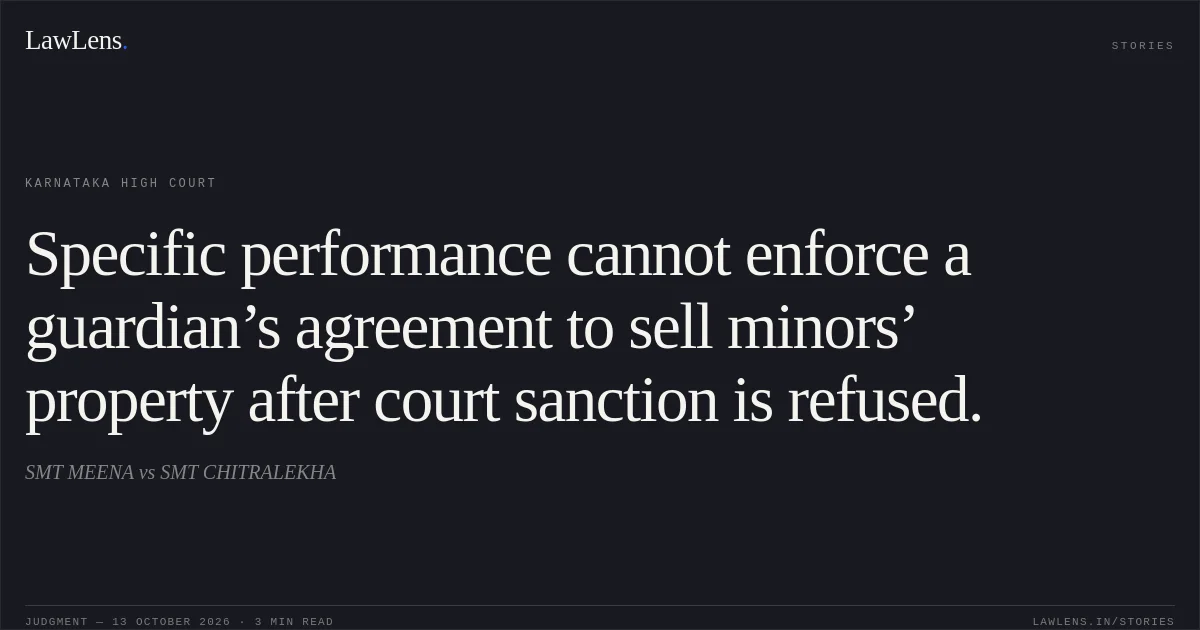
The suit property had been bequeathed by its owner, who died in 2006, to his minor children.
Source reference: para. 2The children’s mother, acting as their natural guardian, agreed to sell the property to the appellant for ₹35,00,000, subject to obtaining court permission to sell the minors’ share; the appellant paid ₹17,00,000 and entered permissive possession.
Source reference: paras. 2–3, 15–16The Guardianship Court dismissed the mother’s application for permission on 26 October 2007.
Source reference: para. 4The appellant said she learned of the dismissal when the respondents issued a notice on 20 May 2010 demanding possession, and filed suit on 19 June 2010 for specific performance.
Source reference: paras. 4, 20–22The Trial Court refused specific performance, ordered defendant No. 1 to refund ₹17,00,000, and directed the appellant to deliver vacant possession to defendants Nos. 2 and 3. The appellant appealed.
Source reference: paras. 5, 16Issues
Whether the suit for specific performance was within the limitation period under Article 54 of the Limitation Act, 1963, where performance was conditional on court permission and the appellant claimed she learned of its refusal only upon receiving the legal notice.
Source reference: para. 13(1); paras. 17–22Whether the agreement, made without prior court sanction under Section 8 of the Hindu Minority and Guardianship Act, 1956, was enforceable against the minor co-owners.
Source reference: para. 13(2); paras. 23–29Whether the Trial Court could direct delivery of possession upon ordering a refund, despite the absence of an express counterclaim for possession.
Source reference: para. 13(3); paras. 30–36Law Applied
Article 54 of the Limitation Act provides a three-year limitation period for specific performance: where a performance date is fixed, time runs from that date; otherwise, it runs from when the plaintiff has notice that performance is refused.
Source reference: paras. 17–19Section 8 of the Hindu Minority and Guardianship Act restricts a natural guardian’s power to transfer a minor’s immovable property without prior court permission; the judgment treated that permission as a statutory safeguard that a purchaser cannot waive.
Source reference: paras. 25–28The Court relied on K.S. Shivappa v. K. Neelamma and Kallathil Sreedharan v. Komath Pandyala Prasanna on the requirement for court permission, and distinguished the contractual-waiver principle in Dr. Jiwan Lal.
Source reference: paras. 27–28It also applied Section 29 of the Specific Relief Act, 1963, and relied on Tukaram Sadashiv Chambar v. Mallu Babu Chambar for the proposition that, where refund is ordered and the contract is treated as rescinded, a purchaser in permissive possession must restore possession.
Source reference: paras. 31–35The Court held that the rule against granting unpleaded relief in Bachhaj Nahar v. Nilima Mandal did not bar a consequential order restoring possession.
Source reference: paras. 31–35Reasoning
The agreement made performance dependent on obtaining court permission, so the Court held that the three-month period was not a fixed performance date for Article 54 purposes.
Source reference: paras. 18–22As the appellant was not a party to the guardianship proceedings and the record supported her claim that she learned of the dismissal through the 20 May 2010 notice, her suit, filed less than a month later, was timely.
Source reference: paras. 18–22The guardian’s authority to bind the minors’ property depended on statutory court approval; once permission was refused, the purchaser could not waive that requirement or enforce the agreement against the minors, regardless of any alleged default by their guardian.
Source reference: paras. 24–29Finally, because the appellant’s possession was permissive and derived from the agreement, the Court considered restoration of possession a consequential step following the refund and rescission, not an impermissible unpleaded relief.
Source reference: paras. 31–36Holding
The Court answered the limitation issue in the appellant’s favour but held that the agreement was unenforceable against the minor respondents and upheld the Trial Court’s possession direction.
It dismissed the appeal and affirmed the decree, directing that delivery of vacant possession be simultaneous with payment or deposit of the full ₹17,00,000 refund; the parties were to bear their own appeal costs.
Source reference: para. 37Acts & Sections Cited
7 provisions across 4 statutes referred to in this judgment. Each provision opens on LawLens.
Code of Civil Procedure, 19083
Hindu Minority and Guardianship Act, 19561
Limitation Act, 19631
Specific Relief Act, 19632
Original Court PDF
SMT MEENAvsSMT CHITRALEKHA
Click to open original judgment
Original judgment, available to read, download and summarize on LawLens.in