Facts
The respondent-plaintiff instituted Title Suit No. 57/2010 seeking specific performance of a registered agreement dated 26 April 2007, under which the defendant allegedly agreed to sell 1 katha 8 lechas of land for ₹2,24,000.
Source reference: pp. 3–5, 14–16; paras. 4, 9–10The plaintiff claimed to have paid ₹95,000 as advance and agreed to pay the balance ₹1,29,000 upon execution of the sale deed.
Source reference: pp. 3–5, 14–16; paras. 4, 9–10The agreement provided that the defendant could return the advance within 30 Ashin, failing which he was required to execute the sale deed by 30 Poush of the relevant Bengali year.
Source reference: pp. 3–5, 14–16; paras. 4, 9–10The defendant denied any intention to sell the property and contended that ₹90,000 had been taken as a loan, that the plaintiff had obtained his signatures on blank papers, and that the alleged agreement was merely security for repayment of the loan.
Source reference: pp. 5–7, 19–20; paras. 4, 14The Trial Court decreed specific performance and directed execution and registration of the sale deed upon payment of the balance consideration. The First Appellate Court affirmed the decree.
Source reference: pp. 7–8; paras. 4–5Issues
Whether the courts below correctly exercised their discretion in granting specific performance on the basis of the stipulations contained in the alleged agreement for sale?
Source reference: p. 8, para. 5; pp. 46–49, paras. 18–18.5Whether the concurrent findings of the courts below were perverse for failing to consider the defendant’s case that the agreement was executed as security for a loan and not as an unconditional agreement to sell?
Source reference: pp. 19–23, paras. 14–14.8Whether the suit was barred by limitation under Article 54 of the Limitation Act, 1963?
Source reference: pp. 9–10, para. 6; pp. 23–26, paras. 15–15.8Whether the finding that the plaintiff was ready and willing to perform her part of the contract was perverse because of her unexplained silence between 16 May 2008 and 24 April 2009?
Source reference: pp. 9–10, para. 5.1; pp. 36–46, paras. 16–17.18Law Applied
The Court applied Section 16(c) of the Specific Relief Act, 1963, which requires the plaintiff to plead and prove continuous readiness and willingness to perform the essential contractual obligations; the plaintiff must establish the availability of funds where payment of money is required.
Source reference: pp. 26–36, paras. 16–16.6It applied Article 54 of the Limitation Act, under which a suit for specific performance must be filed within three years from the date fixed for performance, or, where no date is fixed, from the date when the plaintiff has notice of refusal.
Source reference: pp. 23–26, paras. 15.3–15.7The Court also relied on the principle that specific performance is a discretionary and equitable remedy and is not to be granted automatically merely because a contract is proved; hardship, the parties’ conduct, bona fides, and the availability of alternative relief must be considered.
Source reference: pp. 27–32, paras. 16.1–16.5Under Section 100 CPC, concurrent findings may be interfered with where they are perverse, based on no evidence, or rendered by ignoring material evidence; Sections 100 and 103 CPC permit such limited correction of substantial legal error.
Source reference: pp. 41–46, paras. 17.11–17.17The Court further treated an agreement containing a default-triggered sale clause as potentially being a loan-security arrangement rather than a genuine, concluded agreement for sale, following Muddam Raju Yadav v. B. Raja Shanker.
Source reference: pp. 20–23, paras. 14.3–14.7Reasoning
The High Court found that the agreement’s structure—permitting the defendant to repay ₹95,000 within a specified period and requiring execution of the sale deed only upon default—indicated that the document could operate as security for a loan rather than as an independent and unconditional agreement to sell.
Source reference: pp. 20–23, paras. 14.3–14.8This aspect, together with the defendant’s consistent pleading and evidence that the transaction was a loan, had not been properly considered by the courts below.
Source reference: pp. 20–23, paras. 14.3–14.8Although the suit was held to be within limitation because the agreement fixed 30 Poush 1414 as the date for execution and the suit was filed within three years thereof, the plaintiff failed to establish continuous readiness and willingness.
Source reference: pp. 23–26, 36–40, paras. 15.7, 17–17.6After approaching the defendant on 16 May 2008, she remained silent for approximately one year before approaching him again on 24 April 2009, without explaining the delay.
Source reference: pp. 36–40, paras. 17–17.6The plaintiff also neither pleaded nor proved her source of income or capacity to pay the balance consideration, which weakened her claim of financial readiness.
Source reference: pp. 39–40, para. 17.7These omissions constituted non-consideration of material evidence and rendered the concurrent findings perverse under Section 100 CPC.
Source reference: pp. 41–46, paras. 17.16–17.18The Court additionally considered that specific performance would cause serious hardship because the suit land was the defendant’s only residential property.
Source reference: pp. 46–49, paras. 18.1–18.4Holding
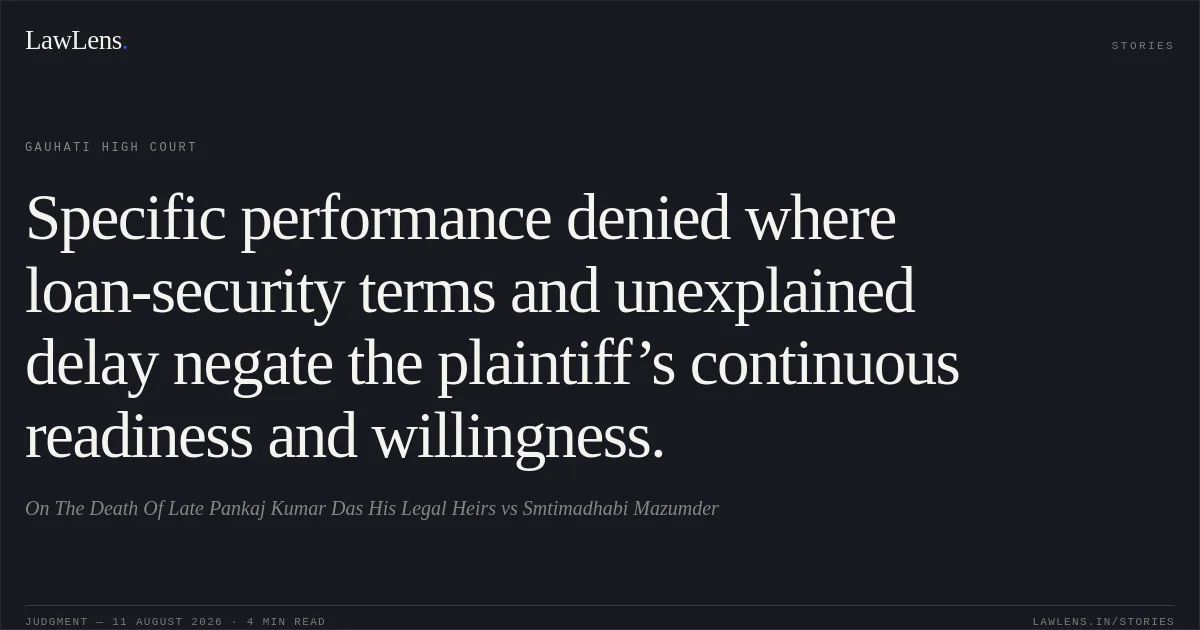
The High Court allowed the second appeal, set aside the judgment and decree of the First Appellate Court, and dismissed the plaintiff’s suit for specific performance.
The Court held that the limitation objection did not succeed, but the plaintiff failed to prove continuous readiness and willingness, financial capacity, and entitlement to the discretionary equitable remedy.
Source reference: p. 50, para. 19As an equitable alternative, the appellants were directed to refund ₹95,000 to the plaintiff within three months, with interest at 9% per annum from 30 Ashin 1414 of the Bengali era.
Source reference: p. 50, para. 19The parties were directed to bear their own costs.
Source reference: p. 50, para. 20Acts & Sections Cited
8 provisions across 3 statutes referred to in this judgment. Each provision opens on LawLens.
Code of Civil Procedure, 19082
Limitation Act, 19631
Specific Relief Act, 19635
Original Court PDF
On The Death Of Late Pankaj Kumar Das His Legal HeirsvsSmtimadhabi Mazumder
Click to open original judgment
Original judgment, available to read, download and summarize on LawLens.in