01Facts
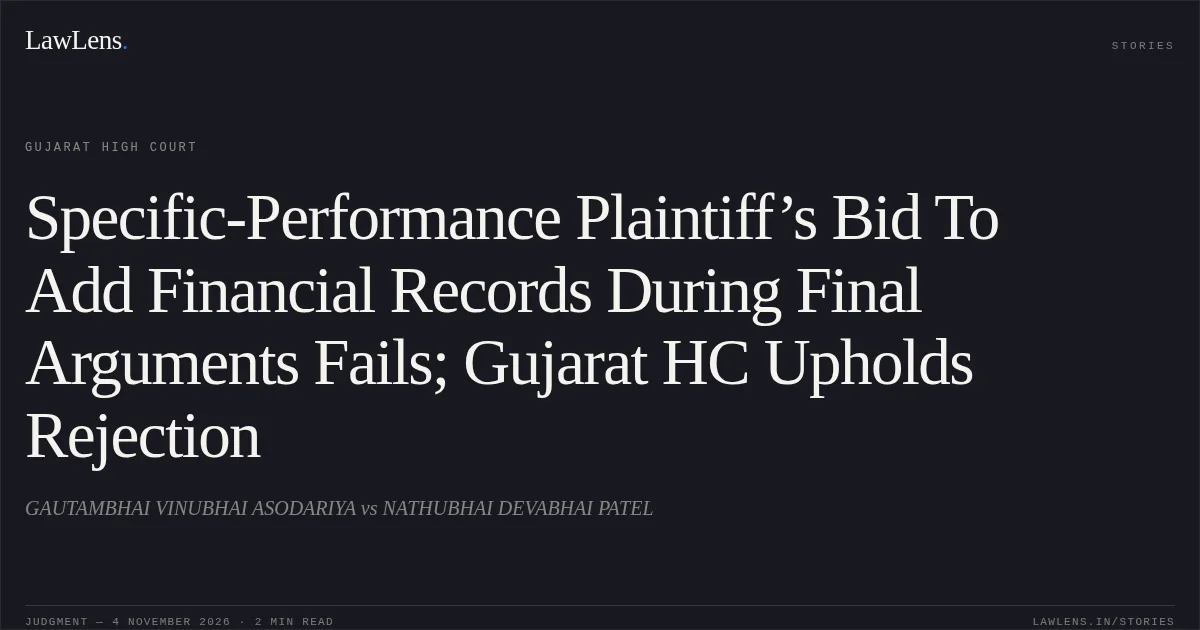
The petitioner, who had brought Special Civil Suit No. 499 of 2014 seeking specific performance of an agreement to sell, applied at the final-hearing stage to place financial documents on record.
pp. 2–3, 5–6 · ¶ 3–4.3, 7–9He said the documents would demonstrate his readiness and willingness to discharge obligations that his vendor, defendant No. 2, had not performed.
pp. 2–3, 5–6 · ¶ 3–4.3, 7–9The trial court rejected the application, finding it belated and that it would reopen the evidence and prejudice the original owner.
pp. 2–3, 5–6 · ¶ 3–4.3, 7–9The petitioner challenged that order under Article 227 of the Constitution.
pp. 2–3, 5–6 · ¶ 3–4.3, 7–902Issues
i.1. Whether the trial court erred in rejecting the petitioner’s application to produce financial documents at the final-hearing stage
pp. 5–7 · ¶ 7–10ii.2. Whether the trial court’s order disclosed perversity, gross error, or another basis for interference under Article 227 of the Constitution
pp. 9–10 · ¶ 13–1403Law Applied
Article 227 supervisory jurisdiction is exercised sparingly; interference is warranted where the impugned order is perverse, contrary to settled legal principles, or affected by an egregious error, and not merely because another view is possible (*Sameer Suresh Gupta v. Rahul Kumar Agarwal* and *M/s Garment Craft v. Prakash Chand Goel*)
pp. 8–9 · ¶ 11, quoting *Ashish Kantibhai Pithva*Although procedural rules are handmaids of justice and a matter should not be rejected on hyper-technical grounds, applications to reopen evidence or introduce further material after adequate opportunity has been afforded require justifiable and compelling reasons; courts should avoid unnecessary reopening that may delay proceedings or fill evidentiary lacunae (*Bagai Construction*, as quoted in *Ashish Kantibhai Pithva*)
pp. 7–8 · ¶ 11The Court considered the petitioner’s cited decisions, *Sugandhi (Dead) by LRs v. P. Rajkumar* and *Levaku Pedda Reddamma v. Gottumukkala Venkata Subbamma*, but held them inapplicable to these facts
p. 3, 7 · ¶ 4.4, 10Provisions in the judgment · 1 · Linked ones open on LawLens
Code of Civil Procedure, 1908 Section 151
04Reasoning
The petitioner knew that his vendor had not come forward to give evidence, yet did not seek to establish at the relevant time that he was ready and willing to perform the vendor’s obligations; he offered no reasonable explanation for waiting until after completion of the trial to apply
p. 6 · ¶ 8Allowing the application would require further evidence at the final-hearing stage, risk prejudice to the original owner, and permit the petitioner to fill a gap in his evidence
pp. 6–7 · ¶ 9–10The trial court had also afforded opportunities for final hearing, and the petitioner’s history of applications and withdrawn petitions supported the concern that the proceedings were being delayed
p. 5, 9 · ¶ 7, 12The High Court therefore found no perversity or gross error warranting supervisory intervention
p. 10 · ¶ 1305Holding
The High Court answered the issues against the petitioner.
p. 10 · ¶ 13–14It held that the trial court had correctly rejected the late application and that no ground for interference under Article 227 was established.
p. 10 · ¶ 13–14The petition was dismissed, with no order as to costs
p. 10 · ¶ 13–14Original Court PDF
GAUTAMBHAI VINUBHAI ASODARIYAvsNATHUBHAI DEVABHAI PATEL
Click to open original judgment
Original judgment, available to read, download and summarize on LawLens.in