Facts
The appellant (original plaintiff) filed a Special Civil Suit for specific performance of a registered agreement to sell dated 07.10.2013 executed by defendant Nos. 1 and 2 regarding "new tenure" land.
Source reference: para 3-3.1At the time of execution, the land was restricted under Section 62 of the Gujarat Land Revenue Code and Section 43 of the Tenancy Act.
Source reference: para 3.1, 15Subsequently, the defendants sold the land to defendant No. 3 via a registered sale deed on 04.02.2020, after the land was converted to "old tenure" and premium was paid.
Source reference: para 3.2Defendant No. 3 filed applications under Order VII Rule 11 of the CPC (Exhs. 20 and 36), arguing the suit was barred by law because the underlying agreement to sell concerned new tenure land without prior statutory permission.
Source reference: para 3.4The trial court allowed the applications and rejected the plaint.
Source reference: para 3.5Issues
Whether the trial court erred in concluding that the agreement to sell is hit by Section 43 of the Gujarat Tenancy and Agriculture Lands Act, 1948, and whether the plaint is liable to be rejected under Order VII Rule 11 of the CPC.
Source reference: para 7Law Applied
Section 43 of the Gujarat Tenancy and Agricultural Lands Act, 1948, which restricts the transfer of restricted tenure land without the prior sanction of the Collector.
Source reference: para 3.4, 15The Larger Bench decision in Decd Shaikh Ismailbhai Hushainbhai Through Lh v. Vankar Ambalal Dhanabhai (2024), which held that a suit for specific performance based on an agreement hit by Section 43 is not maintainable and the plaint is liable for rejection under Order VII Rule 11.
Source reference: para 13-14The principles from Dahiben v. Arvindbhai Bhanusali (2020) regarding the rejection of a plaint where no valid cause of action arises from an illegal or invalid agreement.
Source reference: para 14Reasoning
The Court observed that at the time the agreement to sell was executed (2013), the suit land was admittedly "new tenure" land.
Source reference: para 9, 15Under Section 43(1) of the Tenancy Act, any transfer or agreement to transfer such land without prior permission is invalid.
Source reference: para 11-12The Court rejected the appellant's argument that Section 63 applied instead of Section 43, noting that the Collector’s conversion order specifically referenced Section 43.
Source reference: para 11-12Following the Larger Bench ratio in Shaikh Ismailbhai, the Court reasoned that the Civil Court has the jurisdiction to determine at the threshold whether an agreement is forbidden by law.
Source reference: para 138-139Since the agreement was hit by a statutory restriction at its inception, it was void, and no cause of action for specific performance could arise.
Source reference: para 151The subsequent conversion of the land to "old tenure" in 2020 did not cure the initial illegality of the 2013 agreement.
Source reference: para 15-16Holding
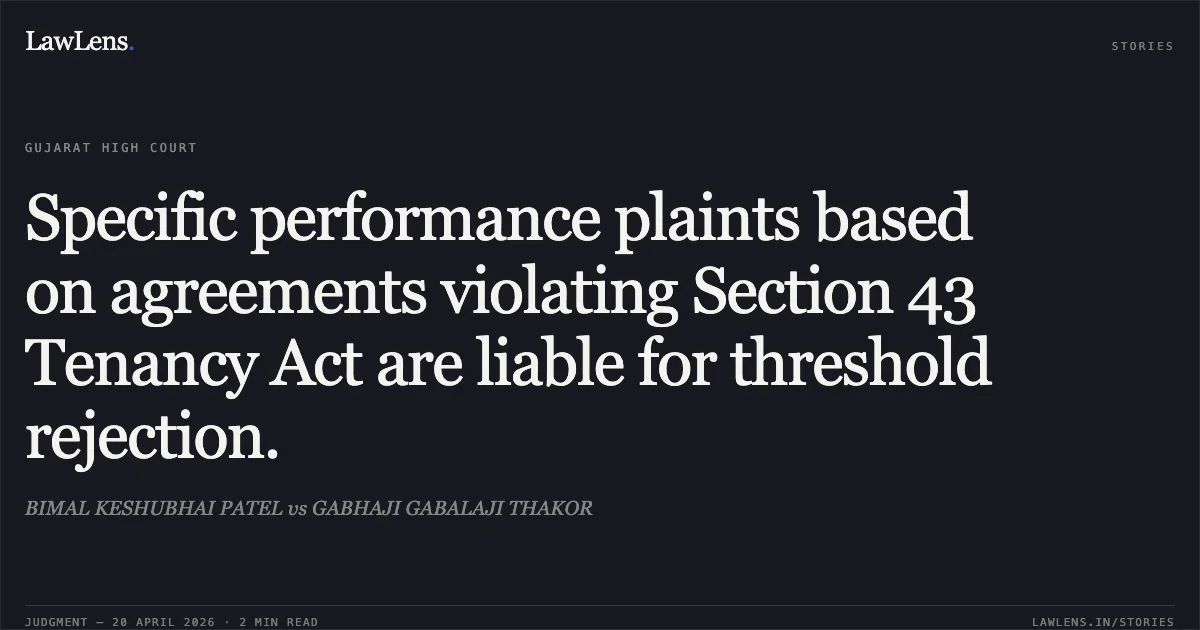
The High Court answered the issue in the negative, holding that the trial court was justified in rejecting the plaint under Order VII Rule 11 of the CPC as the suit was based on an invalid agreement hit by Section 43 of the Tenancy Act.
The appeal was dismissed, and the trial court's judgment and decree were upheld.
Source reference: para 17All pending civil applications were disposed of accordingly.
Source reference: para 19Acts & Sections Cited
5 provisions across 2 statutes referred to in this judgment. Each provision opens on LawLens.
Code of Civil Procedure, 19082
Bombay Tenancy and Agricultural Lands Act-19483
Original Court PDF
BIMAL KESHUBHAI PATELvsGABHAJI GABALAJI THAKOR
Click to open original judgment
Original judgment, available to read, download and summarize on LawLens.in


![Subsequent exoneration does not retrospectively invalidate a finalized promotion select list.. UNNIKRISHNAN M vs M/o Environment And Forests. CAT - ['Ernakulam']. LawLens](/stories/thumbnails/subsequent-exoneration-does-not-retrospectively-invalidate-a-finalized-promotion-select-li-ce80a0e84f2f4887857271e8b4341c42.webp)