Facts
The defendant claimed ownership of land measuring 1 Katha 17 Lechas at Khanapara, Guwahati, on which he had constructed an incomplete G+3 building.
Source reference: no citationThe plaintiff alleged that, on 10 October 2013, the parties executed an agreement for sale for ₹1 crore, pursuant to which he paid ₹90 lakhs and obtained possession; the defendant was allegedly required to obtain sale permission and execute the sale deed but failed to do so.
Source reference: pp.3–4The defendant denied executing the agreement, receiving the money, or delivering possession, alleging that the plaintiff had forcibly entered and dispossessed him in May 2014.
Source reference: pp.5–6He filed a counterclaim seeking declaration of his title, a declaration that the agreement was forged and non-binding, and recovery of khas possession.
Source reference: p.6The trial court dismissed the plaintiff’s suit and partly allowed the counterclaim by holding the agreement dated 10 October 2013 void and non-binding, but declined to declare the defendant’s title.
Source reference: p.8Both parties appealed under Section 96 CPC: the defendant challenged the refusal to fully decree his counterclaim, while the plaintiff challenged dismissal of his suit.
Source reference: pp.8–16Issues
1. Whether the plaintiff proved the execution and existence of a valid agreement for sale dated 10 October 2013 so as to claim specific performance?
Source reference: p.20, para. 11(I)2. Whether the plaintiff proved payment of ₹90 lakhs to the defendant as earnest money?
Source reference: p.20, para. 11(II)3. Whether the trial court erred in refusing to fully decree the defendant’s counterclaim for declaration of title and consequential relief, despite the plaintiff’s admission of the defendant’s ownership?
Source reference: p.20, para. 11(III)Law Applied
The Court applied Section 96 CPC governing first appeals, and the principles under Sections 16(c), 20, 21, 22 and 23 of the Specific Relief Act, 1963, under which specific performance requires proof of a valid and concluded contract, the plaintiff’s readiness and willingness, performance or substantial compliance with his obligations, and entitlement to equitable relief.
Source reference: pp.21–22, para. 12Relying on Kamal Kumar v. Premlata Joshi, (2019) 3 SCC 704, the Court held that proof of a valid contract is the foundational requirement for specific performance.
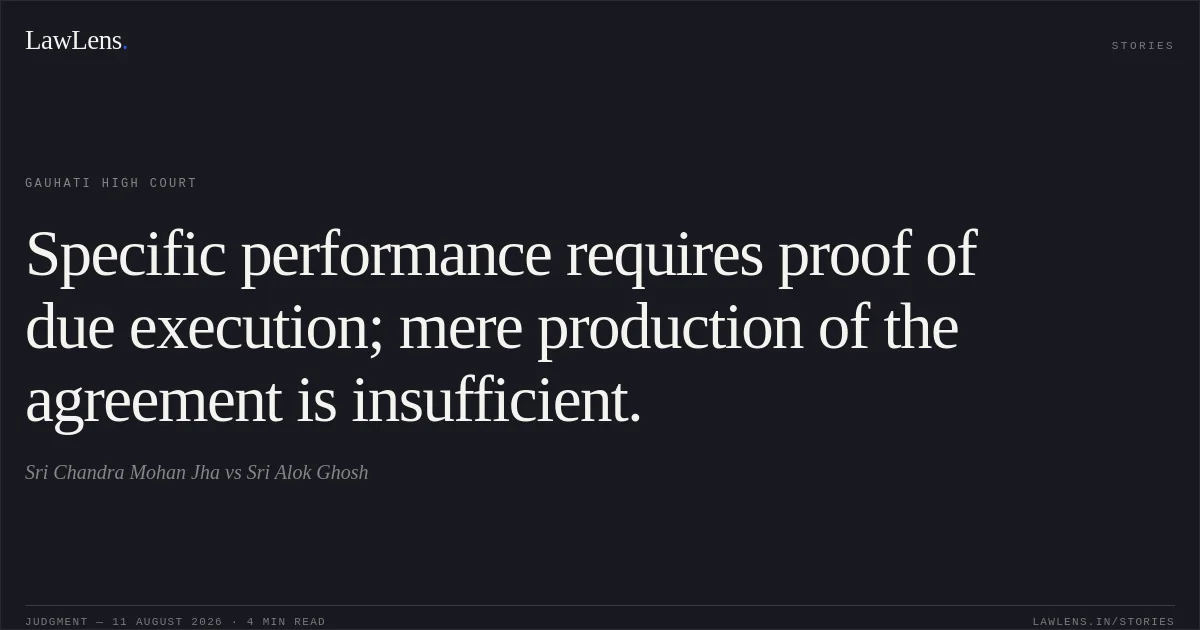
Source reference: pp.21–22, para. 12Under Sections 101 and 102 of the Evidence Act, the initial burden lies on the party asserting the existence of the contract; mere production of the document does not establish its due execution.
Source reference: pp.24–25, paras. 14.2–14.5The Court relied on Anil Rishi v. Gurbaksh Singh, (2006) 5 SCC 558, for the rule that the plaintiff must first establish his case.
Source reference: p.24, para. 14.3Section 58 of the Evidence Act makes admitted facts unnecessary to prove, and judicial admissions in pleadings are binding and may independently found a decision, as explained in Nagindas Ramdas v. Dalpatram Ichharam, AIR 1974 SC 471.
Source reference: pp.28–29, paras. 16.3–16.4Although Section 73 permits comparison of disputed signatures, the Court held that such comparison would not cure the plaintiff’s failure to establish due execution through admissible evidence.
Source reference: p.25, para. 14.5The Court also considered the defendant’s additional electronic copy of the sale deed under Order XLI Rule 27 CPC and the certificate under Section 63 of the Bharatiya Sakshya Adhiniyam, 2023.
Source reference: pp.29–30, paras. 16.5–16.7Reasoning
The Court upheld the finding that the plaintiff failed to prove the agreement dated 10 October 2013.
Source reference: no citationThe defendant specifically denied his signature and execution, while the plaintiff and PW-2 admitted that neither had seen the defendant sign the document.
Source reference: pp.23–24, paras. 14–14.2The original agreement’s production was insufficient because its execution remained unproved; consequently, the plaintiff failed to establish the essential contractual foundation for specific performance.
Source reference: p.25, para. 14.5The claim for payment of ₹90 lakhs also lacked reliable proof: the plaintiff did not produce relevant bank statements, admitted uncertainty regarding the amount paid on the alleged date of execution, and the money receipts relied upon were dated 12 January 2013 and 21 March 2013—months before the alleged agreement.
Source reference: pp.25–27, paras. 15.1–15.3The Court therefore found no error in rejecting both the specific-performance claim and the claim based on payment.
Source reference: p.27, para. 15.4As to the counterclaim, the plaintiff had expressly pleaded that the defendant was the “absolute owner and possessor” of the property; this judicial admission dispensed with the need for further proof of that fact.
Source reference: pp.28–29, paras. 16.2–16.4In addition, the defendant’s e-copy of the 5 March 2012 sale deed was admitted in appeal under Order XLI Rule 27 CPC, supported by the statutory certificate, and was not disputed by the plaintiff.
Source reference: pp.29–30, paras. 16.5–16.10The trial court consequently erred in refusing to grant the defendant full relief on the counterclaim.
Source reference: no citationHolding
RFA No. 111/2019, filed by the plaintiff, was dismissed because the plaintiff failed to prove execution of the agreement for sale or payment of ₹90 lakhs; specific performance and consequential relief were therefore unavailable.
RFA No. 73/2019, filed by the defendant, was allowed.
Source reference: p.31, para. 19The trial court’s partial rejection of the counterclaim was set aside, and the defendant’s counterclaim was decreed in full, including declaration of his right, title and interest and the consequential reliefs claimed.
Source reference: p.31, para. 19The Court also discharged the Receiver appointed during the appeal proceedings.
Source reference: p.31, para. 20Acts & Sections Cited
14 provisions across 4 statutes referred to in this judgment. Each provision opens on LawLens.
Code of Civil Procedure, 19084
Indian Penal Code, 18604
Specific Relief Act, 19635
Bharatiya Sakshya Adhiniyam, 20231
Original Court PDF
Sri Chandra Mohan JhavsSri Alok Ghosh
Click to open original judgment
Original judgment, available to read, download and summarize on LawLens.in