Facts
Dhakshinamoorthy sued for declaration of title, recovery of possession and removal of sheds, relying on his Government assignment patta.
Source reference: no citationThe defendants relied on a 4 January 1978 sale agreement, contending that possession had been delivered and the balance consideration paid; they sought specific performance by counterclaim.
Source reference: no citationThe trial court dismissed the suit and allowed the counterclaim, but the first appellate court reversed those orders and granted Dhakshinamoorthy relief. The defendants appealed under Section 100 CPC.
Source reference: paras. 2–5, 8–10Issues
1. Whether the defendants proved long-standing possession, including by evidence of cultivation, improvements and payment of taxes.
Source reference: para. 132. Whether the disputed recital in the sale agreement recording delivery of possession was a later insertion.
Source reference: paras. 10, 14–153. Whether the defendants were ready and willing to perform the agreement and were entitled to specific performance.
Source reference: paras. 12, 16–204. Whether possession had been delivered to the defendants and whether Dhakshinamoorthy was entitled to declaration, recovery of possession and removal of the sheds.
Source reference: paras. 12, 215. Whether the sale agreement had lapsed or been cancelled for failure to pay the balance consideration by the stipulated date.
Source reference: paras. 12, 22Law Applied
The appeals were brought under Section 100 of the Code of Civil Procedure, which confines second appeals to substantial questions of law.
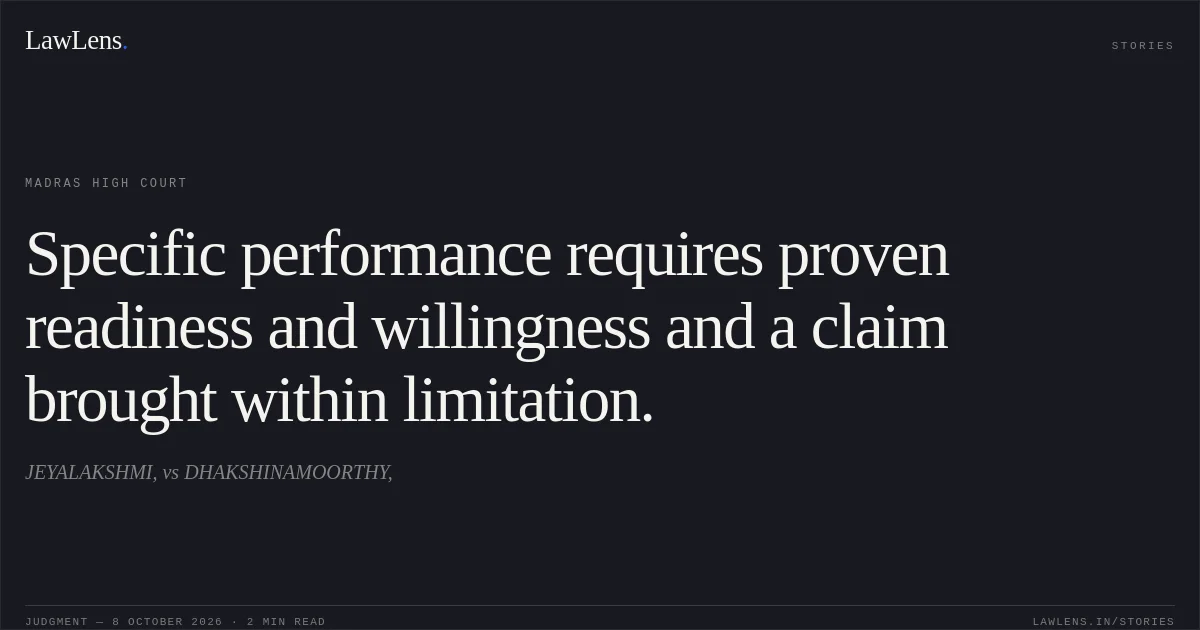
Source reference: prayer; paras. 2, 10The Court assessed the claim for specific performance by examining the contractual deadline and the defendants’ proof of payment, readiness and willingness; it applied a three-year period for bringing a specific-performance suit.
Source reference: paras. 15–19It treated the agreement’s terms, the parties’ documentary and oral evidence, and the handwriting expert’s opinion as relevant to whether possession had been delivered and whether the disputed recital was genuine.
Source reference: paras. 13–15Reasoning
The defendants produced only one kist receipt for the period before the 1999 suit and no supporting records for the alleged well, motor, bank loan or extended agricultural possession. The Court found their later tax and electricity documents insufficient to establish possession from 1978.
Source reference: para. 13It accepted the expert’s opinion that the disputed possession recital used different ink and also considered its wording and appearance evidence of later insertion.
Source reference: paras. 14–15The defendants produced no receipt for the alleged balance payment, had not demanded execution by notice, and had not sued for specific performance within three years; the Court therefore found neither payment nor readiness and willingness proved.
Source reference: paras. 16–20It concluded that the agreement’s deadline and forfeiture clause, together with non-payment, meant the agreement had lapsed and possession had not been delivered under it.
Source reference: paras. 21–22Holding
The Court answered the additional questions on specific performance, readiness and willingness, and delivery of possession against the defendants, and upheld Dhakshinamoorthy’s entitlement to declaration, possession and removal of the sheds.
It confirmed the first appellate court’s judgments and set aside the trial court’s judgment.
Source reference: para. 24It nevertheless directed Dhakshinamoorthy to pay the defendants ₹3,50,000 within one month; upon receipt, the defendants were to vacate and hand over the premises, with execution available if the direction was not complied with.
Source reference: para. 23Both second appeals were disposed of without costs.
Source reference: para. 25Acts & Sections Cited
1 provisions across 1 statute referred to in this judgment. Each provision opens on LawLens.
Code of Civil Procedure, 19081
Original Court PDF
JEYALAKSHMI,vsDHAKSHINAMOORTHY,
Click to open original judgment
Original judgment, available to read, download and summarize on LawLens.in