Facts
The Appellant (Plaintiff) entered into an Agreement to Sell (ATS) dated 24.08.2004 with the Respondents for property in Naraina Industrial Area for ₹95 lakhs
Source reference: p.2The Appellant paid ₹25 lakhs as earnest money, with a later endorsement of an additional ₹10 lakhs for possession of the first floor
Source reference: p.3The date for execution was extended to 31.03.2005 to allow the Respondents to mutate the property
Source reference: p.4Following a series of criminal complaints and civil suits regarding the validity of the sellers' title/Will, the Respondents issued a termination notice on 01.04.2005
Source reference: p.4-7In 2008, the Appellant filed for Specific Performance
Source reference: p.9During the trial (at the stage of evidence), the Trial Court dismissed the suit under Order XII Rule 6 CPC on the ground that the Appellant had not sought a declaration to challenge the termination notice of 01.04.2005
Source reference: p.16-18Issues
1. Whether a suit for specific performance is maintainable without seeking a specific declaration to challenge the unilateral termination of the Agreement to Sell.
Source reference: p.22 / para. 892. Whether the Trial Court was justified in dismissing the suit under Order XII Rule 6 CPC on "admissions" when the validity of the termination was a disputed issue of fact.
Source reference: p.28 / para. 109-110Law Applied
The Court applied Order XII Rule 6 of the CPC, which allows for judgment on admissions only where admissions are clear, unambiguous, and unconditional
Source reference: p.16, 28Section 16 of the Specific Relief Act regarding 'readiness and willingness'
Source reference: p.26The Court relied on Chand Rani v. Kamal Rani and Saradamani Kandappan v. S. Rajalakshmi, which establish that time is not ordinarily of the essence in immovable property contracts unless expressly intended.
Source reference: p.27The Court interpreted I.S. Sikander v. K. Subramani in light of A. Kanthamani v. Nasreen Ahmed and Annamalai v. Vasanthi, which clarify that I.S. Sikander does not create an absolute bar to specific performance if the validity of termination is itself a triable issue.
Source reference: p.29, 31, 32Reasoning
The Court reasoned that the Trial Court erred by treating the Respondents' unilateral termination as an absolute fact that necessitated a declaratory relief.
Source reference: p.26Since the Trial Court had already framed Issue No. 5 specifically asking "Whether the Agreement... was cancelled or terminated", it was contradictory to later dismiss the suit summarily without evidence.
Source reference: p.25, 34The Court noted that in I.S. Sikander, the property had already been sold to a third party, whereas here, the Appellant never accepted the repudiation nor took back the earnest money.
Source reference: p.33-34The Court found that "readiness and willingness" and the "legality of termination" are intrinsically linked and inbuilt into the relief of specific performance; therefore, a separate formal prayer for declaration is not always mandatory if the termination is disputed.
Source reference: p.33Consequently, there were no "unequivocal admissions" to trigger Order XII Rule 6.
Source reference: p.28, 35Holding
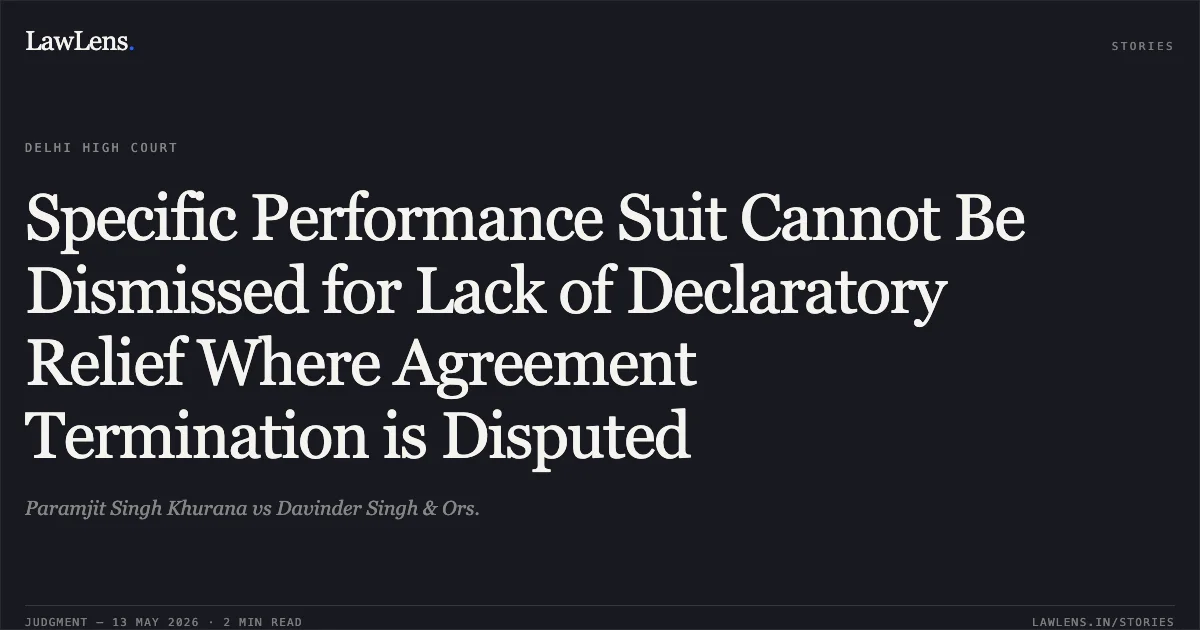
The High Court held that the requirement for seeking a declaratory relief against termination is not an inflexible rule and depends on the factual matrix of the case.
The High Court allowed the appeal, set aside the judgment dated 20.12.2023, and remanded the matter to the Trial Court (Patiala House Courts) to proceed with the trial on merits from the stage of evidence.
Source reference: p.36Acts & Sections Cited
1 provisions across 1 statute referred to in this judgment. Each provision opens on LawLens.
Code of Civil Procedure, 19081
Original Court PDF
Paramjit Singh KhuranavsDavinder Singh & Ors.
Click to open original judgment
Original judgment, available to read, download and summarize on LawLens.in