Facts
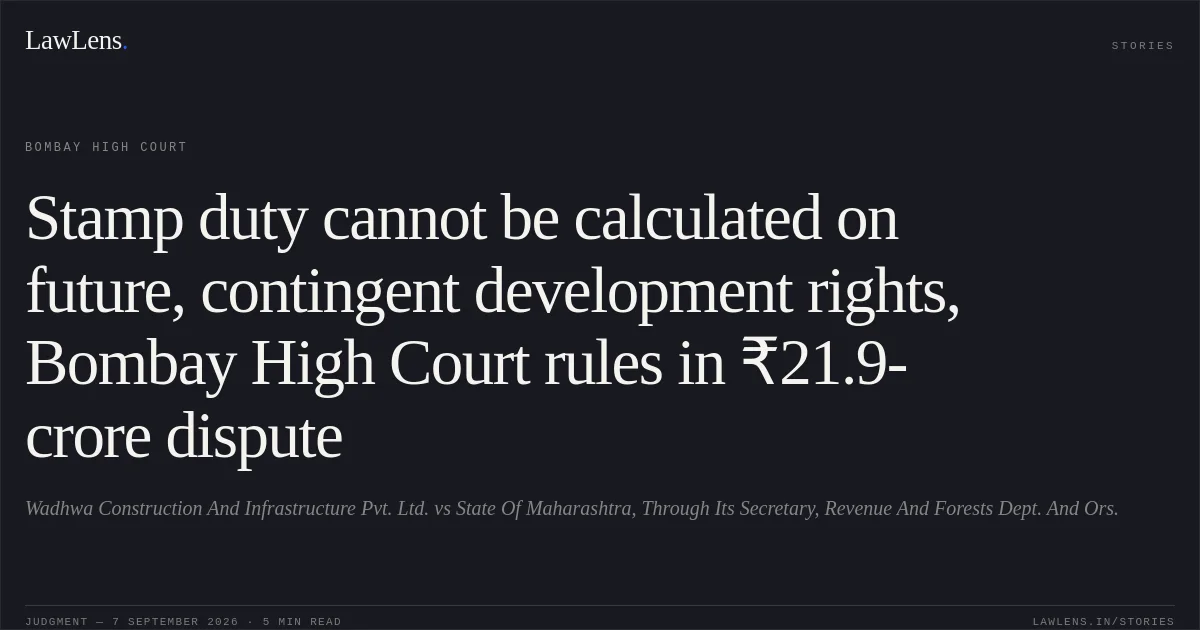
Valuable Properties Pvt. Ltd. (“VPPL”) and Wadhwa Constructions & Infrastructure Pvt. Ltd. entered into a Joint Development Agreement (“JDA”) dated 18 February 2014 concerning development rights over approximately 298 acres of land in the First Schedule and approximately 50.23 acres in the Second Schedule.
Source reference: paras. 2, 58–63The Petitioners paid stamp duty of ₹15.67 crore on the JDA. The Collector of Stamps subsequently determined that the total stamp duty payable was ₹37.69 crore and demanded a deficit of ₹22.02 crore.
Source reference: paras. 3–6On appeal, the Deputy Inspector General of Registration reduced the deficit to ₹21,92,99,814 and issued a demand notice.
Source reference: paras. 3–6The Petitioners challenged the Collector’s order, the appellate order, and the consequential demand notice under Articles 226 and 227 of the Constitution.
Source reference: para. 1Issues
Whether the JDA created present development rights attracting stamp duty under Article 5(g-a)(i) of the Maharashtra Stamp Act, or whether it was merely an executory and contingent arrangement?
Source reference: paras. 47–59, 96–99(i), (xi)Whether the 50.23 acres covered by the Second Schedule and the additional development rights dependent on the Swap Notice could be treated as presently transferred rights for valuation on 18 February 2014?
Source reference: paras. 60–64, 67–68, 99(ii)–(iv)Whether the authorities were entitled to adopt future or maximum FSI, rather than the FSI available on the date of execution?
Source reference: paras. 69–72, 99(v)–(vi)Whether the contractual 1.5 factor for determining “Saleable Area” could be used as the statutory ASR conversion factor instead of the applicable 1.2 factor?
Source reference: paras. 65–66, 73–74, 99(vii)Whether the construction component was required to be valued at the stipulated construction rate of approximately ₹8,500 per sq. metre or at the residential sale rate of approximately ₹24,000 per sq. metre?
Source reference: paras. 75–76, 99(viii)Whether the revenue-sharing provision under Clause 7.1 constituted present consideration for the development rights, despite the deferred and conditional nature of the revenue entitlement?
Source reference: paras. 77–89, 99(ix)Whether the parking requirement could be calculated by including development potential arising from the Swap Notice or other future contingencies?
Source reference: para. 90, 99(x)Law Applied
The Court applied Article 5(g-a)(i) of Schedule I to the Maharashtra Stamp Act, 1958, under which an instrument granting authority or power to a promoter or developer for construction, development, sale, or transfer of immovable property attracts duty equivalent to conveyance duty on the market value of the property.
Source reference: paras. 57, 96–97The Court read this provision with the statutory concept of “market value” under Section 2(na), the valuation framework under Section 32A, the Maharashtra Stamp (Determination of True Market Value of Property) Rules, 1995, and the applicable ASR Guidelines.
Source reference: paras. 55–57, 97–100(xiii)–(xv)The governing principle was that stamp duty must be determined from the substance and effect of the instrument as on its date of execution.
Source reference: paras. 47–56The Court also relied on Suhas Damodar Sathe v. State of Maharashtra , 2025 SCC OnLine Bom 576, concerning the substance of development agreements; Shyamsundar Radheshyam Agrawal v. Pushpabai Nilkanth Patil , (2024) 10 SCC 324, concerning development agreements and conveyance-level stamp liability; and Kolte Patil Developers Ltd. , including its review order, for the proposition that deferred revenue sharing may constitute consideration but must be computed with reference to the FSI and development potential available on the date of execution.
Source reference: paras. 51–52, 78–81The Court further applied the strict construction principle applicable to fiscal statutes: consideration or development potential not operative under the instrument on the relevant date cannot be added by implication.
Source reference: paras. 87–89Reasoning
The Court found that the JDA, read with the possession clause and the irrevocable Power of Attorney, created substantial present rights in favour of Wadhwa over the First Schedule land, including possession for development, construction rights, authority to obtain approvals, and authority to execute documents.
Source reference: paras. 58–60However, the Court distinguished those presently operative rights from the Second Schedule rights. Under Clauses 6.1 and 6.2, the Second Schedule land and the corresponding additional development rights became operative only upon VPPL issuing a Swap Notice.
Source reference: paras. 61–68The Court held that the applicable FSI was the FSI actually available on the date of execution. It accepted 0.5 FSI for the relevant G-1 Special Township development, but rejected the use of any higher future or maximum FSI not shown to be available and operative on that date.
Source reference: paras. 69–72It further held that the contractual 1.5 factor used to express “Saleable Area” was not the ASR conversion factor for stamp valuation; the applicable 1.2 factor had to be applied to the relevant carpet area.
Source reference: paras. 65–66, 73–74Similarly, the construction obligation under Clause 3.1.2(ii), valued at approximately ₹8,500 per sq. metre, had to be distinguished from the retail sale price of completed residential premises, approximately ₹24,000 per sq. metre.
Source reference: paras. 75–76Regarding revenue sharing, the Court held that deferred payment does not by itself prevent an amount from constituting consideration.
Source reference: paras. 77–89Nevertheless, Clause 7.1 did not make VPPL unconditionally entitled from the date of execution to 35% of all future gross revenue. Only the revenue entitlement demonstrably connected with the presently granted development rights could be included, and it had to be calculated using the development potential and FSI available on 18 February 2014.
Source reference: paras. 77–89The parking calculation likewise had to be based on the presently operative development area and could not include the Swap Notice scenario or future additional development potential.
Source reference: para. 90Holding
The Petition was allowed.
The Collector’s order dated 19 March 2016 and the appellate order dated 12 July 2016 were quashed to the extent that they adopted the rejected valuation methodology.
Source reference: para. 100(i)–(ii)The Court held that the 298 acres in the First Schedule formed part of the presently operative development arrangement, whereas the 50.23 acres in the Second Schedule and the additional vertical entitlement dependent on the Swap Notice were not presently transferred development rights and could not be valued as vested rights on 18 February 2014.
Source reference: para. 100(iii)–(vii)The competent authority was directed to undertake a fresh valuation under the Maharashtra Stamp Act, applying the FSI available on the execution date, the ASR-prescribed 1.2 conversion factor, the construction rate of approximately ₹8,500 per sq. metre, and a parking basis of 1,750 spaces rather than 3,383 spaces.
Source reference: para. 100(viii)–(xv)Revenue sharing could be included only to the extent that its conditions had become operative and it constituted consideration for the presently granted rights.
Source reference: para. 100(viii)–(xv)The fresh determination was to be completed preferably within twelve weeks, with no coercive steps until completion and for eight weeks thereafter if the determination was adverse.
Source reference: para. 100(xvi)–(xviii)Acts & Sections Cited
5 provisions across 3 statutes referred to in this judgment. Each provision opens on LawLens.
Indian Contract Act, 18721
Maharashtra Regional and Town Planning Act, 1966.2
Original Court PDF
Wadhwa Construction And Infrastructure Pvt. Ltd.vsState Of Maharashtra, Through Its Secretary, Revenue And Forests Dept. And Ors.
Click to open original judgment
Original judgment, available to read, download and summarize on LawLens.in