Facts
The petitioners (Anwar Hussain, Abdul Sukkur, Isfaq Hussain, and Taj Hussain) were named in an FIR dated 19.07.2012 regarding a violent clash that resulted in two deaths
Source reference: p. 3-6Following an investigation, the police submitted a charge sheet against seven individuals but excluded the petitioners due to insufficient evidence
Source reference: p. 7During the trial, two prosecution witnesses (PW-1 and PW-2) provided examination-in-chief depositions attributing general acts of assault to the petitioners
Source reference: p. 7, 10-11Before cross-examination was conducted, the Trial Court invoked Section 319 of the Cr.P.C. and issued summons to the petitioners to face trial as accused
Source reference: p. 7-8The petitioners challenged this order via a criminal revision petition
Source reference: p. 3Issues
1. Whether the Trial Court was justified in summoning the petitioners as additional accused under Section 319 Cr.P.C. solely based on examination-in-chief depositions that lacked corroboration from prior statements recorded under Section 161 Cr.P.C.
Source reference: p. 8-92. Whether the degree of satisfaction required for summoning a person under Section 319 Cr.P.C. was met in light of the materials available on record
Source reference: p. 12-13Law Applied
Section 319 of the Cr.P.C., which empowers the court to proceed against persons appearing to be guilty of an offence
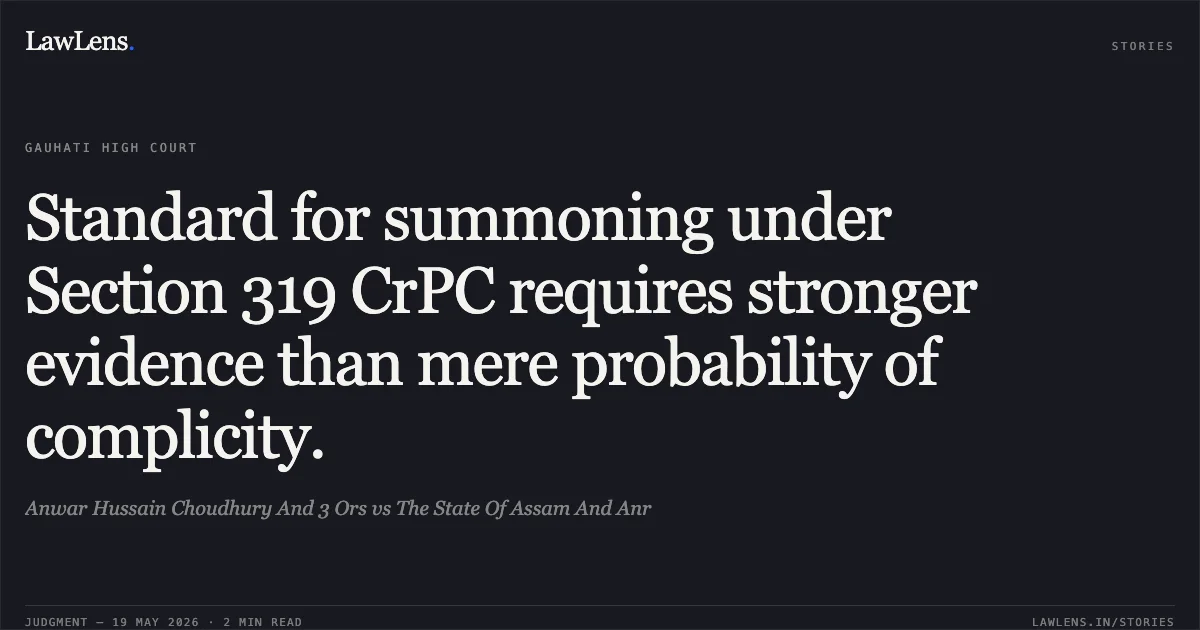
Source reference: p. 2the Constitutional Bench decision in Hardeep Singh v. State of Punjab, which established that the degree of satisfaction for Section 319 is "much stricter" than for a prima facie case at the stage of cognizance; it requires "strong and cogent evidence" higher than a mere probability of complicity
Source reference: p. 8-9principle from Brijendra Singh & Ors. v. State of Rajasthan, which mandates that the trial court must look into the entire material on record, including evidence collected during the investigation (Section 161 statements), and not rely solely on ocular versions in examination-in-chief when forming a prima facie opinion under Section 319
Source reference: p. 13Reasoning
The High Court observed that while the petitioners were named in the FIR, no specific overt acts were attributed to them initially
Source reference: p. 10A comparison of the trial depositions of PW-1 and PW-2 with their previous statements under Section 161 Cr.P.C. revealed that they had failed to mention the petitioners' names or roles during the investigation
Source reference: p. 11The court found that these "new" allegations in the examination-in-chief were uncorroborated by any other material in the case diary
Source reference: p. 12The court reasoned that the Trial Court failed to perform its "duty-bound" task of assessing the totality of the investigation material against the oral testimony to determine if the evidence was strong enough to likely lead to a conviction
Source reference: p. 13Consequently, the available evidence reached only the standard of "mere probability of complicity," which is insufficient for the extraordinary power of Section 319
Source reference: p. 12Holding
The court held that the Trial Court's failure to consider the investigative material (the Section 161 statements) before invoking Section 319 rendered the order unsustainable
The High Court allowed the revision petition and set aside the impugned order dated 16.11.2022 insofar as it related to the four petitioners; however, the court clarified that this judgment does not bar the Trial Court from invoking Section 319 again later in the trial should further evidence emerge to justify such an action
Source reference: p. 14Acts & Sections Cited
12 provisions across 2 statutes referred to in this judgment. Each provision opens on LawLens.
Code of Criminal Procedure, 19732
Original Court PDF
Anwar Hussain Choudhury And 3 OrsvsThe State Of Assam And Anr
Click to open original judgment
Original judgment, available to read, download and summarize on LawLens.in