Facts
The appellant, a contractor, held two earlier PMGSY contracts and three later, separate contracts with CGRRDA.
Source reference: para. 5–10Following an inquiry into the earlier works, the authorities alleged excess payment and ordered recovery of ₹84,17,003 by deductions from amounts payable under the three later contracts.
Source reference: para. 5–10The appellant challenged the deductions, contending that the recovery was made without notice and from contracts unrelated to the alleged overpayment.
Source reference: para. 11The High Court dismissed the writ petitions on the ground that disputed questions of fact could not be determined under Article 226.
Source reference: para. 12The Supreme Court considered the appeals against that decision.
Source reference: para. 13Issues
1. Whether the recovery order dated 27.09.2025 was authorised by the contractual clauses relied upon by the respondents.
Source reference: para. 17(i)2. Whether the recovery satisfied the conditions prescribed by the applicable contractual clause and complied with the principles of natural justice.
Source reference: para. 17(ii)Law Applied
Clause 44.1 of the General Conditions of Contract (GCC) concerns liquidated damages for delay and does not authorise recovery of alleged overpayments.
Source reference: para. 19Clause 53.1(ii) permits cross-contract recovery only in the specified circumstances of termination for fundamental breach of defects-liability or maintenance obligations, after recourse to security and performance security.
Source reference: para. 20Clause 7(iv) of the Integrity Pact permits recovery from amounts due under another contract only where a violation of the pact has first been determined.
Source reference: para. 21.1Clause 38 of the Conditions of Contract allows further recovery for breach only after the breach is ascertained and the contractor is apprised of the allegation.
Source reference: para. 22.1Clause 4.1 of the Special Conditions of Contract (SCC) governs technical-audit recoveries: it requires an opportunity for the contractor to explain, an order of the CEO, CGRRDA, and action initiated and intimated within twelve months of completion; it permits recovery from the audited work’s security deposit or dues.
Source reference: para. 23The Court also applied the principle that an alleged, unadjudicated overpayment is a disputed claim, not an ascertained debt that may be appropriated from sums payable under a separate contract; it relied on Union of India v. Raman Iron Foundry, (1974) 2 SCC 231.
Source reference: para. 25Reasoning
The Court found that the recovery was based on alleged overpayment discovered through technical examination, not delay, so Clause 44.1 did not apply; nor was there a termination for the specified defects-liability or maintenance breach required by Clause 53.1(ii).
Source reference: paras. 19–20.1The recovery order did not invoke the Integrity Pact or record a finding of its violation, and it did not establish a breach or give notice as required for Clause 38.
Source reference: paras. 21.1–22.1Although Clause 4.1 addressed technical-audit recoveries, the respondents did not afford the appellant an opportunity to explain, the order did not show CEO approval, and the clause concerned recovery from the audited work’s security deposit or dues—not deductions from unrelated contracts.
Source reference: para. 23.1The alleged liability remained disputed and unadjudicated; resolving the legality of deductions from sums admittedly payable under separate contracts required construing the contracts, not deciding the underlying factual dispute.
Source reference: paras. 25–27The High Court therefore erred in dismissing the petitions on the basis of disputed facts.
Source reference: paras. 25–27Holding
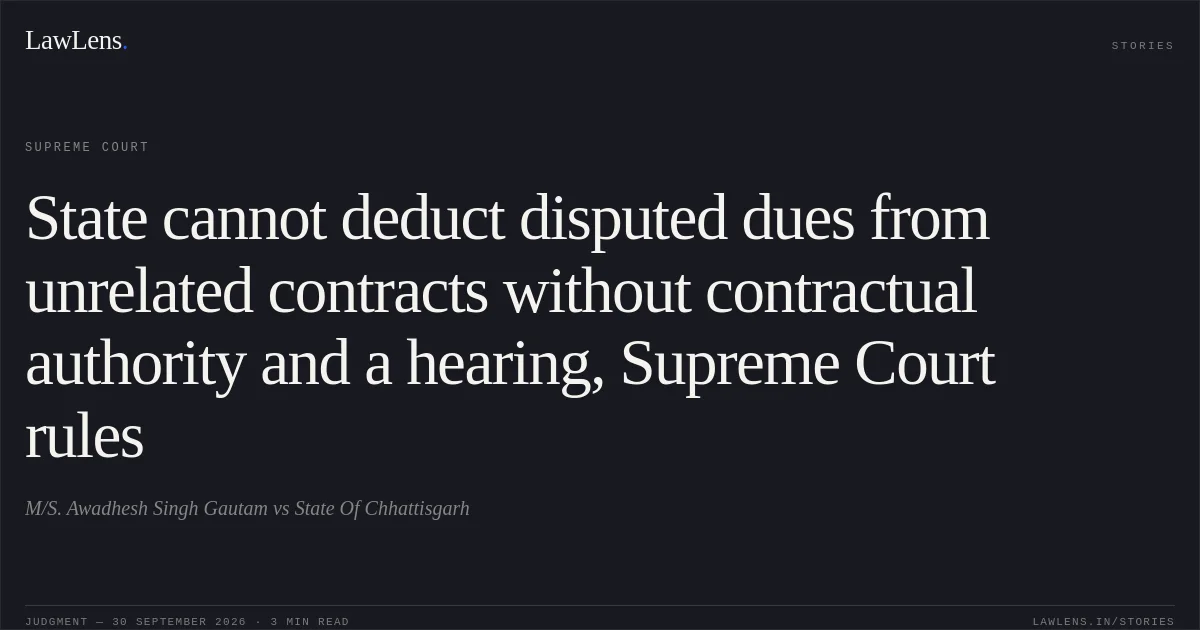
The Supreme Court held that none of the contractual provisions relied upon authorised the deductions in the circumstances or in the manner adopted, and that the recovery violated the contractual conditions and principles of natural justice.
It quashed the recovery order and directed the respondents to release ₹84,17,003 to the appellant with interest at 6% per annum from 27.09.2025 until payment.
Source reference: para. 28The respondents remained at liberty to pursue lawful proceedings to recover any amount ultimately found due in respect of the earlier works; the judgment did not determine the merits of the alleged overpayment or the pending criminal proceedings.
Source reference: para. 29The appeals were allowed, with no order as to costs.
Source reference: para. 30Acts & Sections Cited
5 provisions across 1 statute referred to in this judgment. Each provision opens on LawLens.
Indian Penal Code, 18605
Original Court PDF
M/S. Awadhesh Singh GautamvsState Of Chhattisgarh
Click to open original judgment
Original judgment, available to read, download and summarize on LawLens.in