01Facts
The litigation originated from a PIL filed by S. Raja (Respondent No. 1) alleging illegal encroachments and transactions of "Anadheenam" lands in Thazhambur Village, Tamil Nadu.
¶ 4These lands involved assignments to freedom fighters and later sales to private developers like Casagrand Builder Pvt. Ltd. (Petitioner in SLP 26314/2019).
¶ 4During the High Court proceedings, the State Government constituted an inquiry committee via G.O. Ms. No. 283.
¶ 5Consequently, the Madras High Court disposed of the PIL, holding the purpose was achieved, but vacated an interim status quo order.
¶ 6The State Government appealed to the Supreme Court specifically against the vacating of status quo, and in 2019, the Supreme Court stayed the High Court’s order and reinstated status quo.
¶ 1, 3Over six years, the State failed to finalize its inquiry despite multiple reports, while third-party interests (villas, flats, and educational trusts) were compromised by the lack of basic amenities and stalled registrations.
¶ 8, 15-19, 2102Issues
i.1. Whether the State Government should be permitted to maintain an indefinite status quo order while failing to conclude administrative inquiries and take a final decision.
¶ 14, 21ii.2. Whether a welfare state can retrospectively undo land transactions and assignments made decades ago where significant third-party rights have intervened.
¶ 22iii.3. Whether the contempt petition for alleged violations of the 2019 status quo order was maintainable after the statutory period of limitation.
¶ 2803Law Applied
The Court emphasized the principles of a "welfare State" which precludes the government from arbitrarily turning back the clock after decades to wipe out long-standing land transactions.
¶ 22It applied the principle that fundamental basic amenities (water, sewerage) cannot be denied to bona fide occupants due to pending procedural formalities.
¶ 23Regarding contempt, the Court applied the law laid down in Pallav Sheth v. Custodian and others (2001) 7 SCC 549, which establishes that the limitation for initiating contempt proceedings is ordinarily one year from the date of the alleged commission.
¶ 28Provisions in the judgment · 2 · Linked ones open on LawLens
Code of Civil Procedure, 1908 Section 21
Contempt of Courts Act, 1971 Section 20
04Reasoning
The Court observed that the State utilized the Supreme Court’s process to prolong a status quo order originally intended for a brief inquiry.
¶ 14, 21Despite three inquiry reports (2020-2021) and a subsequent review by a retired High Court Judge, the State remained in "limbo".
¶ 8, 21The Court reasoned that the State’s attempt to claim title over lands decades after issuing pattas (land titles) and allowing development is unjustifiable, especially when innocent citizens have purchased homes.
¶ 22The Court found it unacceptable that the State ignored third-party interests created over the past several decades.
¶ 15, 23It determined that the State’s delay caused undue hardship, effectively denying residents their right to a roof and basic infrastructure under the guise of an open-ended inquiry.
¶ 23-2405Holding
The Supreme Court vacated the interim status quo order dated 21.10.2019 and disposed of the State’s petitions (SLP Nos. 24430-24431 of 2019).
¶ 25The Court granted the State four months to complete the judicial review of the inquiry and a further two months to take a final decision, mandating that the Government respect third-party interests within lawful parameters; further, occupants of the flats/villas must not be denied basic amenities during the finalization process.
¶ 23, 24SLP (C) No. 26314 of 2019 was dismissed as the inquiry was already in progress; SLP (C) Diary No. 2594 of 2021 and the Contempt Petition (Diary) No. 5891 of 2026 were dismissed on the grounds of excessive delay and limitation.
¶ 26, 27-28Original Court PDF
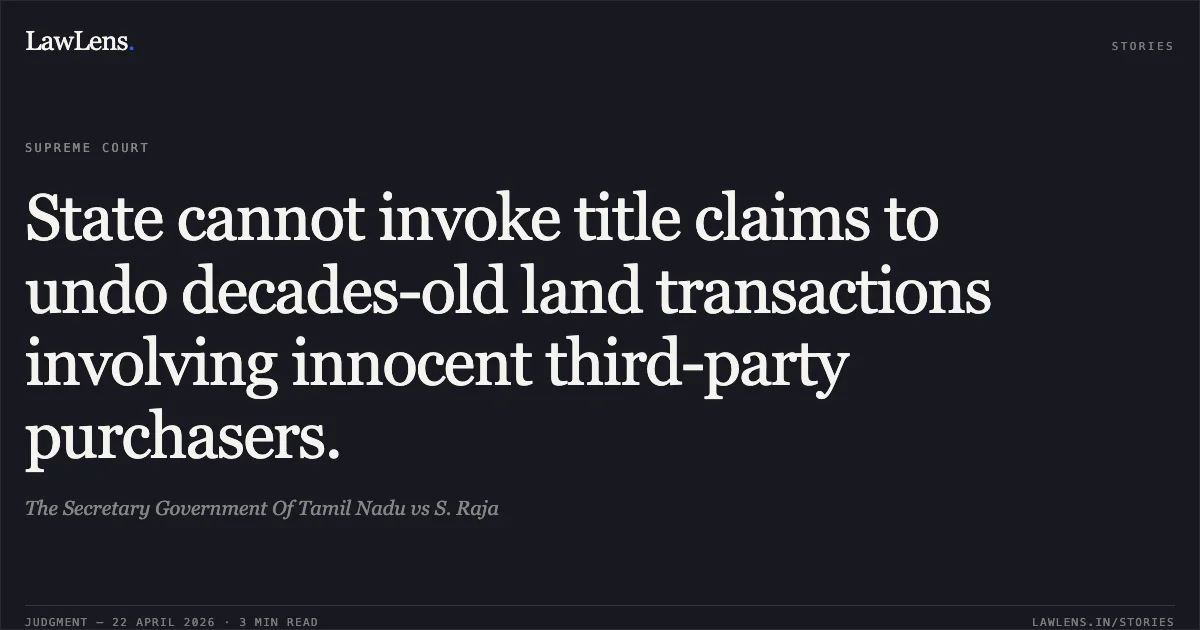
The Secretary Government Of Tamil NaduvsS. Raja
Click to open original judgment
Original judgment, available to read, download and summarize on LawLens.in