Facts
Md. Israil (husband of Petitioner No. 1) was the successful bidder for a five-year sand mining settlement (2015–2019) in Kishanganj
Source reference: p. 3Following a complaint of illegal mining and a subsequent inspection report, the Collector cancelled the settlement on 29.01.2019
Source reference: p. 8On revision, the Mines Commissioner set aside the cancellation on 03.05.2019, finding the allegations based on conjecture and remanding the matter
Source reference: p. 8Upon remand, the Collector restored the settlement on 08.06.2019 after verifying that sand stocks were depleted due to flash floods rather than illegal mining
Source reference: p. 9Despite this restoration, the Mining Department demanded full royalty for the period the lease was cancelled (07.02.2019 to 08.06.2019). The petitioners paid the amount under protest and threat of criminal prosecution
Source reference: p. 10A representation for a pro-rata refund was rejected by the Director of Mines on 20.11.2024 on the grounds that the initial cancellation was "fault-based" and the revisional restoration was merely "lenient"
Source reference: p. 24Issues
1. Whether the State can legally retain royalty/bid amounts for a period during which a settlee was prevented from mining due to a cancellation order that was subsequently set aside on merits
Source reference: p. 3 / para. 42. Whether the respondent authority can supplement or re-interpret the reasons of a quasi-judicial revisional order in a subsequent administrative proceeding
Source reference: p. 25 / para. 28Law Applied
The Court applied the principle from Mohinder Singh Gill v. Chief Election Commr., establishing that the validity of a statutory order must be judged by the reasons mentioned therein and cannot be supplemented by fresh reasons later
Source reference: p. 25It followed the doctrine of actus curiae neminem gravabit (an act of the court shall prejudice no man), as seen in Chitra v. State of Kerala, which held that licensees are entitled to pro-rata remission of fees if precluded from business for reasons not attributable to them
Source reference: p. 31The Court further relied on Jai Durga Finvest (P) Ltd. v. State of Haryana, regarding the frustration of contracts in mining leases
Source reference: p. 28The Court relied on Beg Raj Singh v. State of U.P., which held that a successful party should be placed in the same position they would have occupied had the wrong not been committed
Source reference: p. 35Reasoning
The Court observed that the cancellation order dated 29.01.2019 lost its legal foundation once it was set aside by the Mines Commissioner and the settlement was restored on merits by the Collector
Source reference: p. 27, 42The Court rejected the respondent's attempt to characterize the revisional order as "lenient," holding that an authority cannot recast a quasi-judicial order to justify retaining funds
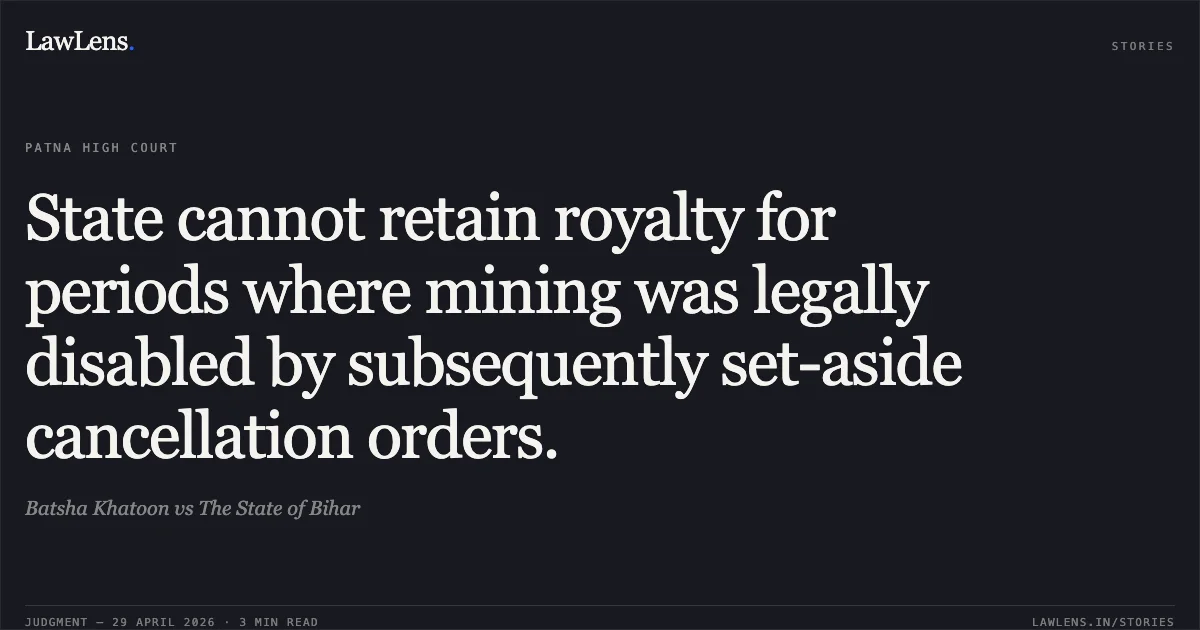
Source reference: p. 26It reasoned that royalty is fundamentally tied to the right to extract and remove minerals; since the settlee was legally disabled from operating between 07.02.2019 and 08.06.2019 due to an unsustainable state action, the state’s demand for royalty for that interregnum constituted "unjust enrichment"
Source reference: p. 41-42The Court further noted that payments made under "protest and fear of criminal prosecution" do not waive the right to a refund
Source reference: p. 44Holding
The Court allowed the writ petition and quashed the order dated 20.11.2024. It held that the petitioners are entitled to a refund of the bid amount on a pro-rata basis for the period they were precluded from mining.
The Court directed the respondents to: (i) quantify the refund amount for the period 07.02.2019 to 08.06.2019 after a hearing within eight weeks and (ii) pay compensatory simple interest at 6% per annum on the quantified amount.
Source reference: p. 44-45Acts & Sections Cited
1 provisions across 1 statute referred to in this judgment. Each provision opens on LawLens.
Environment (Protection) Act, 19861
Original Court PDF
Batsha KhatoonvsThe State of Bihar
Click to open original judgment
Original judgment, available to read, download and summarize on LawLens.in


