Facts
The petitioners were appointed as Chairpersons/Members of Child Welfare Committees (CWC) and Juvenile Justice Boards (JJB) under the J&K Juvenile Justice Act, 2013, for a three-year term
Source reference: p. 1-2Following the J&K Reorganization Act, 2019, the 2013 Act was repealed and replaced by the Central Juvenile Justice Act, 2015
Source reference: p. 2Although their initial term expired on August 24, 2022, the petitioners continued to discharge their duties until March 28, 2023, on the strength of interim orders passed by the High Court in WP(C) No. 1742/2022 and related litigation
Source reference: p. 2-3After their writ petition was dismissed on March 28, 2023, the petitioners ceased to function
Source reference: p. 3The respondents subsequently rejected the petitioners' claim for remuneration for the period worked (August 25, 2022, to March 28, 2023) via Order No. 92-MV of 2024, citing the lack of a valid contract or formal extension
Source reference: p. 3-4Issues
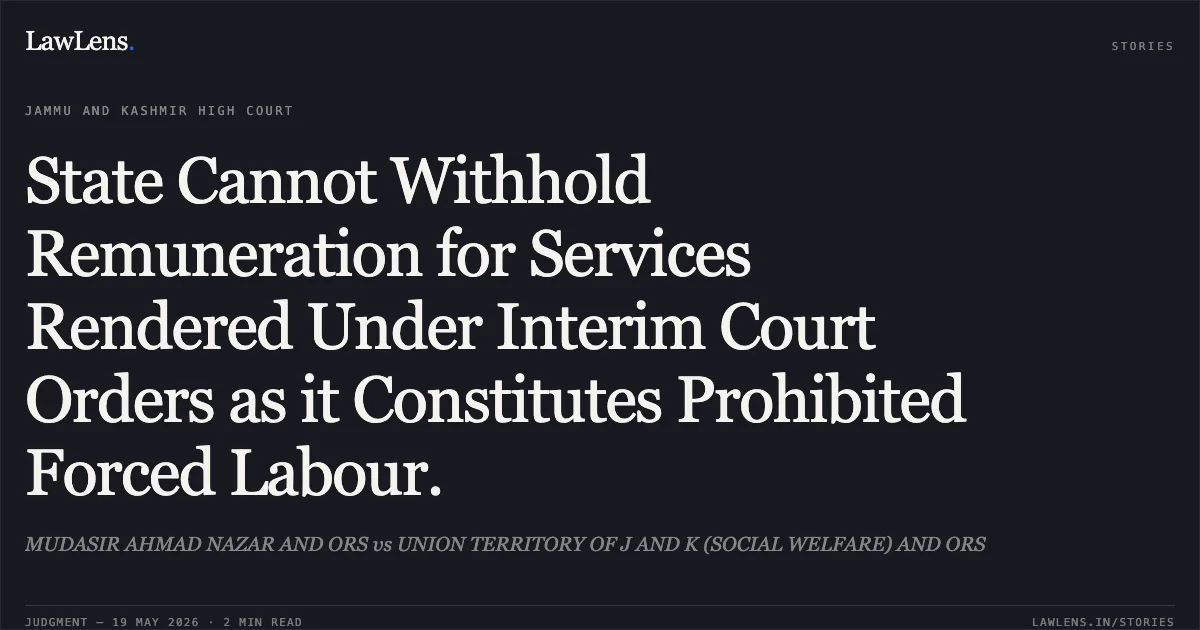
Whether the respondents are legally justified in denying remuneration/salary to the petitioners for the period they discharged their functions on the strength of an interim order passed by the Court
Source reference: p. 5Law Applied
The Court primarily applied Article 21 of the Constitution of India, which guarantees the right to livelihood
Source reference: p. 6It further relied on Article 23 of the Constitution, which prohibits ‘begar’ (forced labor without remuneration)
Source reference: p. 6The Court also took cognizance of the principles established by the Division Bench in PIL No. 09/2013, which recognized that CWC and JJB members continuing under status quo orders exercise all valid powers under the JJ Act of 2015
Source reference: p. 5Reasoning
The court reasoned that the factual performance of duties by the petitioners is undisputed
Source reference: p. 5It noted that a Division Bench of the same Court had previously recognized the legal validity of the functions performed by these committees while they were in position via interim orders
Source reference: p. 5The Court found the respondents' argument—that the absence of a contract or formal extension precluded payment—legally unsustainable
Source reference: p. 5It held that extracting work without payment constitutes "exploitation" and "begar," which is prohibited under Article 23
Source reference: p. 6As a model employer, the Government cannot avail itself of services via court orders and simultaneously deny payment, as such an act infringes upon the right to livelihood under Article 21
Source reference: p. 6Holding
The Court answered the issue in the negative, holding that the petitioners cannot be denied remuneration for actual work done
The Court quashed the impugned order dated December 13, 2024 and directed the respondents to release the remuneration for the period from August 25, 2022, to March 28, 2023, at the previously applicable rates. The payment must be released within two months, failing which it shall carry interest @ 6% per annum from the date of filing the petition
Source reference: p. 6-7Original Court PDF
MUDASIR AHMAD NAZAR AND ORSvsUNION TERRITORY OF J AND K (SOCIAL WELFARE) AND ORS
Click to open original judgment
Original judgment, available to read, download and summarize on LawLens.in


![Subsequent exoneration does not retrospectively invalidate a finalized promotion select list.. UNNIKRISHNAN M vs M/o Environment And Forests. CAT - ['Ernakulam']. LawLens](/stories/thumbnails/subsequent-exoneration-does-not-retrospectively-invalidate-a-finalized-promotion-select-li-ce80a0e84f2f4887857271e8b4341c42.webp)