Facts
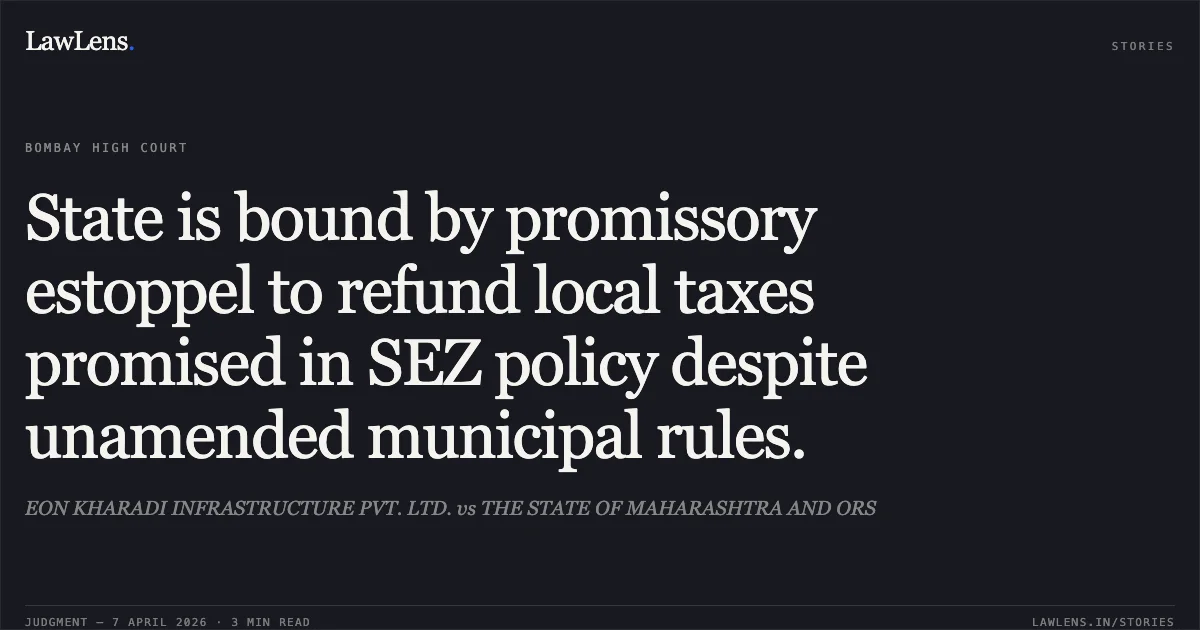
The Petitioner, an approved developer of an IT/ITES Special Economic Zone (SEZ) in Kharadi, Pune, sought a refund of octroi duty amounting to ₹6,69,91,584/- paid to the Pune Municipal Corporation (PMC) between 2005 and 2011
Source reference: para. 3-4The State Government’s SEZ Policy dated 12.10.2001 explicitly promised that SEZ developers would be exempted from all State and local taxes, including octroi, or reimbursed if direct exemption was not feasible
Source reference: para. 3, 29Despite the State directing the PMC to amend its Octroi Rules to align with this policy in 2007, the PMC’s General Body deleted the proposal in 2009, resulting in no statutory amendment
Source reference: para. 15-18Consequently, the PMC informed the Petitioner in 2012 that no exemption would be granted
Source reference: para. 16The Petitioner challenged this denial, invoking the doctrine of promissory estoppel
Source reference: para. 25Issues
1. Whether the Petitioner is entitled to the refund of octroi based on the State SEZ Policy and the doctrine of promissory estoppel.
Source reference: para. 25, 292. Whether the State Government or the Municipal Corporation is liable to fulfill the promise of exemption/refund in the absence of statutory amendments to the Octroi Rules under the Maharashtra Municipal Corporation (MMC) Act.
Source reference: para. 33-35Law Applied
The court primarily applied the doctrine of Promissory Estoppel, as elucidated in Manuelsons Hotels Private Limited v. State of Kerala, which holds that the Government must make good on a promise if a party has altered its position in reliance on that promise, provided no overriding public interest dictates otherwise
Source reference: para. 25, 39-40It further relied on Section 50 of the SEZ Act, 2005, and Rule 5(5)(a) of the SEZ Rules, 2006, which mandate that State Governments endeavor to provide exemptions from local taxes and duties to SEZ developers
Source reference: para. 31Finally, the court considered Sections 450A, 456, and 456A of the MMC Act, which empower the State Government to issue policy directions and make rules if a Municipal Corporation fails to comply with state requisitions
Source reference: para. 36-37Reasoning
The court found that the 2001 State Policy created a "definite promise" of octroi exemption intended to stimulate industrial growth and employment
Source reference: para. 29The State Government expressly admitted in its affidavit that the Petitioner was entitled to this exemption
Source reference: para. 33While the PMC argued it could not refund the money because the Octroi Rules were never formally amended—a position the court accepted as legally sound regarding the PMC's independent liability—the court held that the State Government could not be absolved
Source reference: para. 34-35The court reasoned that the State possessed ample legislative and supervisory powers under the MMC Act to ensure the implementation of its policy but failed to exercise them
Source reference: para. 37Applying Manuelsons Hotels, the court determined that since the Petitioner acted upon the State's promise by developing the SEZ, and since fulfilling the promise aligned with public interest, the State was bound to reimburse the Petitioner for the taxes paid
Source reference: para. 39-42Holding
The court held that the Petitioner is entitled to a refund of the octroi paid during its tenure as an approved developer
It ruled that while the PMC is not liable due to the lack of statutory amendments, the State Government is directed to refund the amount
Source reference: Order iiThe court ordered the State to determine the exact refundable amount upon the Petitioner's representation and to pay the refund with interest at 6% per annum from the date of payment until realization
Source reference: Order i-iiThe exercise must be completed within six months
Source reference: Order iiiRule was made absolute
Source reference: para. 42Acts & Sections Cited
12 provisions across 2 statutes referred to in this judgment. Each provision opens on LawLens.
Special Economic Zones Act, 20055
Maharashtra Municipal Corporations Act.7
Original Court PDF
EON KHARADI INFRASTRUCTURE PVT. LTD.vsTHE STATE OF MAHARASHTRA AND ORS
Click to open original judgment
Original judgment, available to read, download and summarize on LawLens.in


![Subsequent exoneration does not retrospectively invalidate a finalized promotion select list.. UNNIKRISHNAN M vs M/o Environment And Forests. CAT - ['Ernakulam']. LawLens](/stories/thumbnails/subsequent-exoneration-does-not-retrospectively-invalidate-a-finalized-promotion-select-li-ce80a0e84f2f4887857271e8b4341c42.webp)