Facts
The Petitioner owns agricultural land in Village Bijwasan, a portion of which was acquired in 2017 for the Dwarka Expressway
Source reference: p.2Following construction, the Petitioner used a paved road within the National Highways Authority of India’s (NHAI) "right of way" to access her residual land
Source reference: p.3In April 2025, NHAI began constructing a boundary wall that would block this access
Source reference: p.3The Petitioner contended that her land was otherwise landlocked
Source reference: p.7NHAI countered that the road was not a public service road but an internal operational path for the Advanced Traffic Management System (ATMS), situated in a high-speed, access-controlled zone immediately following a toll plaza
Source reference: p.2, 10Issues
1. Whether the Petitioner can compel NHAI to provide vehicular access through a road designed for operational/ATMS purposes under the statutory regime of the National Highways Act
Source reference: p.22. Whether the denial of access to a residual land parcel constitutes a violation of the right to property under Article 300A of the Constitution
Source reference: p.7, 23Law Applied
The court applied Sections 28, 29, and 30 of the Control of National Highways (Land and Traffic) Act, 2002, which mandate that access to a Highway is permission-based and subject to regulation or refusal in the interest of safety and convenience
Source reference: p.11-12It relied on IRC:SP:87-2013, which sets design standards for service roads and entry/exit ramps
Source reference: p.10, 13Regarding Article 300A, the court followed State of Himachal Pradesh v. Tarsem Singh, holding that land vesting in the State "free from all encumbrances" extinguishes prior easementary rights
Source reference: p.24Union of India v. Dr. Kushala Shetty established that judicial review of technical highway alignments and safety designs is limited unless the action is patently arbitrary
Source reference: p.21-22Reasoning
The court found that the disputed road was not a sanctioned service road as per the project schedules but a dedicated path for ATMS facilities and emergency vehicles
Source reference: p.13-16Applying the safety standards of IRC:SP:87-2013, the court noted the site lacked the necessary acceleration/deceleration lanes; allowing private vehicles to turn sharply across post-toll traffic lanes would create "accident-prone locations"
Source reference: p.10, 18The court rejected the Petitioner's Article 300A argument, reasoning that while property rights are protected, they do not grant an inherent right to select a specific access point through state-owned, access-controlled infrastructure
Source reference: p.23The court deferred to NHAI’s technical assessment that private access would compromise the security of ATMS installations and highway safety
Source reference: p.20, 22Even if the land were effectively landlocked, the court held the remedy lies in seeking compensation for "injurious affection" under Section 3G of the National Highways Act or pursuing private easementary claims against neighbors, not in forcing a breach of highway design
Source reference: p.24Holding
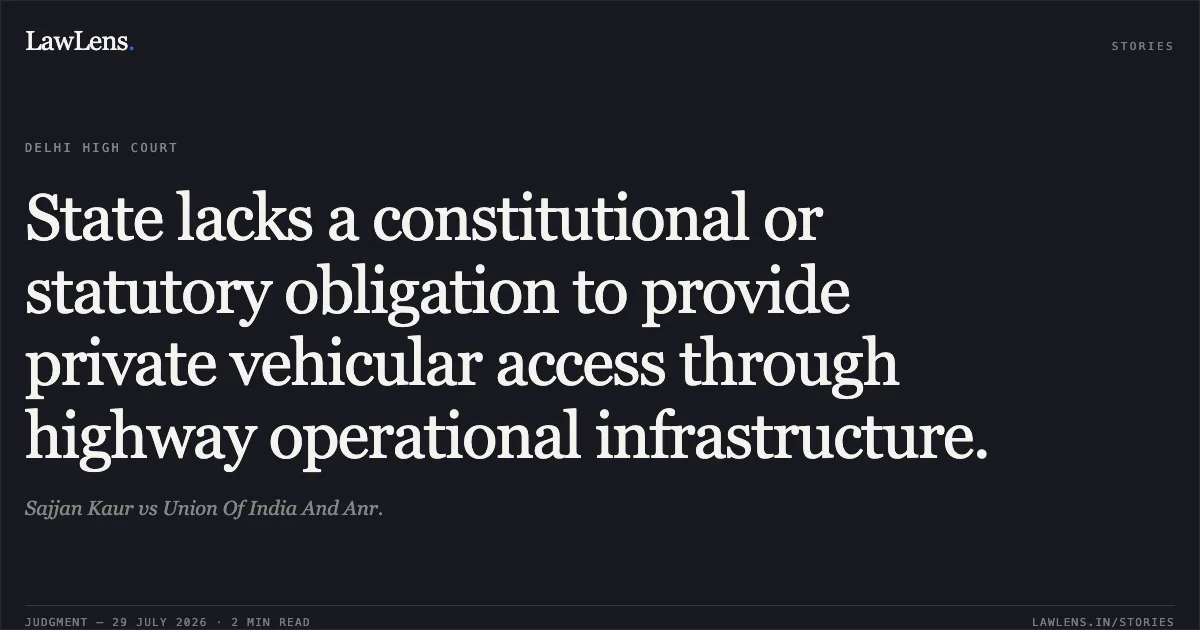
The court dismissed the writ petition, holding that the Petitioner had no legal entitlement to access the Expressway through the operational road
The court ruled that highway access is a regulated privilege, not a vested right, and NHAI provided a rational, technically supported basis for the restriction based on traffic safety and the sanctioned project design
Source reference: p.27The interim protection for access was vacated
Source reference: p.27Acts & Sections Cited
3 provisions across 1 statute referred to in this judgment. Each provision opens on LawLens.
Control of National Highways (Land and Traffic) Act, 20023
Original Court PDF
Sajjan KaurvsUnion Of India And Anr.
Click to open original judgment
Original judgment, available to read, download and summarize on LawLens.in


![Authorities must decide pensionary and retiral-benefit claims through a reasoned order within eight weeks.. Habibullah khan vs HOME DEPARTMENT. CAT - ['Srinagar']. LawLens](/stories/thumbnails/authorities-must-decide-pensionary-and-retiral-benefit-claims-through-a-reasoned-order-wit-d0cbe8a8119c48fbabe7df9f2d353488.webp)