Facts
The appellants, comprising various hydroelectric power generating companies (both public and private), challenged the constitutional validity of "The Uttarakhand Water Tax on Electricity Generation Act, 2012".
Source reference: p. 4, 5The Act seeks to levy a "water tax" on users drawing water from sources within the State for electricity generation.
Source reference: para. 5, Section 2Upon appeal, a Division Bench delivered a split verdict on October 25, 2023: the Chief Justice upheld the Act, while Justice Ravindra Maithani struck it down as ultra vires.
Source reference: para. 2The matter was subsequently referred to Justice Alok Kumar Verma for a tie-breaking opinion.
Source reference: para. 2, 32Issues
1. Whether the State Legislature possesses the legislative competence to impose a tax on water drawn specifically for electricity generation under Entry 17, 45, 49, or 50 of List II or Article 288?
Source reference: para. 3, 512. Whether the tax, in pith and substance, is a tax on the drawal of water or a tax on the generation of electricity?
Source reference: para. 303. Whether Section 17 of the Act suffers from the vice of excessive delegation by granting the State Government unfettered power to fix tax rates without guidelines?
Source reference: para. 43, 454. Whether the State is barred by the doctrine of Promissory Estoppel from levying the tax due to prior Implementation Agreements exempting the companies from such charges?
Source reference: para. 67Law Applied
Primary Rule of Literal Interpretation: the intention of the legislature must be found in the words used.
Source reference: para. 26, 27Doctrine of Pith and Substance: determines the true nature of the tax regardless of its nomenclature.
Source reference: para. 33Principle that taxation is a distinct matter from general subjects of legislation, requiring specific taxing entries (M.P.V. Sundararamier Co. vs. State of A.P.).
Source reference: para. 7, 64Application of Entry 49 List II regarding taxes on land (Union of India vs. H.S. Dhillon).
Source reference: para. 59Article 265: Constitutional mandate requiring the "authority of law" for any tax levy.
Source reference: para. 53, 54Delegation Rule: Essential legislative functions, such as fixing tax rates without policy guidelines or limits, cannot be abdicated to the executive.
Source reference: para. 45Doctrine of Promissory Estoppel: There is no promissory estoppel against the legislature in the exercise of its legislative functions.
Source reference: para. 70Reasoning
The Court analyzed the charging sections of the Act (Sections 12 and 17) and the definition of "User" (Section 2(f)), concluding that since the tax is only triggered when water is drawn specifically for electricity generation, the taxable event is the generation itself, not the mere drawal of water.
Source reference: para. 39, 42The Court rejected the State's reliance on Entry 49 (land) and Entry 50 (mineral rights) of List II, noting that water is not "land" for the purpose of a unit-based property tax, nor is it a "mineral" in a universal sense beyond specific statutory fictions.
Source reference: para. 59, 61The Court observed that Article 288 is an enabling/saving provision and not a source of legislative competence.
Source reference: para. 63Regarding Section 17, the Court found "naked delegation" because the Act provides no minimum or maximum limits or policy guidelines for the State Government to fix tax rates, thus violating the constitutional restriction on excessive delegation.
Source reference: para. 45, 46The Court ruled that executive agreements cannot interdict the sovereign legislative power of the State to tax.
Source reference: para. 69, 72Holding
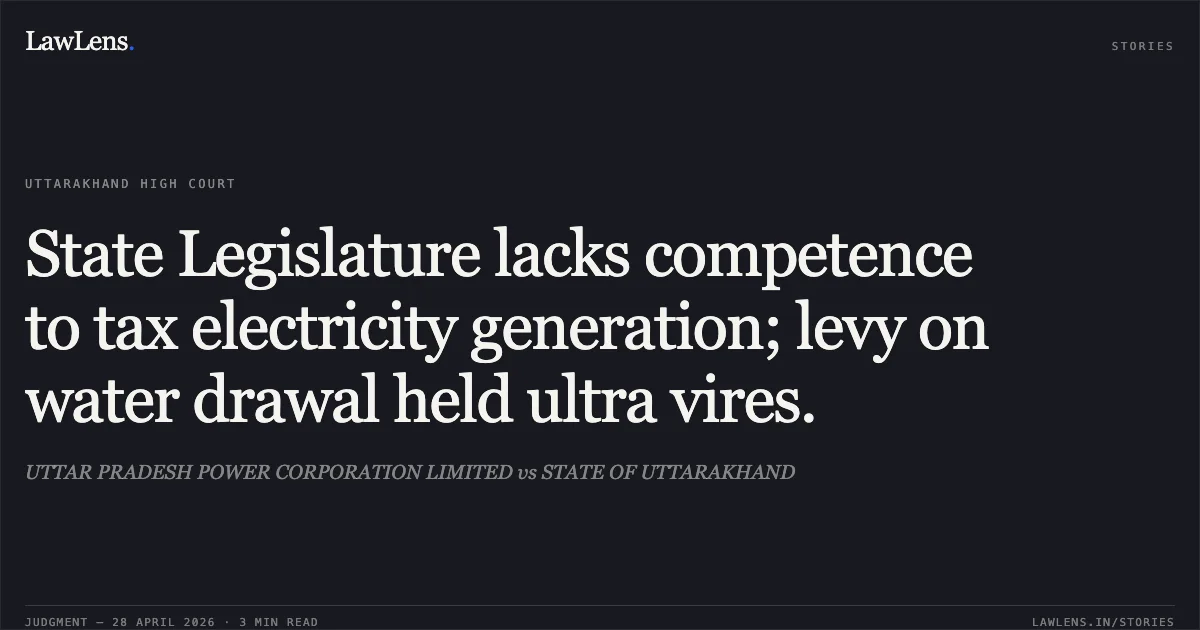
Justice Alok Kumar Verma held that "The Uttarakhand Water Tax on Electricity Generation Act, 2012" is ultra vires the Constitution of India.
The Court held that the State Legislature lacks the competence to levy a tax on the generation of electricity under List II and that the delegation of rate-fixing power was unconstitutional.
Source reference: para. 66, 46The Act was struck down on the grounds of lack of legislative competence and excessive delegation, while the plea of Promissory Estoppel was rejected.
Source reference: para. 73, 74Acts & Sections Cited
20 provisions across 1 statute referred to in this judgment. Each provision opens on LawLens.
Uttarakhand water tax and electricity Generation Act
Original Court PDF
UTTAR PRADESH POWER CORPORATION LIMITEDvsSTATE OF UTTARAKHAND
Click to open original judgment
Original judgment, available to read, download and summarize on LawLens.in


