Facts
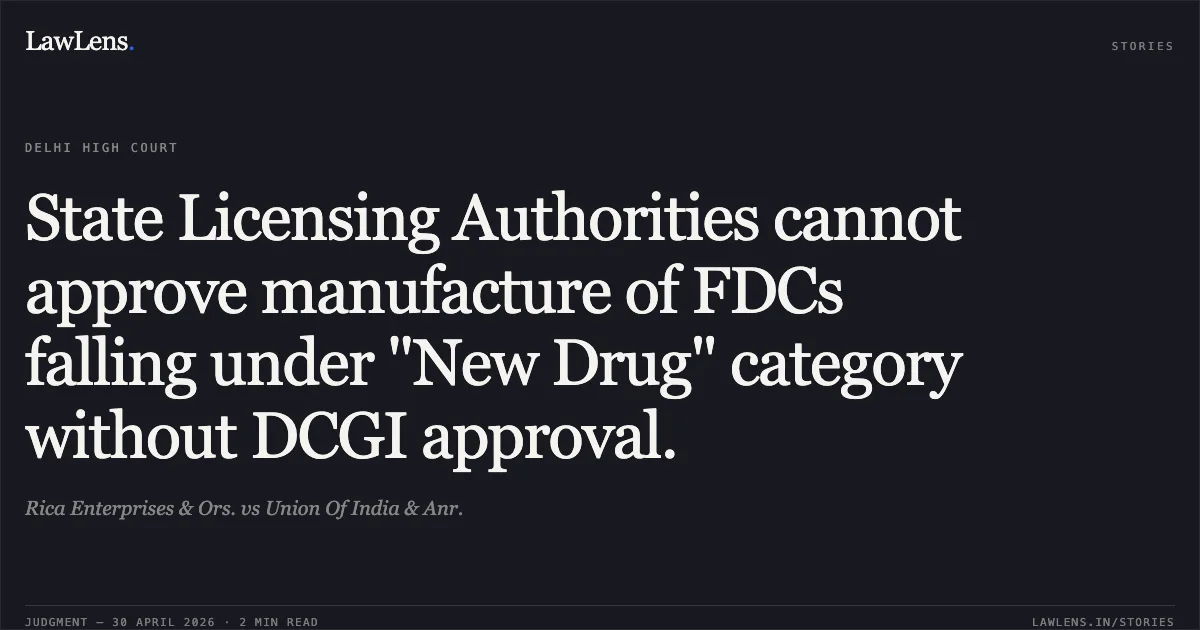
The petitioners, several pharmaceutical companies and firms, challenged an order dated 11.04.2025 issued by the Directorate General of Health Services, Central Drugs Standard Control Organisation (FDC Division).
Source reference: para 1The impugned communication directed State and Union Territory Drug Controllers to review the approvals granted to Fixed Dose Combination (FDC) drugs that qualify as "New Drugs".
Source reference: para 2, 6The regulatory authority observed that several State Licensing Authorities had granted manufacturing and sale licenses for FDCs without following the centralized approval process, potentially compromising patient safety and public health.
Source reference: para 5Issues
1. Whether the impugned communication dated 11.04.2025, directing the review and potential revocation of licenses for unapproved FDCs, warrants judicial interference.
Source reference: para 6, 92. Whether the petitioners possessed valid permissions from the central licensing authority to market the FDC drugs in question.
Source reference: para 9Law Applied
New Drugs and Clinical Trials Rules (NDCT Rules), 2019, framed under Sections 12(1) and 33 of the Drugs and Cosmetics Act, 1940.
Source reference: para 3Rule 2(1)(w)(iii) defines a "new drug" to include fixed-dose combinations of two or more drugs, previously approved separately, when combined for the first time.
Source reference: para 3Rule 3 designates the Drug Controller General of India as the central licensing authority, and Rule 19 mandates that no clinical trial or market authorization be initiated without centralized permission.
Source reference: para 4The framework is further supported by the Good Clinical Practice Guidelines regarding safety and efficacy assessments.
Source reference: para 4Reasoning
The court reasoned that the regulatory framework mandates centralized scrutiny by the respondent-authority for any drug falling under the definition of a "new drug" to ensure scientific validation, safety, and efficacy.
Source reference: para 4, 5The court noted that State Licensing Authorities had bypassed these statutory requirements, leading to the distribution of unapproved FDCs which pose significant health hazards and adverse drug reactions.
Source reference: para 5, 7The court found that the impugned order was a necessary "sensitization" of authorities in the interest of public welfare.
Source reference: para 8Since the petitioners failed to demonstrate that they held valid permissions from the Central Drug Controller for the drugs in question, there was no legal basis to set aside the advisory.
Source reference: para 9, 10Holding
The court dismissed the writ petitions and pending applications, finding no justification to interfere with the impugned order.
The court held that the FDC division acted within its rights to request State authorities to review and revoke licenses where manufacturers failed to adhere to the NDCT Rules, 2019.
Source reference: para 6The final holding affirms that patient safety and public health considerations outweigh the commercial interests of the petitioners in cases where statutory approval processes for "new drugs" are bypassed.
Source reference: para 7, 8Acts & Sections Cited
2 provisions across 1 statute referred to in this judgment. Each provision opens on LawLens.
Drugs and Cosmetics Act, 19402
Original Court PDF
Rica Enterprises & Ors.vsUnion Of India & Anr.
Click to open original judgment
Original judgment, available to read, download and summarize on LawLens.in