01Facts
The petitioners, existing liquor licensees in Rajasthan, challenged the "Rajasthan Excise & Temperance Policy 2025–2029" issued on 29.01.2025.
¶ 3The policy introduced a "cluster" system (grouping 1–5 shops) and mandated that license renewals in a district would only occur if 70% of eligible licensees applied for renewal and all shops within a specific cluster opted in.
¶ 3.1–3.3The petitioners’ renewal applications were cancelled or not considered because certain shops within their assigned clusters remained unrenewed or the 70% district threshold was not met.
¶ 3.5–3.6This led the State to propose settling those shops via e-auction.
¶ 3.5–3.6The petitioners alleged these clauses were arbitrary, discriminatory, and amounted to economic coercion.
¶ 4.302Issues
i.1. Whether Clauses 2.2.6, 2.2.7, and 2.2.8 of the Excise & Temperance Policy 2025–2029 are constitutionally valid under Article 14 of the Constitution of India.
¶ 3.6ii.2. Whether an existing licensee has a fundamental or vested right to the renewal of a liquor license.
¶ 4.1, 6.3.1iii.3. Whether the State's exercise of its "exclusive privilege" in liquor trade is subject to judicial review on the grounds of arbitrariness.
¶ 4.2, 6.3.303Law Applied
The Court applied the principle that there is no fundamental right to trade in liquor under Article 19(1)(g) as it is res extra commercium.
¶ 5.2, 6.1, 6.3.2The State holds "exclusive privilege" over intoxicants under Entries 8 and 51 of List II, Seventh Schedule.
¶ 5.2, 6.1, 6.3.2It relied on Khoday Distilleries Ltd. v. State of Karnataka [(1995) 1 SCC 574] to affirm that while the State has a monopoly, its methods must not be discriminatory or arbitrary under Article 14.
¶ 4.2.1, 6.3.2The Court further cited Section 37 of the Rajasthan Excise Act, 1950, which explicitly states that no person has a claim to the renewal of a license.
¶ 5.2, 6.5.3Provisions in the judgment · 1 · Linked ones open on LawLens
rajasthan excise act, 1950 Section 37
04Reasoning
The Court reasoned that the formulation of excise policy is a matter of executive wisdom involving fiscal considerations and revenue optimization, where judicial interference is limited to "manifest arbitrariness".
¶ 6.3.4, 6.3.5It found the 70% district threshold and the cluster mechanism to be rational policy tools intended to ensure administrative stability and prevent "fallow areas" where illegal liquor trade might flourish if less-profitable shops remained unsettled.
¶ 6.4.1, 6.5The Court rejected the argument of discrimination, noting the policy applies uniformly across the State.
¶ 6.4.1Furthermore, the Court observed that the petitioners had accepted the policy's terms by signing the renewal application forms, thus creating an estoppel against challenging those very terms after failing to secure a renewal.
¶ 5.7, 6.6.3The grouping of contiguous shops was deemed an administrative exercise within the Excise Commissioner’s competence.
¶ 6.5.105Holding
The Court held that the impugned clauses of the Excise Policy are constitutionally valid and do not suffer from any manifest arbitrariness.
¶ 6.7It answered that there is no fundamental or vested right to renewal, and the State’s policy choices to maximize revenue and regulate trade are within its executive domain.
¶ 6.3.1, 6.7.1Consequently, the High Court dismissed the batch of writ petitions and upheld the cancellation of the petitioners' renewal applications in favor of the cluster auction process.
¶ 7Original Court PDF
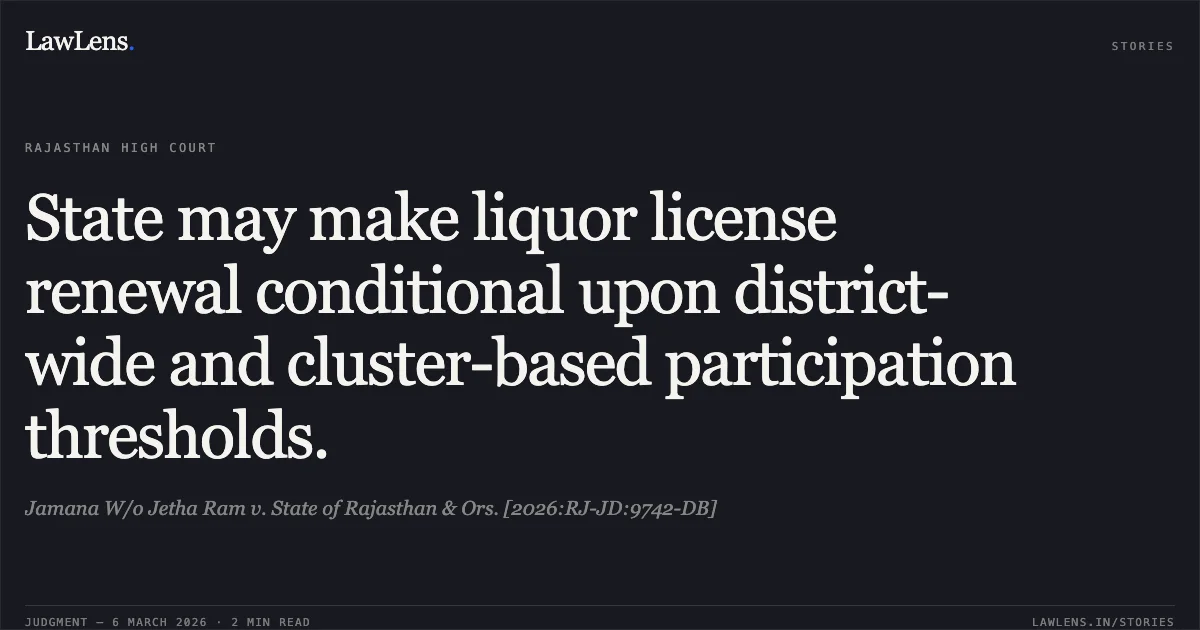
Jamana W/o Jetha Ram v. State of Rajasthan & Ors. [2026:RJ-JD:9742-DB]
Click to open original judgment
Original judgment, available to read, download and summarize on LawLens.in