Facts
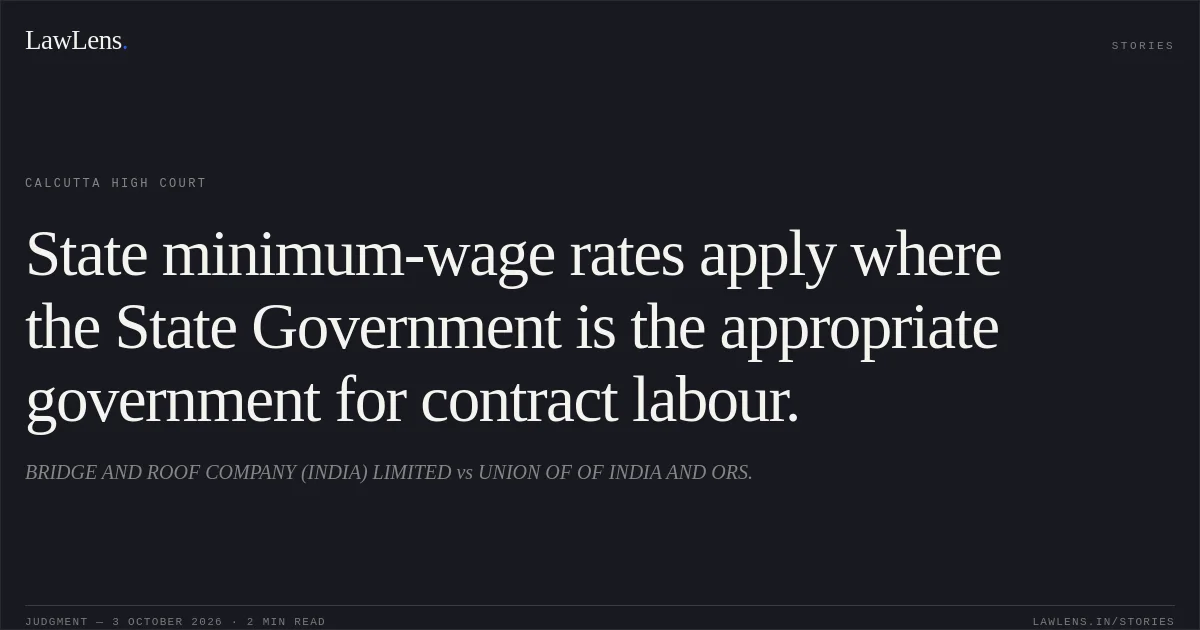
The Central Government Industrial Tribunal, in Reference No. 39 of 2022, held that contract workers engaged for Bridge and Roof Company (India) Ltd. were entitled to minimum wages at the rates fixed by the Central Government from time to time, but found no evidence supporting the union’s specific claim of ₹26,000 per month.
Source reference: para. 2The company challenged the award, arguing, among other things, that the Central Government rates did not apply and that the appropriate government was the State Government.
Source reference: paras. 6–10, 17–20The High Court considered the applicable-government issue and the applicability of the minimum-wage rates to the contract workers.
Source reference: paras. 26–33Issues
Whether the Central Government’s minimum-wage rates applied to the contract workers engaged through contractors for work at the petitioner’s establishment.
Source reference: paras. 17–20, 27–33Whether the Tribunal’s award directing payment at Central Government minimum-wage rates could stand.
Source reference: paras. 2, 34Law Applied
Section 2(b) of the Minimum Wages Act, 1948 identifies the appropriate government: the Central Government for specified scheduled employments, including employment carried on by or under its authority and employment in a corporation established by a Central Act; otherwise, the State Government is the appropriate government.
Source reference: para. 27In Steel Authority of India Ltd. v. National Union Waterfront Workers, the Supreme Court held that Central Government ownership or control of a company does not, by itself, make the Central Government the appropriate government; the relevant statutory and factual conditions must be satisfied.
Source reference: paras. 23–24The judgment also relied on Nashik Workers Union v. Hindustan Aeronautics Ltd. concerning the appropriate government under the Industrial Disputes Act.
Source reference: para. 25The Court referred to National Union Waterfront Workers in concluding that the West Bengal Government was the appropriate government under the Contract Labour (Regulation and Abolition) Act, 1970.
Source reference: paras. 26, 29Reasoning
The Court noted that the workers were engaged through contractors supplying labour for work within the State.
Source reference: paras. 28–31It reasoned that the Supreme Court’s decision in National Union Waterfront Workers supported the conclusion that the West Bengal Government was the appropriate government under the contract-labour legislation.
Source reference: paras. 26, 29The Court then held that, on that basis, State minimum-wage rates applied to the contract workers, rather than the Central Government rates directed by the Tribunal.
Source reference: paras. 31–33It did not separately determine the petitioner’s other challenges, including its submissions concerning the Tribunal’s jurisdiction and the non-joinder of contractors.
Source reference: no citationHolding
The Court held that the award was not in accordance with law and set it aside.
It allowed the writ petition, disposed of any connected applications, and vacated any interim order.
Source reference: paras. 35–37Acts & Sections Cited
1 provisions across 1 statute referred to in this judgment. Each provision opens on LawLens.
Occupational Safety, Health and Working Conditions Code, 20201
Original Court PDF
BRIDGE AND ROOF COMPANY (INDIA) LIMITEDvsUNION OF OF INDIA AND ORS.
Click to open original judgment
Original judgment, available to read, download and summarize on LawLens.in