Facts
The subject land (Survey No. 110-A, Thane) was originally allotted in 1951 to Sarjuprasad Pardeshi (father of the "Original Petitioners") on a new and impartible tenure
Source reference: para. 2(i)In 1974, the Original Petitioners placed the Original Respondents in possession via a deed
Source reference: para. 2(iii)Following a failed eviction application under the BTAL Act, the Collector forfeited and resumed the land in 1984 due to a breach of grant terms
Source reference: para. 2(iii)Successive appeals by both parties against the forfeiture were dismissed
Source reference: para. 2(iv)In 2011, the Minister of Revenue regularized the Original Respondents' occupation
Source reference: para. 2(vi)The Original Petitioners challenged this regularization in Writ Petition No. 11106 of 2011. The learned Single Judge dismissed the Writ Petition, holding the land belonged to the State, but directed that the State could re-auction the land and allow Original Respondents to participate
Source reference: para. 1Both parties filed these Letters Patent Appeals (LPA) challenging that order
Source reference: para. 3Issues
1. Whether the learned Single Judge erred in directing the State to re-auction/re-allot the subject land and allowing the illegal occupants to participate in such a process
Source reference: para. 9-102. Whether the State Government has the exclusive prerogative to decide the use of land once it has been legally resumed and vested in the State
Source reference: para. 10Law Applied
The Court applied the principle of the Rule of Law regarding the disposal of public property, emphasizing that Government lands cannot be dealt with arbitrarily by the Executive or through regularization of illegal occupation
Source reference: para. 11It relied on the doctrine of Separation of Powers, asserting that the Court cannot step into the shoes of the Executive to mandate a specific method of land disposal (such as auction) once land is vested in the State
Source reference: para. 10Reasoning
The Court observed a contradiction in the Single Judge’s judgment: while the judge rightly criticized the "illegal" dealing of public property, the judge simultaneously issued directions for re-auctioning and recognized the participation rights of the Original Respondents
Source reference: para. 9The Division Bench reasoned that once land is forfeited for breach of tenure and vested in the State, it becomes State property
Source reference: para. 10Therefore, the Court cannot grant "participation rights" in a proposed auction to parties whose occupation was found to be contrary to law; doing so would implicitly recognize non-existent rights
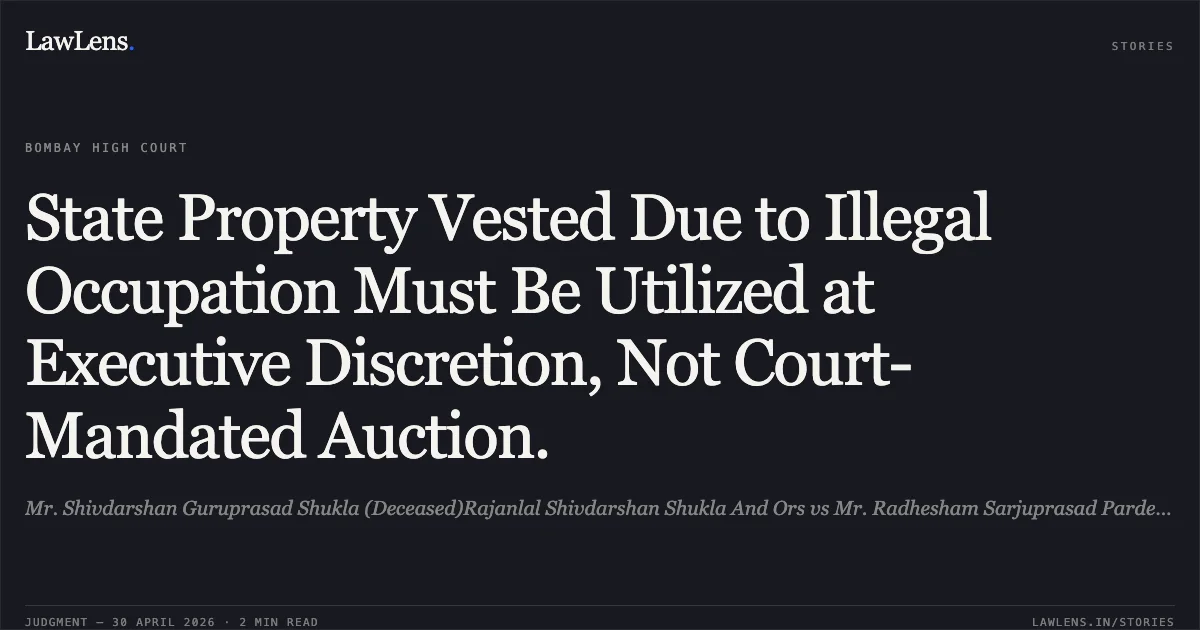
Source reference: para. 10The Court held that the State must have full control to use the land for any public purpose, and the Judiciary should not mandate an auction process as that constitutes an executive function
Source reference: para. 10-11Holding
The Court dismissed both Letters Patent Appeals
It upheld the finding that the land belongs to the State but set aside the Single Judge’s directions regarding re-auctioning and the Original Respondents’ right to participate
Source reference: para. 12The Court held that the State Government is free to use the land for any public purpose in accordance with law
Source reference: para. 13The State was directed to resume physical possession of the subject land within two months
Source reference: para. 12Acts & Sections Cited
2 provisions across 2 statutes referred to in this judgment. Each provision opens on LawLens.
Bombay Tenancy and Agricultural Lands Act-19481
Bombay High Court (Letters Patent) Act, 1866.1
Original Court PDF
Mr. Shivdarshan Guruprasad Shukla (Deceased)Rajanlal Shivdarshan Shukla And OrsvsMr. Radhesham Sarjuprasad Pardeshi (Deceased Through Smt. Kamladevi Radhesham Pardeshi And Ors
Click to open original judgment
Original judgment, available to read, download and summarize on LawLens.in