Facts
The Public Service Commission advertised the post of Principal of Government College of Art and Craft under State Notification No. 1175-Edn(A)/10M-129/11 dated 10 October 2014.
Source reference: para. 2The advertised criteria provided both an academic qualification route—including a Ph.D., prescribed experience and API score—and an alternative route for a traditional or professional artist of great eminence.
Source reference: paras. 2–3, 43–45Respondent No. 10, Chhatrapati Dutta, was initially marked as provisionally called for interview subject to producing satisfactory evidence of experience by 11 August 2016; a later interview list omitted the asterisks, but the record did not disclose how the experience requirement had been verified.
Source reference: paras. 4–6, 54–55He was provisionally appointed Principal on 24 April 2017.
Source reference: para. 6The petitioners sought quo warranto, challenging the alternative eligibility route and alleging that respondent No. 10 lacked mandatory qualifications.
Source reference: no citationThe Court rejected preliminary objections based on the Administrative Tribunal’s jurisdiction and the petitioners’ lack of standing.
Source reference: paras. 16–26Issues
Whether the writ petition was maintainable in the High Court despite the jurisdiction of the West Bengal Administrative Tribunal, and whether the petitioners had standing to seek quo warranto.
Source reference: paras. 16–26Whether the State’s alternative eligibility route for an eminent professional artist was inconsistent with binding UGC Regulations, 2010.
Source reference: paras. 43–49Whether respondent No. 10 satisfied the qualifications legally applicable to the post and could lawfully continue to hold it.
Source reference: paras. 50–60, 73–78Law Applied
Under Articles 226 and 227 of the Constitution, the High Court retains judicial-review jurisdiction, and a quo warranto proceeding may be brought by a person without personal injury to test whether an incumbent has lawful authority to hold a public office; the inquiry concerns legal eligibility, not comparative merit.
Source reference: paras. 20, 23–29Sections 15 and 16 of the Administrative Tribunals Act, 1985 did not bar this distinct quo warranto challenge.
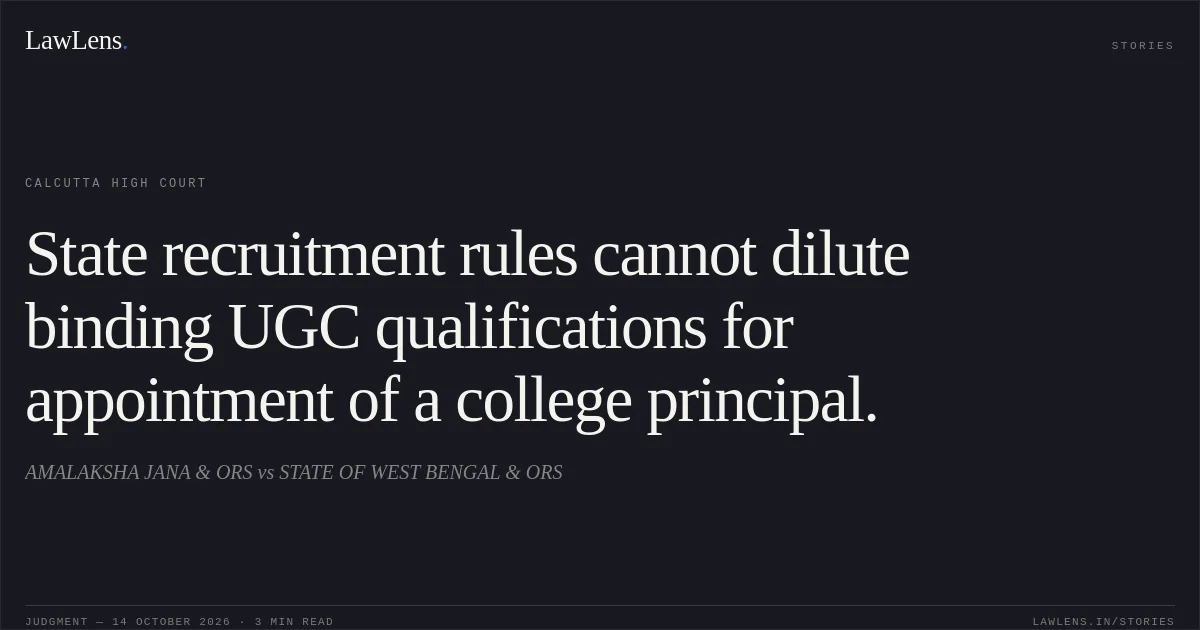
Source reference: paras. 16–21The Court applied the UGC Act, 1956, including section 26, and the UGC Regulations, 2010 as binding standards where applicable; State recruitment rules may regulate selection but cannot derogate from mandatory national qualifications.
Source reference: paras. 36–42Quo warranto requires sufficient material to establish lack of lawful authority and does not permit review of comparative suitability or inquiry into the appointing authority’s subjective deliberations.
Source reference: paras. 27–31The Court also referred to the burden concerning facts especially within a party’s knowledge.
Source reference: para. 53Reasoning
The Court treated the challenge as one to respondent No. 10’s legal authority to occupy a public office, rather than an individual service claim, and therefore rejected both the Tribunal objection and the standing objection.
Source reference: paras. 17–26It held that the State’s alternative artist-eminence route could not sustain an appointment if it displaced mandatory UGC qualifications applicable to the post.
Source reference: paras. 43–49, 74On eligibility, the Court noted that the initial interview list made respondent No. 10’s candidature conditional on proof of experience, while the subsequent list did not establish that the required documents had been submitted or verified; it also considered the allegations concerning the Ph.D., experience and API requirements.
Source reference: paras. 51–60Although it cautioned that a finding of ineligibility had to rest on the applicable regulations and contemporaneous records, it ultimately stated that those materials established respondent No. 10’s failure to meet the mandatory criteria.
Source reference: paras. 76–78The prior dismissal allegation was not treated as independently decisive without the underlying service record and a relevant disqualification under the governing rules.
Source reference: paras. 61–64Holding
The Court allowed the writ petition, rejected the preliminary objections, and declared the relevant parts of the 2014 notification and 2015 advertisement inoperative insofar as they permitted appointment contrary to mandatory UGC qualifications.
It set aside the PSC recommendation and appointment notification insofar as they related to respondent No. 10, issued quo warranto declaring that he had no lawful authority to continue as Principal, and directed the State to give effect to the order and make interim administrative arrangements pending appointment of a duly eligible person.
Source reference: para. 78(iii)–(vi)The petition was allowed and disposed of.
Source reference: para. 79Acts & Sections Cited
4 provisions across 3 statutes referred to in this judgment. Each provision opens on LawLens.
Administrative Tribunals Act, 19852
University Grants Commission Act, 19561
Bharatiya Sakshya Adhiniyam, 20231
Original Court PDF
AMALAKSHA JANA & ORSvsSTATE OF WEST BENGAL & ORS
Click to open original judgment
Original judgment, available to read, download and summarize on LawLens.in


