Facts
The petitioners, traders in petroleum coke (a "declared good" under Section 14 of the Central Sales Tax Act), challenged Notification No. (GHN-14)VAT-2010-S.11(6)(2)-TH dated 29.06.2010.
Source reference: p. 2, 4This notification, issued under Section 11(6) of the Gujarat Value Added Tax (VAT) Act, 2003, reduced input tax credit (ITC) by 2% (later 1%) on goods sold in the course of inter-State trade.
Source reference: p. 4-5The petitioners had purchased petroleum coke locally, paid VAT, and subsequently sold the same in inter-State commerce, paying Central Sales Tax (CST).
Source reference: p. 4-5They argued that denying full ITC violated their right to reimbursement under Section 15(b) of the CST Act.
Source reference: p. 4-5The State relied on the precedent of Kadwani Forge Ltd., which had previously upheld the notification's validity.
Source reference: p. 3Issues
1. Whether the State Government, under Section 11(6) of the VAT Act, can reduce input tax credit for goods that are both purchased and resold as "declared goods" in the course of inter-State trade.
Source reference: p. 42. Whether the impugned notification violates Article 286(3) of the Constitution of India read with Section 15(b) of the CST Act.
Source reference: p. 2Law Applied
The court applied Article 286(3) of the Constitution, which subjects State laws imposing tax on "declared goods" to restrictions specified by Parliament.
Source reference: p. 8It relied on Section 15(b) of the CST Act, 1956, which mandates the reimbursement of local tax paid when declared goods are sold in inter-State trade.
Source reference: p. 8The court utilized the doctrine of sub silentio, noting that if a point of law is not consciously determined in a prior judgment, that judgment is not binding on that specific point.
Source reference: p. 7It specifically followed the precedent in Hides and Skin Owners Seva Mandal v. State of Gujarat (2020).
Source reference: p. 3, 6-9Reasoning
The court harmonized two seemingly conflicting precedents. It noted that while Kadwani Forge Ltd. upheld the notification, that case involved declared goods used in manufacturing new products, whereas the present case involved goods purchased and resold in the same form.
Source reference: para 10Applying the reasoning from Hides and Skin Owners Seva Mandal, the court observed that Section 15(b) of the CST Act is an overriding Central mandate for full reimbursement.
Source reference: para 10The court reasoned that while Section 11(6) of the VAT Act allows the State to restrict ITC generally, it cannot be used to "tinker with the amount of reimbursement" guaranteed by Central law for declared goods.
Source reference: para 9, citing p. 8-9Consequently, the notification was "read down" rather than struck down, meaning it remains valid generally but is inapplicable to the specific category of declared goods resold in inter-State commerce.
Source reference: para 10Holding
The Court allowed the petition.
It held that the impugned Notification dated 29.06.2010 (as amended) shall not apply to goods that are both purchased and sold as declared goods.
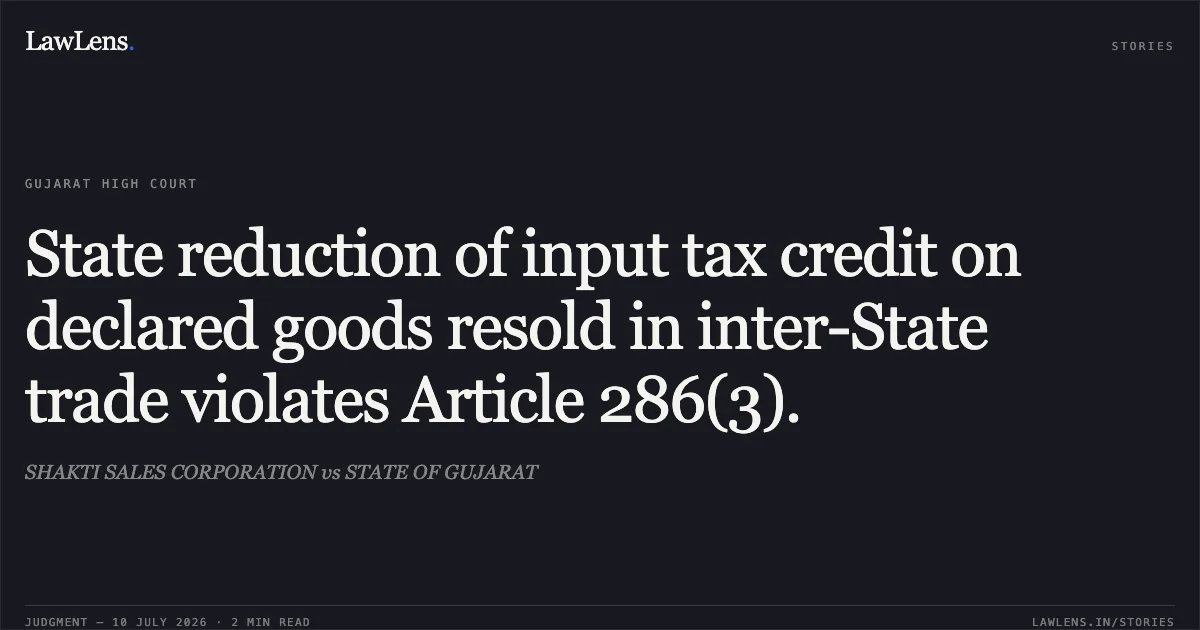
Source reference: para 11The court declared the reduction of input tax credit on such transactions as violative of Article 286(3) of the Constitution and Section 15(b) of the CST Act.
Source reference: para 10.1, 11The show cause notice dated 17.12.2019 was quashed, and the respondents were directed to grant the petitioners full input tax credit for the taxes paid.
Source reference: para 11Acts & Sections Cited
3 provisions across 2 statutes referred to in this judgment. Each provision opens on LawLens.
Central Sales Tax Act, 19562
Gujarat Value Added Tax Act, 2003.1
Original Court PDF
SHAKTI SALES CORPORATIONvsSTATE OF GUJARAT
Click to open original judgment
Original judgment, available to read, download and summarize on LawLens.in


