Facts
The State of Assam engaged a large number of Muster Roll (MR) and Work Charged (WC) workers since 1980
Source reference: para. 6In 1983 and 1995, the State issued directives to regularize those with long service, eventually setting a cut-off date of April 1, 1993
Source reference: paras. 7-12In July 2005, the State Cabinet decided to regularize WC/MR workers engaged before the cut-off, creating over 30,000 posts for this purpose
Source reference: para. 17Approximately 30,000 workers were regularized, but the appellants were excluded due to clerical errors, spelling mistakes, and oversight
Source reference: paras. 21-22Despite State undertakings to the High Court to resolve these omissions, the Finance Department issued a 2012 O.M. halting further regularization, citing the restrictive judgment in Secretary, State of Karnataka v. Umadevi
Source reference: paras. 24-25, 29A Single Judge of the Gauhati High Court quashed the 2012 O.M., but a Division Bench reversed this, holding that the lack of sanctioned posts barred regularization under Umadevi
Source reference: paras. 31, 34Issues
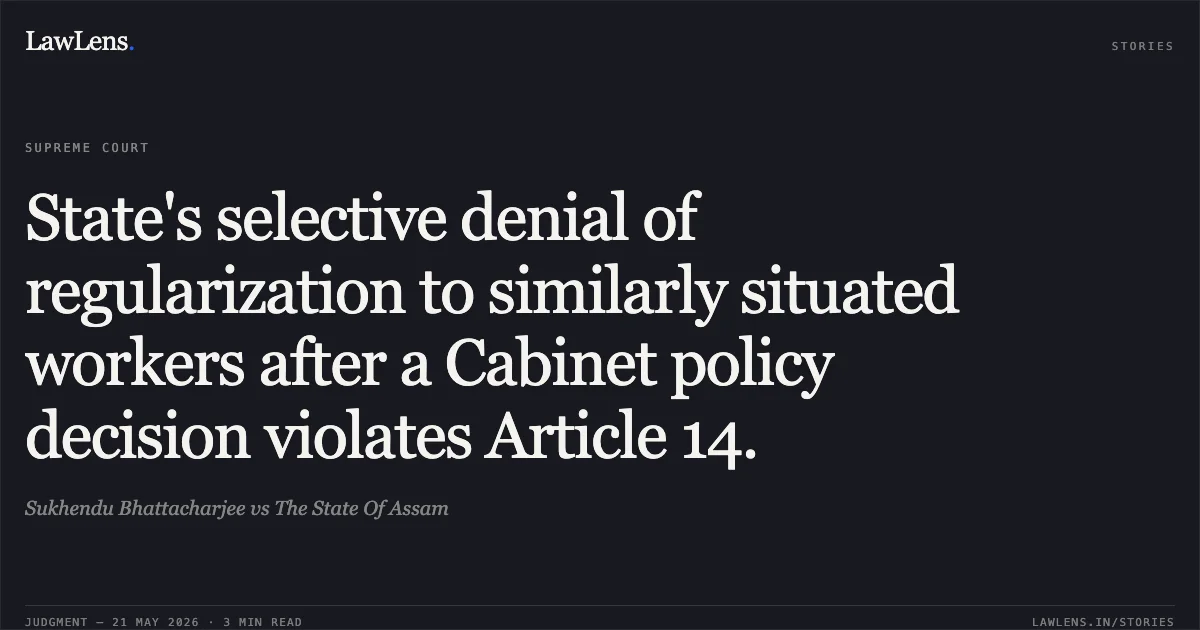
1. Whether the State can deny regularization to a left-out group of workers while having granted the same benefit to 30,000 similarly situated employees under the 2005 Cabinet decision
Source reference: para. 542. Whether the decision in State of Karnataka v. Umadevi acts as a blanket embargo against regularizing employees who were not initially appointed against sanctioned posts when the State itself created posts for a specific class
Source reference: para. 733. Whether the State, as a "Model Employer," can resile from solemn undertakings given to a Constitutional Court
Source reference: para. 67Law Applied
Article 14 of the Constitution, which ensures equality and prohibits arbitrary state action against similarly situated persons
Source reference: para. 60The exception to the bar on regularization found in Paragraph 53 of State of Karnataka v. Umadevi (2006), as clarified in State of Karnataka v. M.L. Kesari (2010), which allows a "one-time measure" for irregular appointments with 10 years of service
Source reference: paras. 56-57Doctrine of "Legitimate Expectation" from National Buildings Construction Corporation v. S. Raghunathan
Source reference: para. 69Principle of the "Model Employer" established in Bhola Nath v. State of Jharkhand (2025) and Jaggo v. Union of India (2024), which mandates fairness and prohibits the exploitation of temporary workers for perennial tasks
Source reference: paras. 74-75Reasoning
The appellants were not seeking a new mandate for regularization but were requesting the non-discriminatory application of the 2005 Cabinet policy
Source reference: para. 59Since the State had already regularized 30,000 workers by creating posts, excluding the appellants—who were identical in status and service length—solely due to the State’s own clerical errors was "manifestly arbitrary"
Source reference: para. 61Umadevi was not intended to "weaponize" procedural formalities against long-serving employees performing essential state functions
Source reference: para. 74The State’s conduct in 2012 (seeking court leave to implement a policy it already committed to) was viewed as an unwarranted abdication of executive authority
Source reference: para. 71By making categorical representations to the High Court and then resiling via the 2012 O.M., the State violated the principles of a Model Employer and hit the threshold of "approbate and reprobate"
Source reference: para. 67Holding
The appellants are entitled to regularization in terms of the July 22, 2005 Cabinet decision
The Supreme Court set aside the Division Bench judgment and restored the Single Judge's order, directing the State to identify eligible appellants, create supernumerary posts, and grant all consequential benefits, including pay fixation, continuity of service, and full pensionary/retiral benefits within one year
Source reference: para. 79Acts & Sections Cited
3 provisions across 3 statutes referred to in this judgment. Linked provisions open on LawLens.
Assam Services (Pension) Rules, 19691
Assam Fiscal Responsibility and Budget Management Act, 20051
PWD Code1
Original Court PDF
Sukhendu BhattacharjeevsThe State Of Assam
Click to open original judgment
Original judgment, available to read, download and summarize on LawLens.in


