Facts
Several teaching and non-teaching staff and private educational institutions filed writ petitions challenging orders/inactions of the Education Department concerning approvals, transfers, and service benefits.
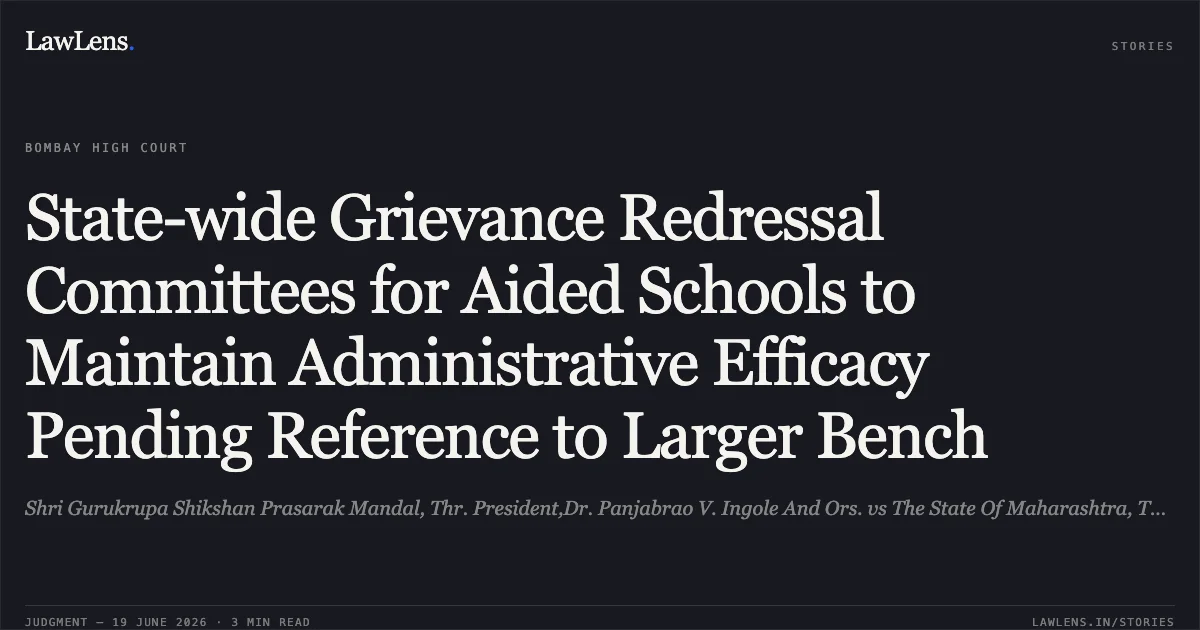
Source reference: p.11A Government Resolution (GR) dated 27-03-2024 had established a Grievance Redressal Committee (GRC) to handle such "petty matters" to reduce litigation.
Source reference: p.11-12A later coordinate bench in Shri Agrasen Shikshan Sanstha v. State of Maharashtra (WP 8322/2023) doubted the State's executive power to create such an appellate forum and referred the matter to a Larger Bench.
Source reference: p.12-13The petitioners approached the High Court directly, contending the GRC mechanism was under legal cloud due to this pending reference.
Source reference: p.13Issues
1. Whether the Grievance Redressal Committee/Appellate Authority constituted under the GR dated 27-03-2024 stands vitiated or suspended due to a pending reference to a Larger Bench.
Source reference: p.13 / para. 32. Whether the State Government, under Article 162 of the Constitution, can validly create an administrative/supervisory grievance mechanism for matters governed by the M.E.P.S. Act and Rules.
Source reference: p.16 / para. 83. Whether the existing GRC mechanism requires further strengthening or statutory backing to ensure efficacy.
Source reference: p.25 / para. 26Law Applied
The court primarily applied the principle from Union Territory of Ladakh v. Jammu and Kashmir National Conference, which mandates that High Courts must decide matters based on the law as it stands, even if a reference to a Larger Bench is pending.
Source reference: p.13-14Article 162 of the Constitution regarding the State's executive power, as interpreted in Bishambhar Dayal Chandra Mohan v. State of U.P. and Naraindas Indurkhya v. State of M.P., establishing that the State can issue administrative instructions on matters within its legislative competence where no specific enactment covers a particular aspect.
Source reference: p.23-24Directions from Nitin Bhika Tadge v. State of Maharashtra, which emphasized the duty of educational authorities to comply with settled judicial pronouncements.
Source reference: p.14-16Reasoning
The court reasoned that until the Larger Bench decides otherwise, the validity of the GR dated 27-03-2024, previously upheld in Komal v. State of Maharashtra, remains the law.
Source reference: p.16The court noted that the GRC is not a "quasi-judicial" body replacing statutory forums but an executive mechanism intended to ensure administrative "fair play" and compliance with settled law.
Source reference: p.20By scrutinizing the rules under the M.E.P.S. Act, the court found that while rules exist for authorities to take decisions, there is often a gap in addressing inaction or delayed decisions, justifying the GR’s supplementary role.
Source reference: p.21-22The court emphasized that the State’s duty is to carry out general administration; so long as the GR does not conflict with existing law, its amplitude remains wide under Article 162.
Source reference: p.24To address gaps in the current GR (such as approvals requiring the Commissioner's sanction under Rule 41A), the court exercised its jurisdiction to expand the grievance framework.
Source reference: p.26Holding
The court held that the GRC mechanism remains operational and must be exhausted by petitioners before approaching the High Court.
It directed that the GR of 27-03-2024 shall be treated as directions issued by the Court until statutory provisions are enacted.
Source reference: para. 28(i)Specifically, the Court ordered: (1) the constitution of a State-level GRC headed by the Secretary of Education to hear complaints against higher-level officers [para. 28(ii)]; (2) that GRCs must examine officer delays under the Maharashtra Prevention of Delay in Discharge of Official Duties Act, 2005 [para. 28(iii)]; and (3) petitioners were granted 6 weeks to approach the GRC [para. 28(iv)].
Source reference: para. 28The State was requested to grant the mechanism statutory backing via the M.E.P.S. Act or Section 9 amendments to ensure permanence.
Source reference: p.25-26Acts & Sections Cited
2 provisions across 2 statutes referred to in this judgment. Each provision opens on LawLens.
Maharashtra Employees of Private Schools (Conditions of Service) Regulation Act, 1977.1
Maharashtra Government Servants Regulation of Transfers and Prevention of Delay in Discharge of Official Duties Act, 2005.1
Original Court PDF
Shri Gurukrupa Shikshan Prasarak Mandal, Thr. President,Dr. Panjabrao V. Ingole And Ors.vsThe State Of Maharashtra, Thr. Secretary, Dept. Of School Education And Sports, Mumbai And Ors.
Click to open original judgment
Original judgment, available to read, download and summarize on LawLens.in