Facts
The National Legal Services Authority (NALSA) filed a writ petition under Article 32 of the Constitution of India highlighting systemic concerns regarding the continued incarceration of elderly (above 70 years) and terminally ill prisoners
Source reference: para. 3Data from a NALSA nationwide campaign (Dec 2024 – March 2025) identified 5,393 such prisoners, noting that 20.8% of the prison population is aged 50+ and many custodial deaths are linked to aging and lack of specialized medical care
Source reference: paras. 6-7, 13Despite a 2010 Government of India Advisory recommending the release of terminally ill inmates, NALSA argued that systemic inertia and inadequate facilities resulted in a violation of the right to live with dignity
Source reference: paras. 9-10Only the States of Bihar and Himachal Pradesh filed responses
Source reference: para. 15Issues
1. Whether the continued incarceration of elderly and terminally ill prisoners in conditions of medical inadequacy violates the fundamental rights to life and dignity under Articles 14 and 21 of the Constitution
Source reference: para. 32. Whether there is a need for a uniform, nationwide mechanism and policy framework for the compassionate or premature release of such vulnerable prisoners
Source reference: para. 26Law Applied
The Court applied Article 21 of the Constitution, affirming that the right to dignity is not suspended upon conviction
Source reference: para. 2It relied on Maneka Gandhi v. Union of India regarding substantive due process and Sunil Batra v. Delhi Administration, which established prisoners' rights against cruel/inhuman treatment and the right to health
Source reference: para. 18Precedents like Dr. P. Varavara Rao v. NIA and Rasik Chandra Mondal v. West Bengal were cited to show that medical condition and advanced age are decisive factors for bail/release
Source reference: para. 33The Court also integrated international standards from the Nelson Mandela Rules (UN) and the UNODC Handbook on Prisoners with Special Needs regarding the definition of "terminal illness"
Source reference: paras. 21, 35Reasoning
The Court reasoned that prisons are not spaces where constitutional values are suspended and that the State’s power is most intrusive when exercised upon vulnerable individuals
Source reference: para. 2It observed that while "prisons" is a State subject (Schedule VII, List II), the failure to implement humane standards results in a substantive erosion of Article 21
Source reference: para. 37The Court found that punishment must not degenerate into "retributive suffering" divorced from proportionality and humanity
Source reference: para. 33By analyzing the NALSA data and existing (but poorly implemented) 2010 Advisory, the Court determined that the lack of a structured, digitalized, and time-bound release mechanism across all States constituted a systemic failure requiring judicial intervention under Articles 32 and 142
Source reference: paras. 31, 39, 41Holding
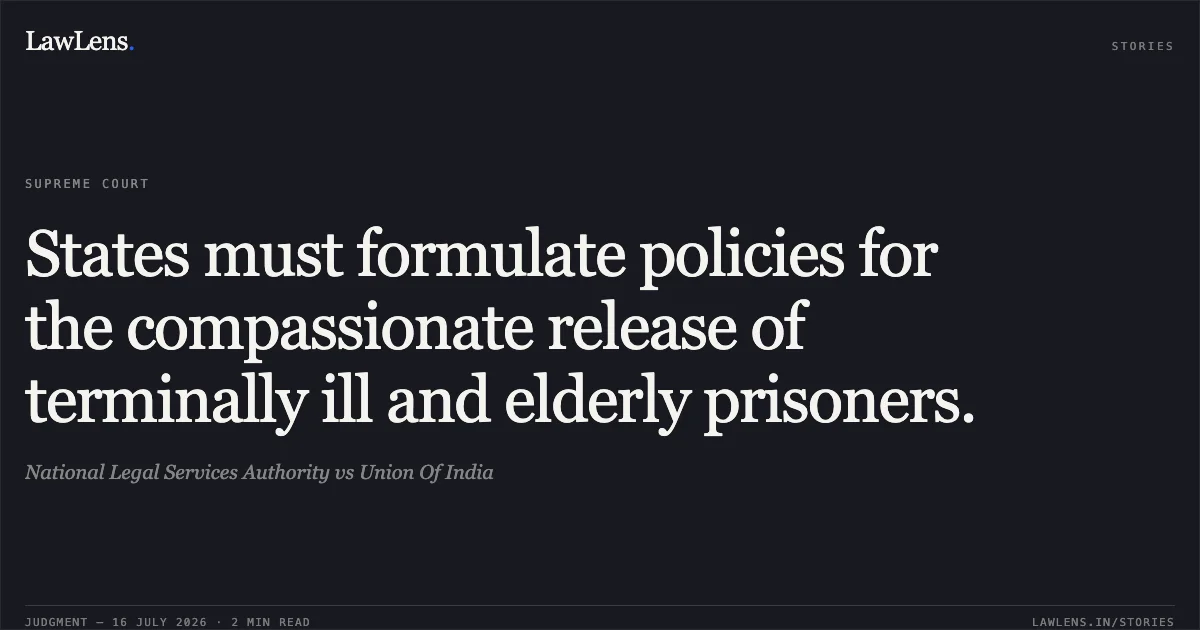
The Court held that advanced age and terminal illness are constitutionally relevant factors in the administration of justice and directed the Union and all States/UTs to act
It issued several mandates: (i) States must formulate a comprehensive policy for premature release within three months; (ii) Adoption of the UNODC definition of "terminal illness"; (iii) Constitution of independent Medical Boards and integration with Under Trial Review Committees (UTRCs); (iv) Mandatory integration of the entire process with the "National e-Prisons Portal" for real-time tracking; and (v) Submission of compliance affidavits within six months
Source reference: para. 40-A, 40-B, 40-C, 40-E, 40-H, 40-JThe matter is listed for review on January 19, 2027
Source reference: para. 42Acts & Sections Cited
1 provisions across 1 statute referred to in this judgment. Each provision opens on LawLens.
Legal Services Authorities Act, 19871
Original Court PDF
National Legal Services AuthorityvsUnion Of India
Click to open original judgment
Original judgment, available to read, download and summarize on LawLens.in