Facts
The petitioner, owning "Hotel Dynasty" in Guwahati, has been a consumer of the respondent (APDCL) since 1984.
Source reference: p. 2On 02.07.2021, APDCL issued a supplementary bill for ₹18,66,000/- as a surcharge for the period of June 1991 to July 2005, based on an audit report from 2007-08.
Source reference: p. 2The respondent claimed the petitioner had delayed payments for a bill raised in 1991, and though the principal was paid by 2006, the surcharge was missed due to a "bona fide error" discovered only in 2021.
Source reference: p. 4APDCL issued a notice on 22.07.2021 threatening disconnection if the dues were not cleared within 15 days.
Source reference: p. 3The petitioner challenged the bill and the threatened disconnection as a violation of Section 56 of the Electricity Act, 2003.
Source reference: p. 2Issues
1. Whether the respondent authorities can resort to Section 56(2) of the Act of 2003 to disconnect electricity supply on the basis of the bill dated 02.07.2021?
Source reference: p. 5 / para. 122. Whether the Court is required to interfere with or set aside the supplementary bill dated 02.07.2021?
Source reference: p. 5 / para. 12Law Applied
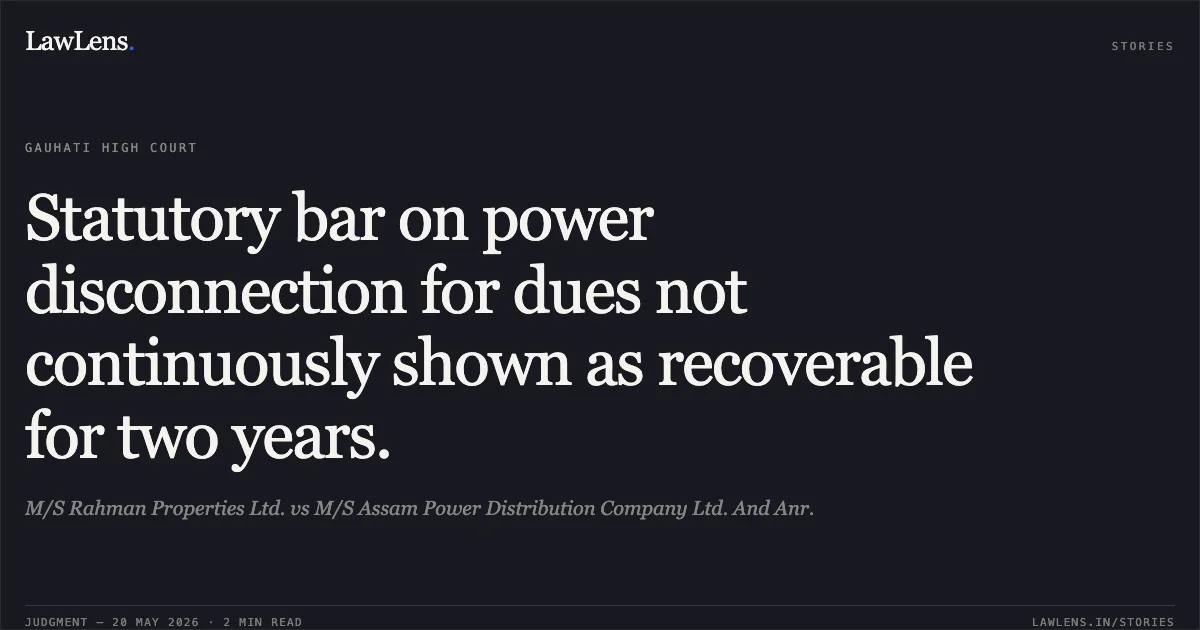
The court primarily applied Section 56 of the Electricity Act, 2003, which governs the disconnection of supply for default in payment. Specifically, Section 56(2) prohibits the recovery of any sum due after two years from the date it "first became due" unless shown continuously as an arrear, and expressly bars disconnection after this period.
Source reference: p. 6-7The court relied on the Supreme Court precedent Assistant Engineer (D1), Ajmer Vidyut Vitran Nigam Limited & Anr. v. Rahamatullah Khan alias Rahamjulla (2020), which clarified that while Section 56(2) bars the coercive remedy of disconnection after two years, it does not preclude the licensee from raising a supplementary demand or pursuing other legal modes of recovery.
Source reference: p. 10The court noted Section 17(1)(c) of the Limitation Act, 1963 regarding the discovery of a mistake.
Source reference: p. 10Reasoning
The court found that the monthly bills for the two years preceding the petition did not show the surcharge of ₹18,66,000/- as continuous arrears.
Source reference: p. 8Consequently, under Section 56(2), the right of APDCL to disconnect the supply was extinguished because the sum was not "continuously shown as recoverable" for the statutory two-year period.
Source reference: para 14-15However, following the ratio in Ajmer Vidyut Vitran Nigam Limited, the court reasoned that the underlying liability to pay does not vanish; the licensee is still permitted to issue a supplementary bill for a "bona fide mistake".
Source reference: para 16-17The question of whether the demand was time-barred for civil recovery involves questions of fact regarding the "discovery of mistake" under the Limitation Act, which the writ court declined to adjudicate.
Source reference: p. 11Holding
The court held that the respondent cannot disconnect the petitioner’s electricity supply based on the bill dated 02.07.2021.
The court declined to set aside the bill itself, affirming that the respondent has the authority to make supplementary demands.
Source reference: para 20(b)The writ petition was disposed of with directions that APDCL may seek recovery through other legally permissible modes, and the petitioner may raise all legal defenses, including limitation, in such proceedings. The court clarified that this judgment does not enlarge the period of limitation for the respondent.
Source reference: para 20(c) and para 22Acts & Sections Cited
2 provisions across 2 statutes referred to in this judgment. Each provision opens on LawLens.
Electricity Act, 20031
Limitation Act, 19631
Original Court PDF
M/S Rahman Properties Ltd.vsM/S Assam Power Distribution Company Ltd. And Anr.
Click to open original judgment
Original judgment, available to read, download and summarize on LawLens.in