Facts
The appellant, a sitting Member of the Legislative Assembly (MLA) from Datia, Madhya Pradesh, and former Chairman of the District Co-operative Agriculture & Rural Development Bank, was accused of influencing bank officials to unauthorizedly extend a Fixed Deposit term from three to fifteen years at a high interest rate of 13.5%.
Source reference: para. 3This act allegedly benefited a Trust headed by his mother, causing wrongful loss to the Bank.
Source reference: para. 3, 6Following a transfer of the case to Delhi by the Supreme Court, the Trial Court convicted the appellant on April 1, 2026, under Section 120B r/w Sections 420/467/468/471 of the IPC, sentencing him to three years of simple imprisonment.
Source reference: para. 8-10Consequently, the appellant was disqualified from the Vidhan Sabha under the Representation of the People Act, 1951.
Source reference: para. 18While his sentence was suspended earlier, the appellant moved this application specifically to stay his conviction to contest the upcoming bye-elections for his constituency.
Source reference: para. 1, 19Issues
1. Whether the appellant demonstrated "exceptional circumstances" or manifest illegality in the judgment to warrant a stay of conviction under Section 389(1) of the Cr.P.C.
Source reference: para. 13, 312. Whether the potential loss of an opportunity to contest a bye-election constitutes "irreversible consequence" sufficient to stay a conviction involving moral turpitude.
Source reference: para. 37, 43Law Applied
The court primarily applied Section 389(1) of the Cr.P.C. regarding the suspension of execution of sentence and conviction.
Source reference: para. 31It relied on the principle from Rama Narang v. Ramesh Narang, which established that while appellate courts have the power to stay convictions, it must be exercised only in "fit cases".
Source reference: para. 31The court further applied the "exceptional circumstances" doctrine from K.C. Sareen v. CBI and Ravikant S. Patil v. Sarvabhouma S. Bagali, emphasizing that the power should be used sparingly where failure to stay would lead to injustice and irreversible consequences.
Source reference: para. 33-34It also considered Afjal Ansari v. State of U.P., which mandates balancing the integrity of the electoral process against the rights of the constituency, especially concerning offences involving moral turpitude.
Source reference: para. 35The court noted the statutory mandate of disqualification under Section 8 of the Representation of the People Act, 1951.
Source reference: para. 36Reasoning
The court reasoned that a stay of conviction is an extraordinary remedy and not a matter of right.
Source reference: para. 30-32Upon a prima facie review of the Trial Court record, the court found no "palpable, manifest, or apparent error" that would render the conviction unsustainable.
Source reference: para. 45-46The court noted that the evidence—including alterations to bank records and a co-accused’s prior admissions—supported a systematic conspiracy to benefit the appellant's family Trust at the bank’s expense.
Source reference: para. 45The court rejected the argument that the upcoming bye-election constituted a "classic" irreversible hardship, stating that disqualification is a universal statutory consequence for all convicted representatives and not an "individual-centric" exceptionality.
Source reference: para. 41-43The court held that the offences involved moral turpitude (forgery and cheating by a public figure), and staying the conviction would frustrate the legislative intent of Section 8 of the Representation of the People Act, which aims to maintain purity in political life.
Source reference: para. 47Holding
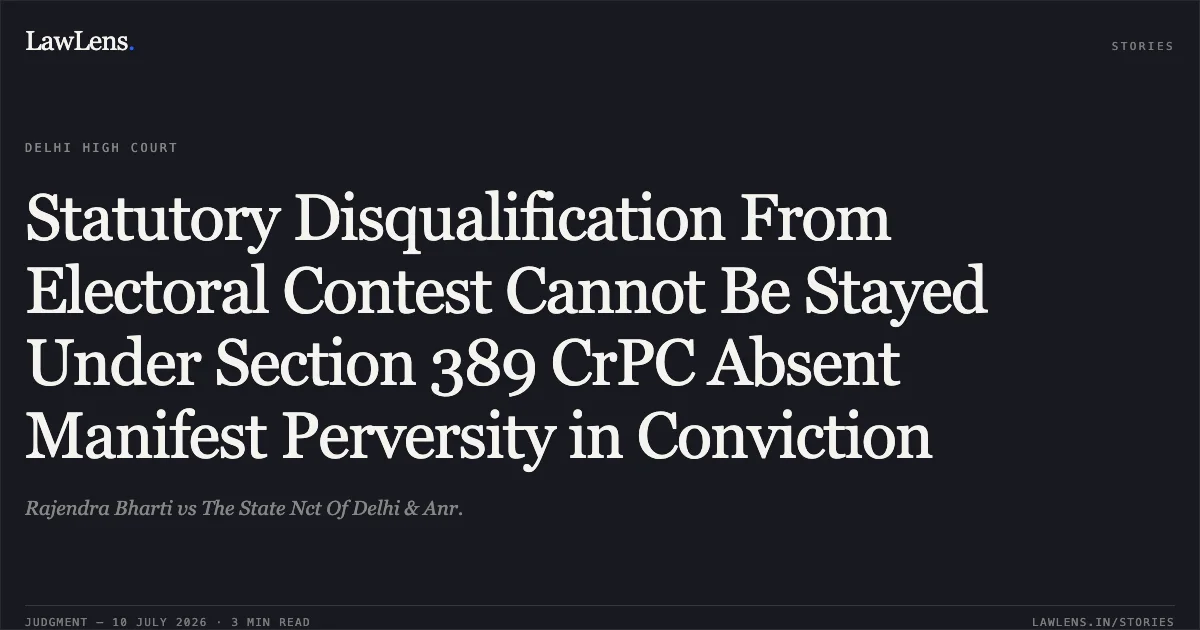
The court held that the appellant failed to meet the threshold of proving "exceptional circumstances" or "manifest unreasonableness" in the trial judgment.
The court concluded that protecting the integrity of the electoral process outweighs the appellant's desire to contest the election, especially given the nature of the charges and the lack of a fundamental flaw in the conviction at this stage.
Source reference: para. 47The court dismissed the application for stay of conviction.
Source reference: para. 48Acts & Sections Cited
1 provisions across 1 statute referred to in this judgment. Each provision opens on LawLens.
Representation of the People Act, 19511
Original Court PDF
Rajendra BhartivsThe State Nct Of Delhi & Anr.
Click to open original judgment
Original judgment, available to read, download and summarize on LawLens.in


![Subsequent exoneration does not retrospectively invalidate a finalized promotion select list.. UNNIKRISHNAN M vs M/o Environment And Forests. CAT - ['Ernakulam']. LawLens](/stories/thumbnails/subsequent-exoneration-does-not-retrospectively-invalidate-a-finalized-promotion-select-li-ce80a0e84f2f4887857271e8b4341c42.webp)