Facts
Various insurance companies filed statutory appeals under Section 173 of the Motor Vehicles Act, 1988, challenging awards passed by Motor Accident Claims Tribunals (MACT).
Source reference: p. 6In each case, the Tribunal found a policy violation—such as the driver lack of a valid license, driving under the influence of alcohol, or plying without a permit—but nonetheless directed the insurers to pay compensation to the third-party claimants and subsequently recover the amount from the insured (the "pay and recover" doctrine).
Source reference: p. 7-12The insurers argued that the Motor Vehicles (Amendment) Act, 2019, which substituted Chapter XI and replaced Section 149 with Section 150, deliberately omitted the proviso to Section 149(4) and Section 149(5) that previously formed the statutory basis for the "pay and recover" doctrine.
Source reference: p. 13Issues
1. Whether the deletion of the proviso to Section 149(4) and the omission of Section 149(5) in the amended Section 150 of the Motor Vehicles Act, 1988, abolishes the doctrine of "pay and recover".
Source reference: p. 13 / para. 42. Whether the statutory duty of an insurer to satisfy an award in favor of a third party under Section 150(1) is independent of the contractual defenses available to the insurer against the insured under Section 150(2).
Source reference: p. 43 / para. 29Law Applied
Section 150(1) of the Motor Vehicles Act, 1988 (as amended in 2019), which mandates that insurers satisfy judgments/awards against the insured "notwithstanding" their entitlement to avoid or cancel the policy.
Source reference: p. 41, 51Section 150(6) Explanation (c), which encompasses liabilities that would be covered but for the insurer’s right to avoid the policy.
Source reference: p. 52National Insurance Co. Ltd. v. Swaran Singh (2004) 3 SCC 297, which established that the insurer's liability to third parties is statutory, whereas liability to the insured is contractual.
Source reference: p. 61Principles of beneficial construction for social welfare legislation as seen in Shivaji Dayanu Patil v. Vatschala Uttam More (1991) 3 SCC 530.
Source reference: p. 55Reasoning
The Court reasoned that the statutory duty under Section 150(1) creates a "jural correlative" between the third party’s right to compensation and the insurer’s obligation to pay, which is distinct from the contract of indemnity between the insurer and the insured.
Source reference: para. 29-34The Court observed that the deletion of the proviso to Section 149(4) did not destroy the "pay and recover" doctrine because the Supreme Court in United India Insurance Co. Ltd. v. Lehru had characterized that proviso as merely "illustrative," not the sole source of power.
Source reference: para. 45, 61The deletion of Section 149(5) was found to be a logical consequence of Section 147(2) making insurer liability "unlimited," thereby rendering the concept of "excess" payments (above statutory limits) redundant.
Source reference: para. 60Parliamentary debates and Standing Committee reports confirmed that the 2019 Amendment intended to protect third parties and maintain unlimited liability rather than erode the protection of the "pay and recover" regime.
Source reference: para. 56-59Therefore, establishng a defense under Section 150(2) only absolves the insurer of contractual liability toward the insured, but the statutory obligation toward the third party remains intact under Section 150(1).
Source reference: para. 73, 75Holding
The Court held that the 2019 Amendment does not obliterate the "pay and recover" doctrine.
The insurer’s duty toward third parties is statutory under Section 150(1) and remains regardless of whether the insurer establishes a defense under Section 150(2).
Source reference: para. 75(b)The Court concluded that if an insurer proves a policy violation, it must first satisfy the award to the third party and may then recover the sum from the insured as per the procedure in Swaran Singh.
Source reference: para. 75(c)All appeals were dismissed, and the Tribunals' directions for "pay and recover" were upheld.
Source reference: para. 78-79Acts & Sections Cited
13 provisions across 3 statutes referred to in this judgment. Each provision opens on LawLens.
Code of Civil Procedure, 19081
Indian Contract Act, 18722
Original Court PDF
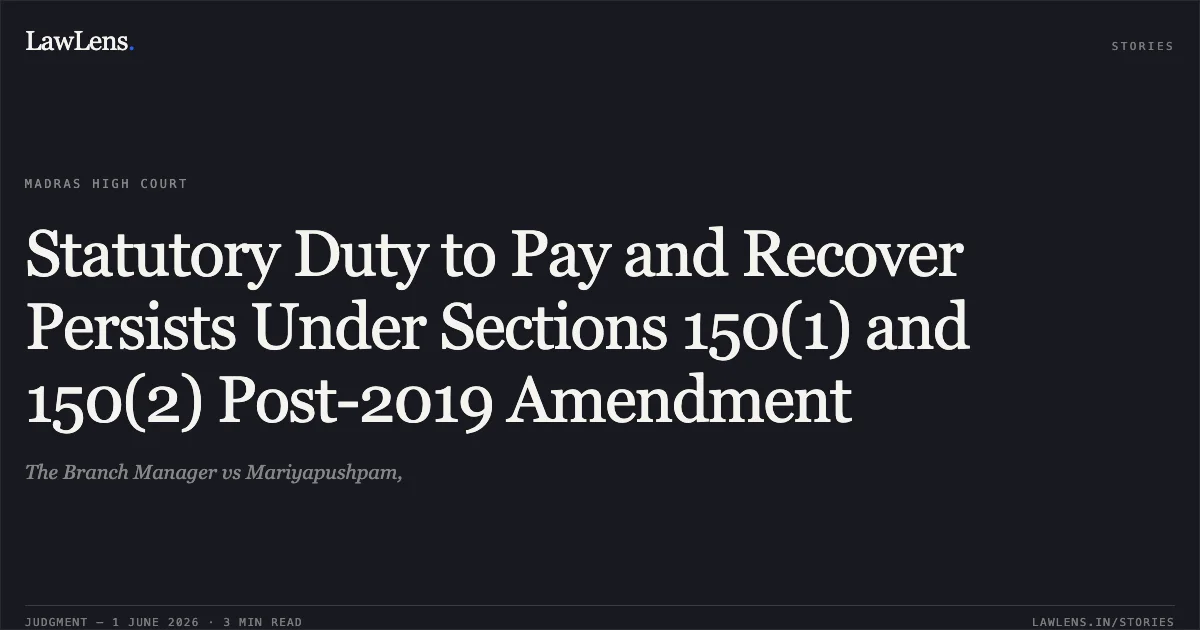
The Branch ManagervsMariyapushpam,
Click to open original judgment
Original judgment, available to read, download and summarize on LawLens.in