Facts
The petitioners own ancestral property in Sarafa Bazar, Gwalior, designated as a commercial-cum-residential area
Source reference: para. 2Seeking reconstruction, they obtained a building plan sanction from the Town and Country Planning department and subsequently filed an application under Section 294 of the M.P. Municipal Corporation Act, 1956 ("the Act") with the Gwalior Municipal Corporation on April 17, 2005
Source reference: para. 2, 12When the Commissioner failed to communicate a decision within the 30-day statutory period, the petitioners commenced construction on June 15, 2005, under the "deemed permission" provision of Section 295(3)
Source reference: para. 3, 13On July 6, 2005, the respondents issued a stop-work order based on Resolution No. 1210 (dated 1999), which restricted construction within 500 meters of Maharaj Bada
Source reference: para. 4This resolution was later withdrawn in 2009 via Resolution No. 446
Source reference: para. 6, 11Despite the withdrawal, the respondents issued a notice on April 5, 2010, declaring the construction unauthorized, and a letter on March 30, 2010, demanding a compounding fee of ₹1,51,62,480/-
Source reference: para. 6, 7Issues
1. Whether the construction carried out by the petitioners is valid under the doctrine of deemed sanction pursuant to Section 295(3) of the Act.
Source reference: para. 122. Whether the respondents can sustain enforcement actions based on a resolution (Resolution No. 1210) that was subsequently withdrawn.
Source reference: para. 113. Whether the demand for a compounding fee and the notice for demolition were legally sustainable and compliant with the principles of natural justice.
Source reference: para. 15Law Applied
Section 295(3) of the M.P. Municipal Corporation Act, 1956, which establishes a "legal fiction" of deemed permission if the Commissioner fails to grant or refuse sanction within 30 days of an application
Source reference: para. 12Any administrative action founded upon a withdrawn resolution cannot be sustained
Source reference: para. 11Precedent in Administrator, Municipal Corporation, Raipur vs. Charanlal Sahu (C. Revision No. 471 of 1975), which held that if an application is not rejected within the statutory period, the right of the authority to refuse permission is forfeited
Source reference: para. 8Reasoning
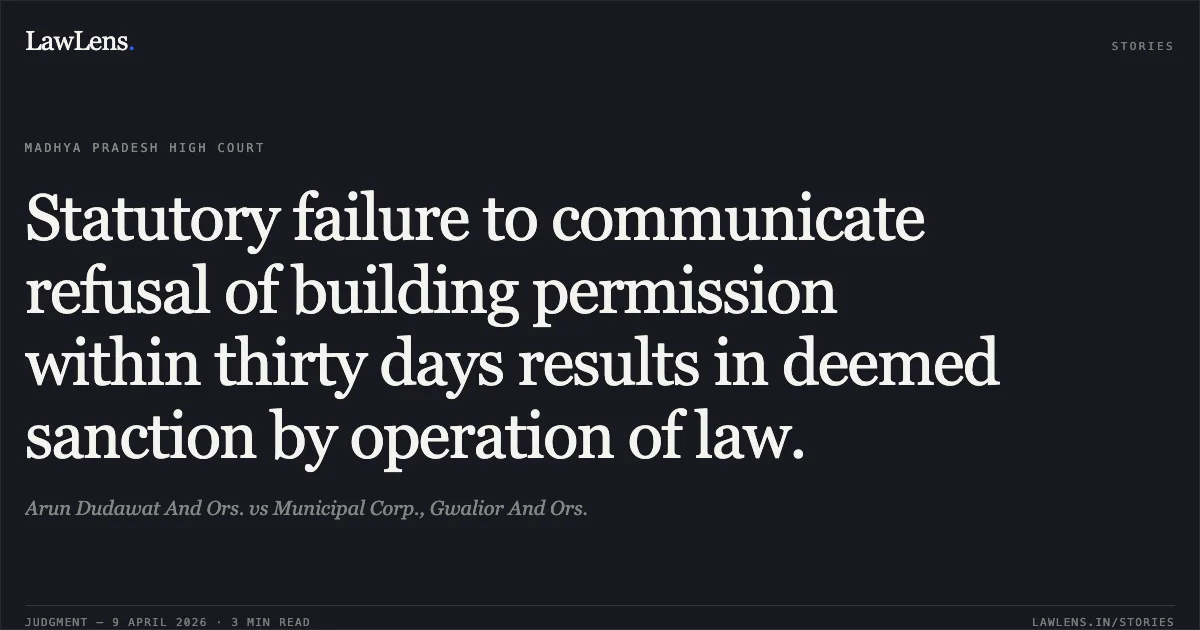
The court reasoned that the statutory scheme of Section 295(3) imposes a mandatory obligation on the competent authority to decide on building applications within a fixed timeframe
Source reference: para. 12Since the respondents failed to communicate any refusal within 30 days of the April 17, 2005, application, a vested right was created in favor of the petitioners through the operation of law
Source reference: para. 12, 13Regarding Resolution No. 1210, the court noted that since it was withdrawn by the Corporation itself in 2009, any subsequent action (such as the 2010 notices) predicated on that resolution was void ab initio
Source reference: para. 11The court found the impugned notices for demolition and compounding fees to be arbitrary, as they ignored the legal fiction of the deemed sanction and were issued without a proper hearing, thereby violating the principles of natural justice
Source reference: para. 15Holding
The Court allowed the writ petition and quashed the impugned notice dated April 5, 2010 (Annexure P/18) and the letter dated March 30, 2010 (Annexure P/19)
The Court held that the petitioners' construction shall be treated as having been carried out under deemed permission in accordance with law
Source reference: para. 17The respondents were restrained from taking coercive action, though the Court granted them liberty to initiate fresh action only if it is factually determined that the construction deviates from the original sanctioned layout plan
Source reference: para. 17No costs were awarded
Source reference: para. 17Acts & Sections Cited
19 provisions across 2 statutes referred to in this judgment. Linked provisions open on LawLens.
M.P. Municipal Corporation Act, 1956
Madhya Bharat Kans Eradication Act Samvat, 20051
Original Court PDF
Arun Dudawat And Ors.vsMunicipal Corp., Gwalior And Ors.
Click to open original judgment
Original judgment, available to read, download and summarize on LawLens.in


