Facts
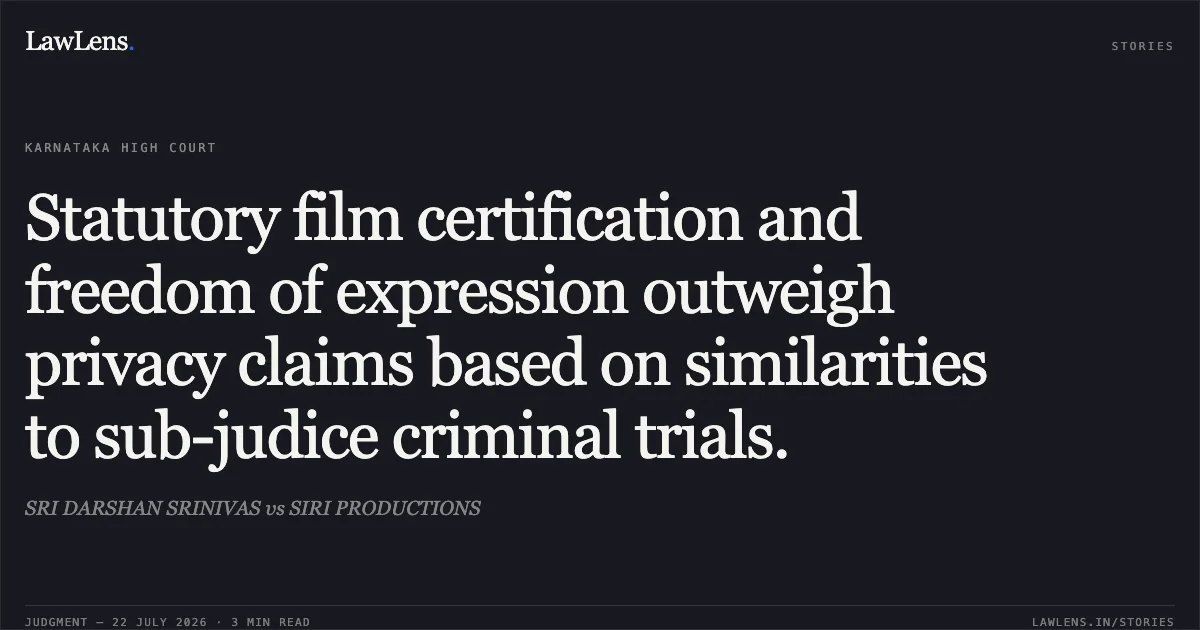
The Appellants (Plaintiffs), a prominent Kannada actor known as "D-Boss" and his wife, filed an original suit seeking a permanent injunction against Respondents 1 and 2 (Producer/Director) to restrain the release of the film titled "BOSS".
Source reference: p. 5, 16The Appellants alleged the film is a thinly veiled cinematic re-enactment of an ongoing criminal trial (S.C. No. 1319/2024) where Appellant No. 1 is an under-trial prisoner accused of murder.
Source reference: p. 8-11They identified 13 factual parallels between the film’s teaser and the sub-judice matter, including the victim’s plea, the crime scene location, and the protagonist’s moniker.
Source reference: p. 12-15The Trial Court initially granted an ad-interim injunction but subsequently dismissed the application for temporary injunction (I.A. No. 1) on June 2, 2026.
Source reference: p. 4-6The Appellants challenged this dismissal, arguing it violates their right to a fair trial and privacy under Article 21.
Source reference: p. 23-24The Respondents maintained the film is a work of fiction concerning a cricketer-turned-politician and is protected by Article 19(1)(a).
Source reference: p. 31-33Issues
1. Whether there is any perversity or illegality in the Trial Court’s order dismissing the application for temporary injunction.
Source reference: p. 50, para. 112. Whether the release of a certified film, allegedly mirroring an ongoing criminal trial, warrants a prior restraint in light of the fundamental right to freedom of speech.
Source reference: p. 50, 52Law Applied
The Court applied the three-pronged test for temporary injunctions—prima facie case, balance of convenience, and irreparable injury—under Order XXXIX Rules 1 and 2 of the CPC.
Source reference: p. 50-51, para. 12It relied on Wander Ltd. v. Antox India P. Ltd. regarding the limited scope of appellate interference in discretionary orders.
Source reference: p. 58, para. 20The Court emphasized the fundamental right to freedom of speech and expression under Article 19(1)(a) of the Constitution, as interpreted in Nachiketa Walhekar v. CBFC, Bobby Art International v. Om Pal Singh Hoon, and Adarsh Co-operative Housing Society Ltd. v. Union of India.
Source reference: p. 63, para. 24; p. 43, para. 10.20; p. 69, para. 26Regarding privacy and public records, it applied the principles from R. Rajagopal v. State of T.N. (Auto Shankar Case), and for the "right to a fair trial," it considered the "doctrine of sub judice" versus freedom of expression.
Source reference: p. 65, para. 25; p. 69, para. 26Reasoning
The Court reasoned that the film "BOSS" was not a biopic but a work of fiction that incorporated elements already in the public domain due to extensive media reporting of the criminal trial.
Source reference: p. 53-55It held that once the Central Board of Film Certification (CBFC), a statutory expert body, grants certification, the judiciary should not act as a "Super Censor Board".
Source reference: p. 54, para. 16The Court rejected the argument that the film would prejudice the criminal trial, noting that judicial officers possess the wisdom to decide cases based on legal evidence rather than cinematic depictions.
Source reference: p. 56-57, para. 18Weighing the balance of convenience, the Court found that restraining the release would cause severe financial hardship to the producers, whereas any potential reputational harm to the Appellants could be adjudicated at trial or compensated via damages.
Source reference: p. 47, 57The presence of a disclaimer stating the work is fictional further mitigated the necessity for prior restraint.
Source reference: p. 36, 71Holding
The High Court dismissed the appeal, affirming the Trial Court's order.
It held that there was no perversity, illegality, or arbitrariness in refusing the injunction.
Source reference: p. 72, para. 28The Court ruled that the Appellants failed to establish a prima facie case for prior restraint against a CBFC-certified film, as the materials used were within the public domain and the Respondents' rights under Article 19(1)(a) must be protected.
Source reference: p. 54-56All observations were limited to the interlocutory stage.
Source reference: p. 73Acts & Sections Cited
4 provisions across 1 statute referred to in this judgment. Each provision opens on LawLens.
Code of Civil Procedure, 19084
Original Court PDF
SRI DARSHAN SRINIVASvsSIRI PRODUCTIONS
Click to open original judgment
Original judgment, available to read, download and summarize on LawLens.in


![Subsequent exoneration does not retrospectively invalidate a finalized promotion select list.. UNNIKRISHNAN M vs M/o Environment And Forests. CAT - ['Ernakulam']. LawLens](/stories/thumbnails/subsequent-exoneration-does-not-retrospectively-invalidate-a-finalized-promotion-select-li-ce80a0e84f2f4887857271e8b4341c42.webp)