Facts
The petitioner was appointed as an Assistant in 1986 under BISCOLAMF and later allocated to JHASCOLAMF in Jharkhand
Source reference: para. 2He superannuated on 31.01.2025 after more than 38 years of service
Source reference: para. 1, 23Upon retirement, the respondents released leave encashment for only 147 days instead of 300 days and paid Rs. 18,38,925/- as gratuity by applying the Jharkhand Pension Rules, 2000
Source reference: para. 5, 15The petitioner challenged this, claiming a higher gratuity amount (Rs. 21,21,836/-) based on the Payment of Gratuity Act, 1972, and full leave encashment
Source reference: para. 9-11Issues
1. Whether the writ petition is maintainable despite the availability of an alternative remedy under the Payment of Gratuity Act?
Source reference: para. 19(a)2. Whether the petitioner's gratuity was wrongly calculated by applying Jharkhand Pension Rules instead of the Payment of Gratuity Act, 1972?
Source reference: para. 19(b)3. Whether the restriction of leave encashment to 147 days is sustainable in law?
Source reference: para. 19(c)Law Applied
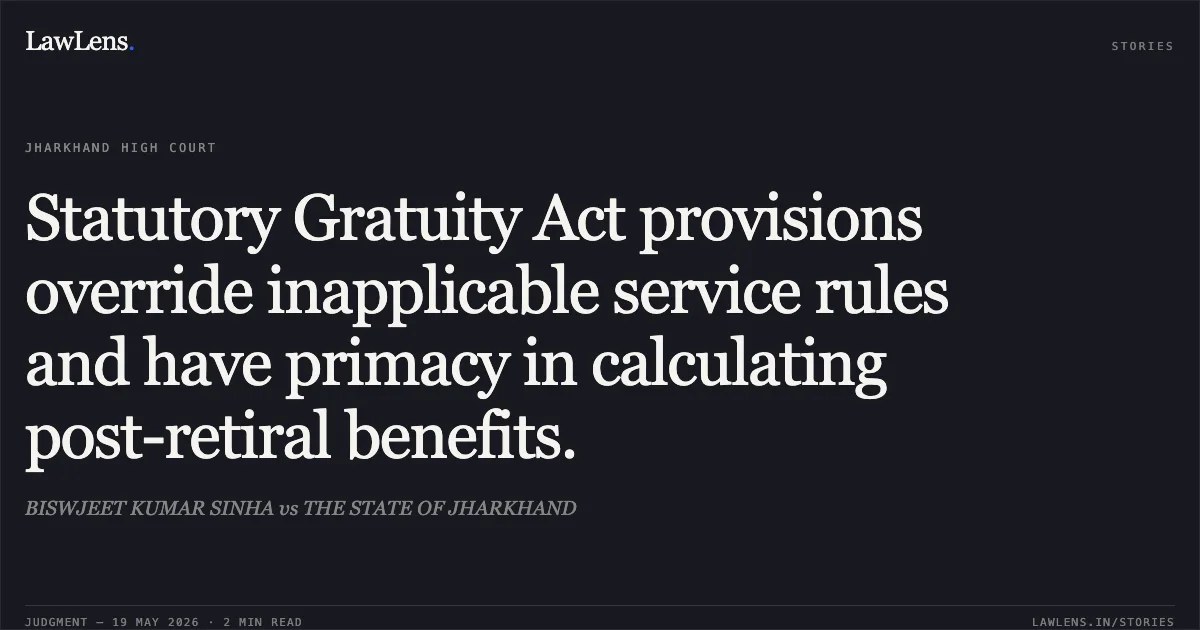
The court primarily applied the Payment of Gratuity Act, 1972, noting it is a complete code with overriding effect over inconsistent rules for entities like Co-operative Societies and Federations
Source reference: para. 21-22It relied on the principle that writ jurisdiction is exercisable despite alternative remedies when actions are arbitrary or involve patent illegalities
Source reference: para. 20The court also applied Rule 298 of the Jharkhand Service Code, which mandates the employer to verify leave accounts and service books annually, placing the burden of record maintenance on the State/Employer rather than the employee
Source reference: para. 26Reference was also made to Dr. Dudh Nath Pandey vs. State of Jharkhand & Ors. regarding the timely release of post-retiral benefits
Source reference: para. 8Reasoning
The court rejected the respondents' preliminary objection on maintainability, holding that since the respondents failed to apply the statutory Act entirely and instead used inapplicable Pension Rules—which do not govern JHASCOLAMPF—it constituted a patent illegality
Source reference: para. 20-21Regarding gratuity, the court found the respondents' formula (Basic + DA × ½ × half-years of service) per the Pension Rules was incorrect; the statutory formula under the Gratuity Act (Last Drawn Salary × Years of Service × 15/26) must prevail
Source reference: para. 11, 22Furthermore, the court noted that because DA exceeded 50%, the gratuity ceiling should have increased by 25% as per Memo No. 218/f dated 18.01.2017
Source reference: para. 24On leave encashment, the court ruled that the petitioner cannot be penalized for missing records, as the duty to maintain and verify leave accounts lies with the Head of Office under Rule 298 of the Jharkhand Service Code
Source reference: para. 26Holding
The court allowed the writ petition, holding that the application of Pension Rules was illegal and the restriction of leave encashment was arbitrary
The respondents were directed to: (a) recalculate and pay the differential gratuity amount strictly under the Payment of Gratuity Act, 1972, with statutory interest; and (b) recalculate and pay leave encashment for the full 300 days. The exercise must be completed within six weeks.
Source reference: para. 29-30Acts & Sections Cited
1 provisions across 1 statute referred to in this judgment. Linked provisions open on LawLens.
PAYMENT OF GRATUITY ACT, 19721
Original Court PDF
BISWJEET KUMAR SINHAvsTHE STATE OF JHARKHAND
Click to open original judgment
Original judgment, available to read, download and summarize on LawLens.in


