Facts
The subject land, admeasuring approximately 12.40 hectares in Bijwasan, Delhi, was originally acquired as agricultural land in 1986 and handed over to the Delhi Development Authority (DDA)
Source reference: para. 4(i)In 2008, the DDA allotted the land to the Railway Authority on a perpetual lease for the development of an Integrated Metropolitan Passenger Terminal (IMPT)
Source reference: para. 4(ii)The project was incorporated into the Master Plan of Delhi (MPD) 2015 and 2021 as a "Multi-Use" zone
Source reference: para. 4(iii)In 2022, the Rail Land Development Authority (RLDA) issued a Request for Proposal (RFP) for mixed-use development, which was challenged by Respondent No. 5 before the National Green Tribunal (NGT) on the grounds that the land constituted "deemed forest" under the Forest (Conservation) Act, 1980 (the "1980 Act")
Source reference: para. 2, 5The NGT dismissed the application, finding no cogent evidence of the land being forest and noting that the 2023 Amendment to the 1980 Act excluded "deemed forests"
Source reference: para. 8The Appellants, acting as public-spirited individuals, challenged the NGT’s order
Source reference: para. 3Issues
1. Whether land that is not recorded as forest in revenue records or declared as such, and does not fulfill the requirements of a "deemed forest" at the time of being earmarked for a project under a statutory Master Plan, can be declared a "deemed forest" due to the subsequent natural growth of trees, thereby overriding the Master Plan?
Source reference: para. 25(i)2. Which date is relevant for determining the nature of land as a "deemed forest": the date the Master Plan came into force or the date project execution was initiated?
Source reference: para. 25(ii)Law Applied
Section 2 of the Forest (Conservation) Act, 1980, which restricts the use of forest land for non-forest purposes without Central Government approval
Source reference: para. 26The dictionary-based definition of "forest" established in T.N. Godavarman Thirumulkpad v. Union of India
Source reference: para. 27The character of land cannot be altered merely by subsequent plantation if it was historically non-forest as held in Re: Construction of Park at NOIDA
Source reference: para. 30The statutory finality and binding nature of an approved Master Plan as established in The Auroville Foundation v. Navroz Kersasp Mody
Source reference: para. 41The principle of sustainable development, balancing economic needs with environmental protection as seen in Essar Oil Ltd. v. Halar Utkarsh Samiti
Source reference: para. 23Reasoning
The Court reasoned that a statutory Master Plan is a long-term planning instrument that attains finality and provides certainty for urban development
Source reference: para. 38, 42If land is not recorded as forest when a Master Plan is notified, the subsequent proliferation of vegetation—often consisting of invasive alien species like Prosopis juliflora (Vilayati Kikar) which disrupt native ecosystems—cannot legally transform the land into a "deemed forest"
Source reference: para. 44, 46, 54The Court emphasized that a mechanical application of tree-density tests to determine "deemed forest" status is improper if it ignores the historical character and planned use of the land
Source reference: para. 30, 32Since the subject land was agricultural at the time of acquisition and earmarked for a critical public infrastructure project (the IMPT) under the MPD 2021, the Master Plan must prevail over any ecological changes occurring by efflux of time
Source reference: para. 59-60The Court also noted that the proliferation of invasive species does not signify a natural forest ecosystem worthy of protection under the 1980 Act
Source reference: para. 54Holding
The Supreme Court dismissed the appeal and upheld the NGT’s judgment, holding that the subject land cannot be treated as "deemed forest" and thus requires no Central Government approval under Section 2 of the 1980 Act
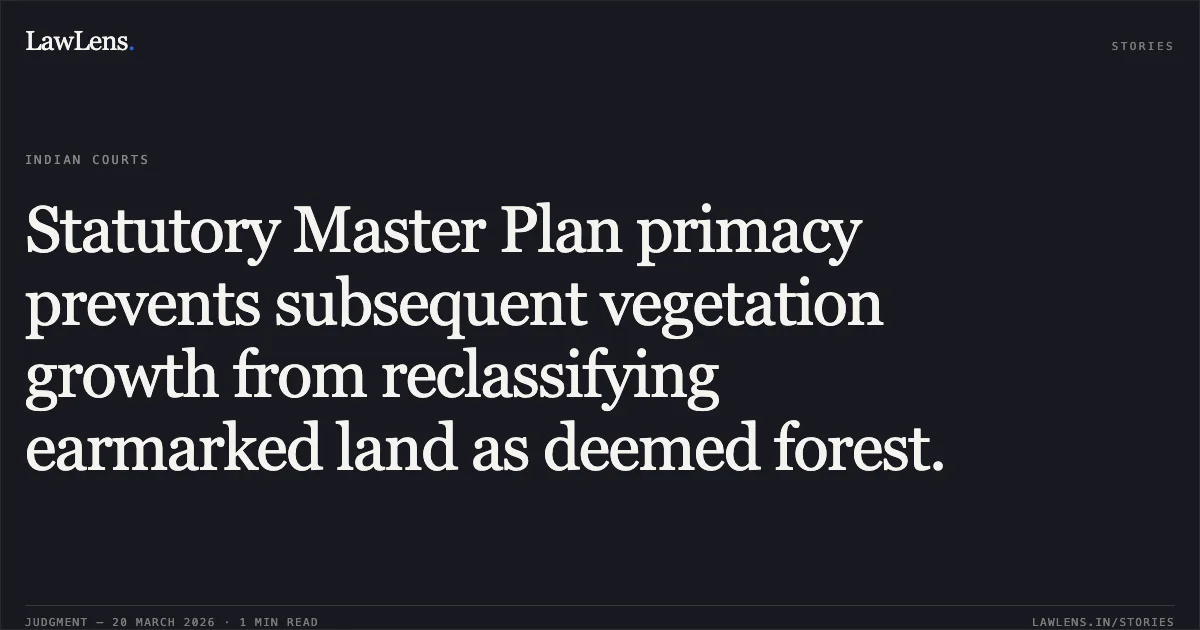
Land earmarked in an approved Master Plan cannot be subsequently declared a "deemed forest" due to later vegetation growth if it was not a forest at the Master Plan's inception
Source reference: para. 65(i)The relevant date for determining "deemed forest" status is the date the Master Plan came into force
Source reference: para. 65(ii)The Court directed the respondents to maintain 20% green cover, transplant native/indigenous trees to the maximum extent possible, and undertake compensatory afforestation as per statutory rules
Source reference: para. 62, 67Acts & Sections Cited
2 provisions across 2 statutes referred to in this judgment. Each provision opens on LawLens.
Van (Sanrakshan Evam Samvardhan) Adhiniyam, 19801
National Green Tribunal Act, 20101
Original Court PDF
Naveen SolankivsRail Land Development Authority
Click to open original judgment
Original judgment, available to read, download and summarize on LawLens.in


![Subsequent exoneration does not retrospectively invalidate a finalized promotion select list.. UNNIKRISHNAN M vs M/o Environment And Forests. CAT - ['Ernakulam']. LawLens](/stories/thumbnails/subsequent-exoneration-does-not-retrospectively-invalidate-a-finalized-promotion-select-li-ce80a0e84f2f4887857271e8b4341c42.webp)