Facts
The Petitioner, a 3rd-year veterinary student at Respondent No. 3 college, was caught using unfair means during the ‘Veterinary Pharmacology and Toxicology-I’ theory examination on November 14, 2025
Source reference: para. 4(f)Following an inquiry by the University, he was found guilty and issued a communication dated January 8, 2026, declaring him ‘failed’ in the subject and disentitling him from the compartmental examination
Source reference: para. 4(g)Consequently, despite passing other subjects, his final result showed him as 'Fail'
Source reference: para. 4(h)The Petitioner challenged the communication and the vires of the Maharashtra Animal and Fishery Science University Academic Regulations, 2016, alleging that the imposition of multiple penalties constituted double jeopardy
Source reference: para. 5(a)Issues
1. Whether the imposition of penalties under both Rule 26(6)(2) and Rule 26(9) of the Regulations of 2016 constitutes double jeopardy or is inconsistent with the Constitution of India.
Source reference: para. 5(a) / 6(c)2. Whether the Academic Regulations of 2016 are ultra vires to the Constitution of India.
Source reference: para. 3(C) / 6(b)Law Applied
Rule 26(6)(2) mandates that a student using unfair means in an annual examination shall be declared failed in the subject and rendered ineligible for the compartmental examination
Source reference: para. 6(e)-(f)Rule 26(9) further provides that "apart from other punishments," such a student shall be deemed to have attempted and failed the entire examination
Source reference: para. 6(h)The court also relied on the precedent Atharva Anil Kshirsagar v. The State of Maharashtra (WP No. 702 of 2024), which held that punishments for malpractices must be deterrent and do not constitute double jeopardy as they are components of a single disciplinary action
Source reference: para. 5(d) / 6(p)Reasoning
The court rejected the Petitioner's contention of double jeopardy, clarifies that the concept was "misconceived" in this context
Source reference: para. 6(c)It reasoned that Rule 26(9) is an additional, non-overlapping penalty clearly marked by the legislative intent "apart from other punishments"
Source reference: para. 6(i)The court emphasized that students who fail due to poor performance cannot be equated with those who fail due to "scandalizing the process of examination" through unfair means; thus, stringent, deterrent punishments are rational
Source reference: para. 6(p), quoting Atharva KshirsagarRegarding the challenge to the vires of the rules, the court found no inconsistency between the provisions or with the Constitution, noting that the Petitioner was provided a fair inquiry in accordance with natural justice
Source reference: para. 6(j)-(l), 6(r)Holding
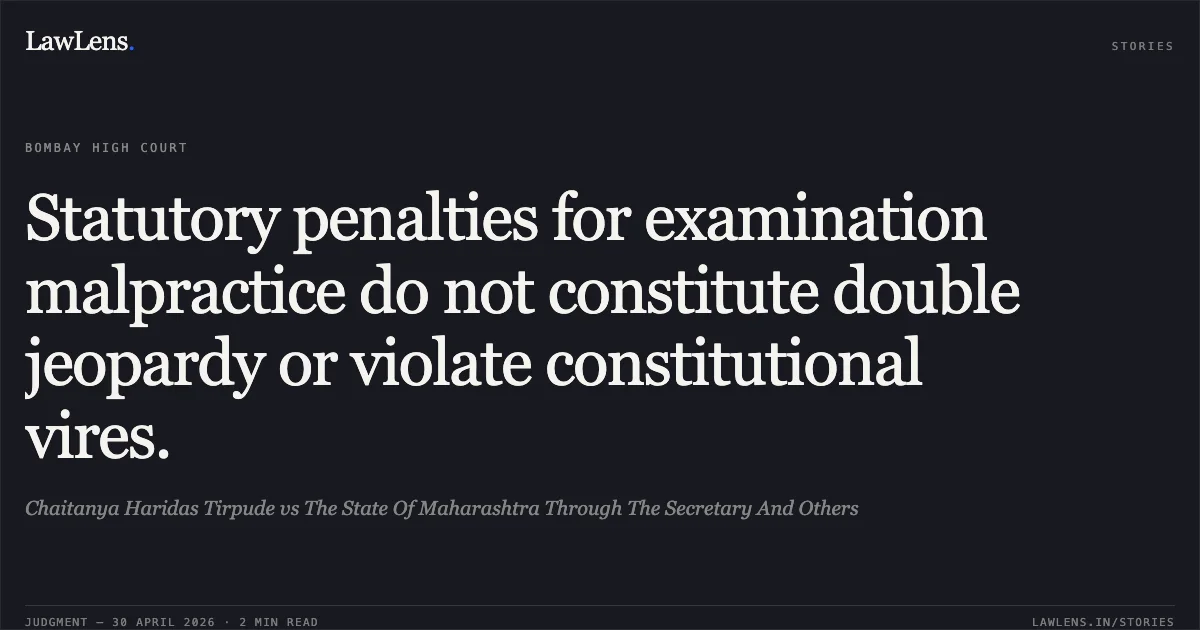
The Court answered both issues in the negative, holding that the Regulations are neither inconsistent nor ultra vires.
The punishment of being declared ‘failed’ in the entire examination and being debarred from the compartmental session is a valid, singular disciplinary consequence of malpractice
Source reference: para. 6(q)The High Court dismissed the Writ Petition and discharged the Rule, refusing to interfere with the University’s decision
Source reference: Order I-IIOriginal Court PDF
Chaitanya Haridas TirpudevsThe State Of Maharashtra Through The Secretary And Others
Click to open original judgment
Original judgment, available to read, download and summarize on LawLens.in


![Subsequent exoneration does not retrospectively invalidate a finalized promotion select list.. UNNIKRISHNAN M vs M/o Environment And Forests. CAT - ['Ernakulam']. LawLens](/stories/thumbnails/subsequent-exoneration-does-not-retrospectively-invalidate-a-finalized-promotion-select-li-ce80a0e84f2f4887857271e8b4341c42.webp)