Facts
The State appealed against the acquittal of the respondents (the husband and in-laws) by the Additional Sessions Judge, Panchmahal at Godhra
Source reference: p. 1On March 23, 2008, the deceased, Manjulaben, allegedly consumed poison and died after an incident where she slapped her daughter for complaining about burning feet while heading to a 'Mela'
Source reference: p. 2Initially registered as an accidental death, a subsequent complaint was filed by the deceased’s brother, Hareshbhai, alleging that the respondents harassed her for not bearing a male child, driving her to suicide
Source reference: p. 2The Trial Court acquitted the respondents on March 20, 2009, finding insufficient evidence of cruelty or abetment
Source reference: p. 2Issues
1. Whether the Trial Court was justified in passing the judgment of acquittal based on the evidence adduced
Source reference: p. 52. Whether the prosecution established the essential ingredients of Sections 498-A and 306 of the IPC beyond a reasonable doubt
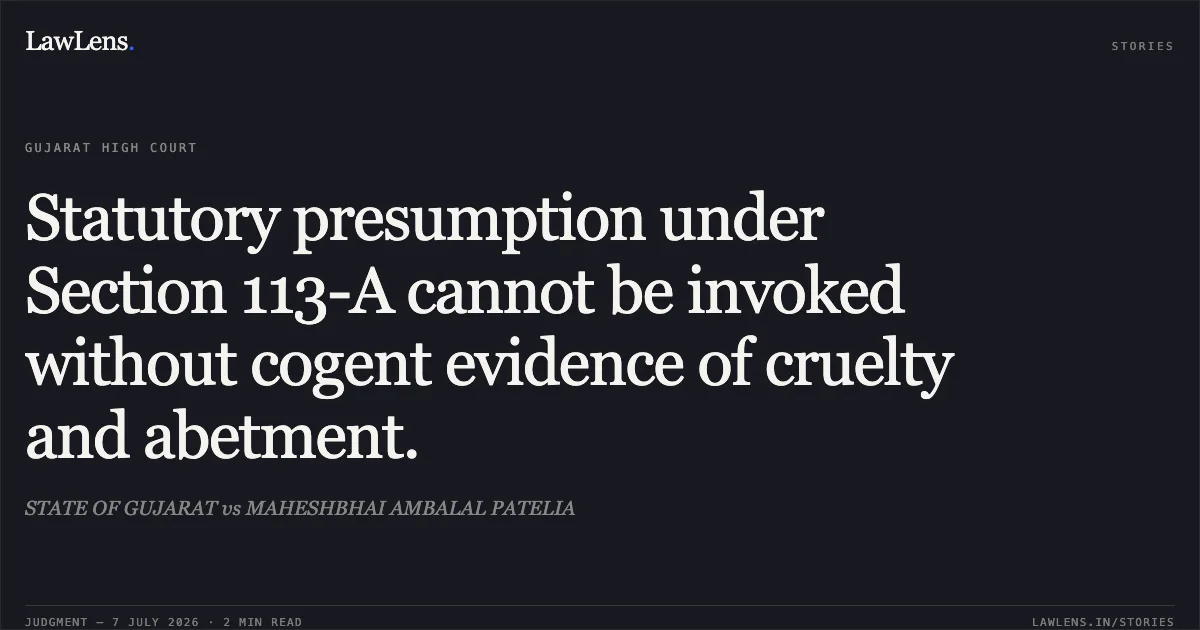
Source reference: p. 5, 73. Whether the statutory presumption under Section 113-A of the Indian Evidence Act was attracted in the absence of evidence of cruelty
Source reference: p. 4, 9Law Applied
The court applied Section 498-A of the IPC, which defines "cruelty" as willful conduct likely to drive a woman to suicide or harassment for unlawful demands
Source reference: p. 8It considered Section 306 regarding abetment of suicide and Section 107 defining abetment through instigation, conspiracy, or intentional aid
Source reference: p. 9The court further referenced Section 113-A of the Indian Evidence Act, noting that the presumption of abetment by the husband arises only if the suicide occurred within seven years of marriage and it is shown the husband subjected her to cruelty
Source reference: p. 9Precedents such as Chandrappa v. State of Karnataka and Rajesh Prasad v. State of Bihar were cited to emphasize the "double presumption of innocence" in appeals against acquittal
Source reference: p. 11-13Reasoning
The High Court observed that although the allegations centered on the deceased not bearing a male child, the marriage had subsisted for over seven years, and no complaints of harassment were recorded during that period despite the birth of two daughters
Source reference: p. 6, 8The court noted that the deceased had not visited her parental home for two months prior to the incident, and family members admitted she never complained of abuse during her lifetime
Source reference: p. 7The allegations surfaced only after the FIR was registered, lacking foundational facts
Source reference: p. 8Applying the rule from Ramesh v. State of Karnataka, the court held that without cogent material showing the respondents' conduct drove the deceased to suicide, the statutory presumption under Section 113-A could not be invoked, and the trial court's view was a "reasonable conclusion" that should not be disturbed
Source reference: p. 10, 14Holding
The High Court dismissed the appeal and confirmed the Trial Court’s acquittal
The court held that the prosecution miserably failed to prove the charges under Sections 498-A and 306 of the IPC beyond reasonable doubt
Source reference: p. 15It concluded that there was no manifest illegality or perversity in the Trial Court's judgment and that the bail bonds of the respondents stand cancelled
Source reference: p. 15Acts & Sections Cited
4 provisions across 2 statutes referred to in this judgment. Each provision opens on LawLens.
Code of Criminal Procedure, 19731
Indian Penal Code, 18603
Original Court PDF
STATE OF GUJARATvsMAHESHBHAI AMBALAL PATELIA
Click to open original judgment
Original judgment, available to read, download and summarize on LawLens.in