Facts
The complainant, Ganesh Majumdar, filed a case under Section 138 of the Negotiable Instruments Act against Sreekanta Pathak for the dishonor of two cheques totaling Rs. 10,00,000/- due to "insufficient funds"
Source reference: p.5The Trial Court convicted the accused, sentencing him to 18 months of simple imprisonment and a compensation of Rs. 18,00,000/-
Source reference: p.3On appeal, the Court of the Additional Sessions Judge upheld the conviction but modified the sentence to 3 months of simple imprisonment and reduced the compensation to Rs. 13,00,000/-, noting the transaction was non-commercial
Source reference: p.4/16Both parties filed cross-revision petitions: the accused challenging the conviction and the complainant challenging the reduction of the sentence and compensation
Source reference: p.4-5Issues
1. Whether the Appellate Court was correct in upholding the conviction of the accused under Section 138 of the Negotiable Instruments Act
Source reference: p.12 / para. 282. Whether the lack of an affidavit or verification supporting the initial complaint is fatal to the prosecution
Source reference: p.6 / para. 12; p.14 / para. 333. Whether the Appellate Court was justified in modifying and reducing the sentence and compensation
Source reference: p.12 / para. 28Law Applied
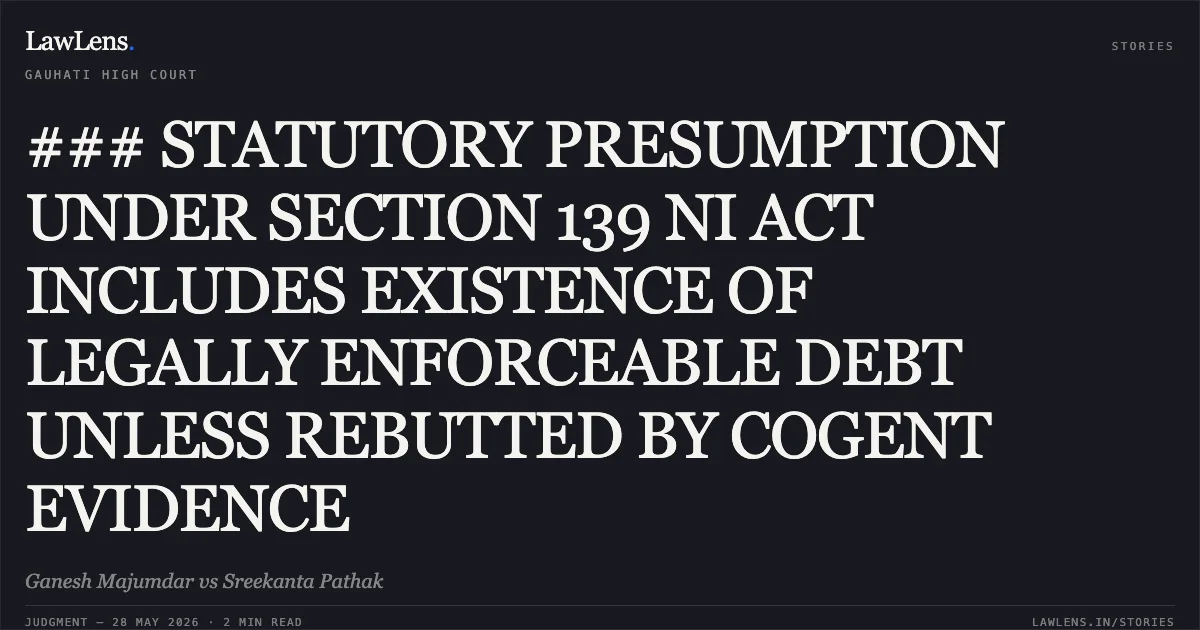
The court applied Section 138 of the Negotiable Instruments Act, 1881 regarding the dishonor of cheques and Section 139, which mandates a rebuttable presumption that the holder of a cheque received it for the discharge of a debt or liability
Source reference: p.3/9It relied heavily on the precedent Rangappa v. Sri Mohan (2010), which clarified that the presumption under Section 139 includes the existence of a legally enforceable debt
Source reference: p.11/13The court also noted that under Section 200 of the CrPC, a complainant must be examined on oath, which cures the absence of a preliminary affidavit
Source reference: p.10/14Reasoning
The High Court observed that the accused admitted to issuing the cheques in his reply to the demand notice
Source reference: p.9Under the Rangappa doctrine, once the issuance of the cheque is established, the court must presume a legally enforceable debt exists; the burden then shifts to the accused to provide a "probable defense"
Source reference: p.11/13The court found that the accused’s mere denial during his Section 313 CrPC examination did not constitute sufficient evidence to rebut this statutory presumption
Source reference: p.14 / para. 32Regarding the procedural objection, the court held that the lack of a verification affidavit was not fatal because the complainant provided evidence on affidavit during the trial and was examined on oath
Source reference: p.14 / para. 33Regarding the sentence modification, the court held that while the Appellate Court's reasoning was brief, sentencing involves judicial discretion; in the absence of perversity, a revisional court should not substitute its own discretion for that of the lower court
Source reference: p.16 / para. 38-40Holding
The High Court dismissed both revision petitions, upholding the Appellate Court’s judgment in its entirety
The conviction under Section 138 was maintained as the statutory presumption remained unrebutted
Source reference: p.15 / para. 36The modified sentence of 3 months imprisonment and Rs. 13,00,000/- compensation was upheld as a valid exercise of judicial discretion
Source reference: p.16 / para. 40The accused was directed to surrender within one month to serve the remaining sentence
Source reference: p.17 / para. 43Acts & Sections Cited
6 provisions across 3 statutes referred to in this judgment. Each provision opens on LawLens.
Negotiable Instruments Act, 18813
Code of Civil Procedure, 19081
Code of Criminal Procedure, 19732
Original Court PDF
Ganesh MajumdarvsSreekanta Pathak
Click to open original judgment
Original judgment, available to read, download and summarize on LawLens.in


