Facts
The appellant, a Company Commander in the Delhi Home Guard, was accused of demanding and accepting a bribe of ₹100/- from PW3 (a Home Guard constable) on 28.10.1997 to assign him traffic duty.
Source reference: p.2, para. 2Following a complaint by PW3, the Anti-Corruption Branch (ACB) conducted a trap operation where the appellant was apprehended after accepting tainted currency.
Source reference: p.13, para. 16The trial court convicted the appellant on 11.08.2004 under Sections 7 and 13(2) read with 13(1)(d) of the Prevention of Corruption Act (PC Act), sentencing him to one year of rigorous imprisonment and a fine.
Source reference: p.4-5, para. 10The appellant challenged the conviction, contending that the money was a loan repayment, that PW3 was on duty elsewhere during the trap, and that he lacked the authority to mark attendance.
Source reference: p.3-4, para. 8; p.5-6, para. 11Issues
1. Whether the prosecution successfully established the twin requirements of demand and acceptance of illegal gratification.
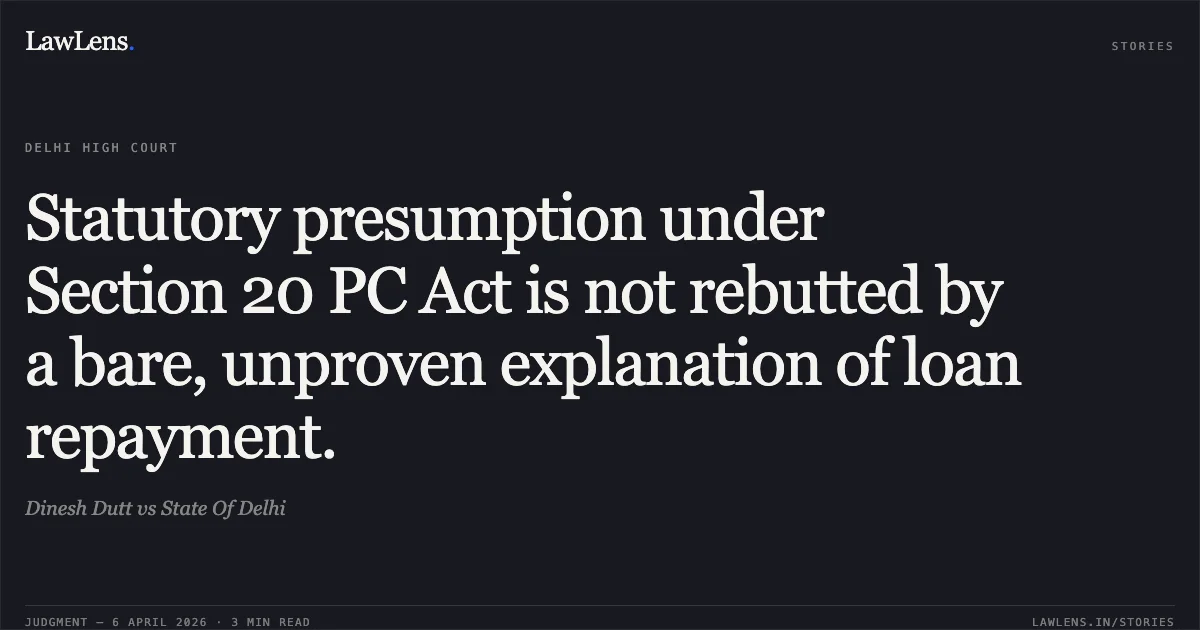
Source reference: p.18, para. 202. Whether the accused successfully rebutted the statutory presumption under Section 20 of the PC Act by providing a probable defense of loan repayment.
Source reference: p.22, para. 233. Whether the alleged lack of authority to mark attendance or the presence of the complainant elsewhere vitiated the prosecution case.
Source reference: p.21, para. 21-22Law Applied
The court primarily applied Sections 7, 13(1)(d), and 13(2) of the PC Act, 1988, which criminalize the demand and acceptance of illegal gratification by public servants.
Source reference: p.1-2, para. 1; p.18, para. 20It relied on the statutory presumption under Section 20 of the PC Act, which mandates that once acceptance of gratification (other than legal remuneration) is proved, it is presumed to be for a motive or reward unless the contrary is proved.
Source reference: p.9, para. 12.2; p.22, para. 23The court cited State of Maharashtra v. Rashid B. Mulani (2006) and Dhanvantrai Balwantrai Desai v. State of Maharashtra (1964) to establish that a "mere explanation" is insufficient to rebut this presumption; rather, the accused must offer "proof" of a lawful transaction that is more than just a plausible story.
Source reference: p.25-27, para. 24.1-24.2Reasoning
The Court found that the testimony of PW3 (complainant) and PW4 (independent witness) consistently proved that the appellant made a conscious demand for money ("jo kaam maine bola tha wo kaam ho gaya") and accepted the tainted notes.
Source reference: p.19-20, para. 20This oral evidence was corroborated by the positive results of the phenolphthalein test on the appellant’s hands and shirt pocket.
Source reference: p.20, para. 20Regarding the defense of loan repayment, the Court noted that the appellant failed to produce any documentary evidence or witnesses to substantiate the existence of a prior loan.
Source reference: p.9, para. 12.2; p.28, para. 25Following the principles in Rashid B. Mulani, the Court held that the burden of proof on the accused, while not as onerous as the prosecution's, requires establishing a "reasonable probability" through evidence, which the appellant failed to do.
Source reference: p.28, para. 24.3Furthermore, the Court dismissed the argument regarding lack of authority, noting that even if a subordinate (Munshi) marked attendance, the appellant exercised overall control as a superior officer.
Source reference: p.21, para. 21Holding
The High Court dismissed the appeal and upheld the conviction and sentence passed by the trial court.
The Court held that the prosecution proved the foundational facts of demand and acceptance beyond reasonable doubt, and the appellant failed to rebut the statutory presumption under Section 20 of the PC Act with any credible evidence.
Source reference: p.28-30, para. 25The Court concluded there was no infirmity in the impugned judgment.
Source reference: p.30, para. 25Acts & Sections Cited
7 provisions across 3 statutes referred to in this judgment. Each provision opens on LawLens.
Code of Criminal Procedure, 19733
Prevention of Corruption Act, 19883
Indian Penal Code, 18601
Original Court PDF
Dinesh DuttvsState Of Delhi
Click to open original judgment
Original judgment, available to read, download and summarize on LawLens.in

![Authorities must decide pensionary and retiral-benefit claims through a reasoned order within eight weeks.. Habibullah khan vs HOME DEPARTMENT. CAT - ['Srinagar']. LawLens](/stories/thumbnails/authorities-must-decide-pensionary-and-retiral-benefit-claims-through-a-reasoned-order-wit-d0cbe8a8119c48fbabe7df9f2d353488.webp)